Strategy
8 min read
Why Healthcare Sales Cycles Take So Long and How ABM Can Help You Win Buyers Faster

Marketing & Growth Director, MedicalProspects • Published August 10, 2026
TL;DR Summary
A healthcare deal rarely stalls because a hospital is slow. It stalls because you're talking to one person while eight or ten others quietly decide the outcome. Modern healthcare buying groups now run 6 to 13 stakeholders deep, and most of the deliberation happens before your sales team ever hears about it. Account-based marketing built around committee mapping, technology fit, and timing signals won't make a hospital move faster than it's willing to. But it will strip out the friction you're accidentally adding, and that's usually where the months go.
Twelve years into my career, I lost a deal I was certain we'd won.
I'd built a great relationship with a VP of IT at a mid-size health system. He liked our platform. He said so, more than once. I had him on the phone every couple of weeks, and every call ended the same way: encouraging, warm, close to yes. Then one Friday he told me the CFO had killed it in a budget review I never knew was happening. I hadn't even known her name.
That deal didn't die because the health system moved slowly. It died because I was managing a relationship instead of a hospital buying committee. Nobody told me there was a committee. I found out the hard way, which is how most of us learn this lesson in healthcare sales.
It's Not a Slow Buyer. It's a Crowded Room
We blame the sales cycle a lot in this industry. “Healthcare just moves slow.” I said it myself for years. But the more accounts I've worked, the less I believe that's the real problem.
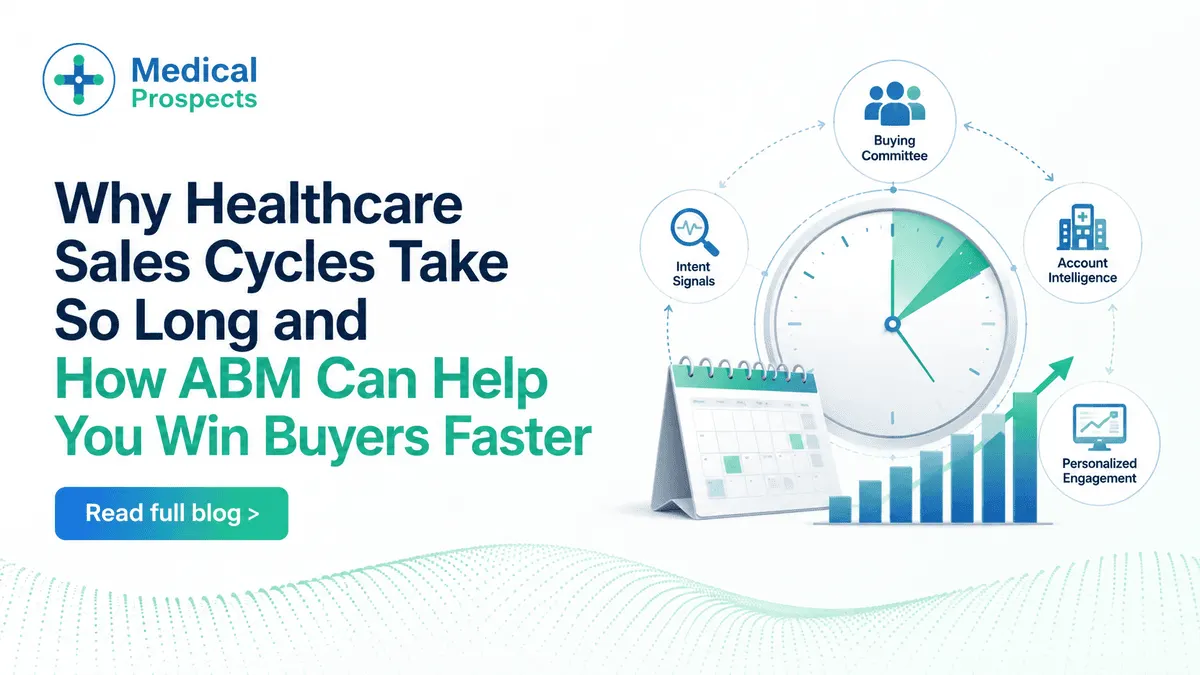
Buying groups have gotten bigger everywhere, not just in healthcare, and the numbers back that up. Forrester's 2024 State of Business Buying research found the average B2B purchase now involves 13 stakeholders, with nearly 89% of buying decisions touching more than one department. Complex, higher-stakes purchases push that even higher, and a hospital evaluating a new clinical or IT platform is about as complex as B2B buying gets. You've got a CIO worried about integration. A CMIO worried about physician adoption. A CFO doing the math on total cost of ownership. Compliance asking about HIPAA and data residency. Procurement negotiating terms nobody in the clinical department even sees.
Your rep might be talking to one of them. Maybe two, if you're doing well. The other six or seven are forming opinions in meetings you're not in, based on information you never sent them.
That gap between contact engagement and account engagement is where deals quietly die. Not in a rejection email. In a budget meeting nobody told you was happening.
What Actually Slows a Healthcare Deal Down
I keep a running list in my head of the deals that stalled, and after a while a pattern showed up. It's rarely the buyer dragging their feet. It's almost always one of these:
- You've been talking to one stakeholder while five others form their own view of the problem.
- The clinical team hasn't bought in, and IT can't push a platform physicians won't use.
- Finance doesn't have a clean ROI story, so the deal sits in a “maybe next quarter” pile.
- Procurement enters the process late and resets the timeline because nobody looped them in early.
- You show up after the shortlist is already built, which happens more often than people admit.
Forrester's research puts a number on this: 86% of B2B purchases stall at some point, usually because one stakeholder's concerns went unaddressed early in the process. That statistic matches almost exactly what I've watched happen inside health systems for two decades. The stall isn't reluctance. It's a gap in the room that nobody filled.
Map the Committee Before You Map the Campaign
Here's where most healthcare ABM programs go wrong, in my experience. They build a target account list, run one campaign at that account, and call it account-based marketing. It isn't. It's contact-based marketing with a bigger spreadsheet.
The work that actually moves a deal is mapping who sits on the committee and what each person needs to say yes. For a clinical software company, that might look like a CIO evaluating integration risk, a nursing informatics lead evaluating workflow disruption, a CFO evaluating payback period, and a CMO who ultimately has to defend the decision to the board.
This is exactly where good data separates the campaigns that work from the ones that just generate noise. If you're a health IT vendor trying to reach infection prevention directors at mid-size hospital systems, you can pull a list of your exact buyer persona from MedicalProspects and put a coordinated campaign in front of every one of them at once, instead of hoping your one CIO contact happens to loop in the right people. That's the difference between a campaign and a coincidence.
Let Technology Tell You Who's Actually a Fit
One thing I wish I'd understood earlier in my career: your best-fit account isn't always the biggest hospital on your list. It's often the one running the right technology stack already.
If your platform integrates with a specific EHR, or plugs into a particular imaging system, or works best alongside a certain revenue cycle tool, a mid-size hospital running that stack can be a stronger prospect than a much larger system running something incompatible. I learned this on a deal early in my time doing outbound, where I chased a flagship 800-bed system for four months while a 200-bed system three states over, already running the exact integration we needed, closed in six weeks flat once we finally reached them.
Technographic data turns “which hospitals should we target” into “which hospitals already have the conditions that make our solution work.” For a medical device manufacturer selling into biomedical engineering departments, that might mean identifying which hospitals use compatible monitoring equipment and building a list around exactly those buyers, rather than blasting every biomed director in a five-state radius.
Timing Beats Volume
Intent data gets oversold in this industry. I've sat through plenty of pitches where “intent” meant somebody read one blog post and got flagged as ready to buy. That's not a signal. That's noise wearing a signal's clothes.
What actually matters is convergence. An account that fits your ideal customer profile, runs compatible technology, and is showing increased research activity around your category deserves attention now. An account that fits your ICP but shows no movement can wait.
McKinsey's B2B Pulse research found buyers now use an average of ten channels across the purchasing journey, and inconsistent information or unhelpful support across those channels has become one of the top reasons buyers switch suppliers. If your marketing and sales teams aren't watching the same signals across those channels, you're not just missing the moment. You're actively creating the disjointed experience that pushes buyers toward whoever executes better.
I had a QBR a few years back where we noticed a health system's revenue cycle team had suddenly gone quiet after months of steady content engagement. Everyone assumed we'd lost them. Turned out they'd entered a vendor evaluation internally and stopped engaging with outside content on purpose, standard procurement protocol at that organization. We reached back out at exactly the right moment with a case study built for their specific EHR environment, and closed the deal a month later. Timing mattered more than anything else we did on that account.
Speak Differently to Every Chair at the Table
A physician doesn't care about the same thing as a CFO. That sounds obvious written down, but I still see healthcare marketing teams sending the same one-pager to every stakeholder on an account, just with a different name in the subject line.
Clinical stakeholders want outcomes data, workflow impact, and peer validation. IT wants integration specs and security documentation. Finance wants a real ROI model, not a vague “efficiency gains” slide. Executives want to know how the decision fits the organization's broader strategic direction.
If you're a pharmacy device manufacturer trying to reach both pharmacy directors and hospital CFOs at the same accounts, you need two different conversations happening in parallel, not one generic campaign hoping to land with both. That's the kind of segmented list-building where MedicalProspects tends to help the most: giving marketing teams the exact buyer personas within an account so each message actually lands with the person it was written for. Staffing companies selling into healthcare face the same challenge from a different angle. A VP of clinical operations and a director of HR care about very different things when they're evaluating a staffing partner, and treating them as one audience wastes the campaign on both.
Stop Waiting for the RFP
By the time an RFP hits your inbox, the account has usually already done most of the thinking without you. Gartner's research puts the pre-sales portion of the B2B buying journey at 70 to 80% complete before a buyer contacts a vendor directly. In healthcare specifically, that means the problem's been defined, requirements built, and often a shortlist quietly formed, all before your name comes up.
I've watched good products lose RFPs to worse products more than once, simply because the other vendor had been in the conversation for six months before the paperwork existed. That's not a coincidence. That's earlier engagement paying off.
The fix isn't complicated, even if it takes discipline. Build content around the problems that precede your category, not just the category itself. Watch for the organizational signals that tend to show up before a purchase: a new service line launch, a technology transition, a leadership change in a relevant department. Show up in the conversation before the RFP exists, and you're not competing against a shortlist. You're helping build it.
Turn Marketing Signals into Sales Motion
This is where a lot of good ABM work quietly goes to waste. Marketing identifies an account. The account shows real signals: multiple stakeholders engaging, technology fit confirmed, research activity increasing. And then the handoff to sales is a generic “just checking in” email that ignores everything marketing just learned.
The signal has to change the outreach. Not “following up on your download,” but something closer to “we've seen a few patterns specific to organizations running your infrastructure, here's what tends to matter for that setup.” That single change in framing has moved more stalled conversations forward for me than any amount of additional email volume ever did.
I've watched a healthcare staffing company do this well. They noticed a cluster of hospital HR directors from health systems with high nurse turnover engaging with retention-focused content at the same time. Instead of a generic nurture sequence, they built a MedicalProspects list of exactly those HR and clinical operations leaders at systems showing elevated turnover signals, and sales reached out with a message built around that specific problem. The response rate wasn't close to their usual outbound numbers.
The Real Win Isn't Speed. It's Reduced Friction
I want to push back gently on the framing that ABM's job is to make hospitals decide faster. It isn't, and chasing that goal usually backfires.
You can't skip clinical validation. You can't bypass security review. You shouldn't want to, because those steps exist for good reasons that protect patients. What you can do is make sure the right people have the right information at the right time, so the process moves at its natural pace instead of stalling on gaps you created by accident.
Gartner's research also found that buying groups reaching real consensus are 2.5 times more likely to report a high-quality purchasing decision, even though 74% of groups experience some degree of internal conflict along the way. That conflict isn't a flaw in the healthcare buying process. It's the process working as intended. Your job isn't to eliminate it. It's to make sure your solution has an advocate in every one of those conversations, even the ones you'll never sit in on.
Twenty years into this, that's the shift I keep coming back to. Less time chasing a faster yes. More time making sure the people who never talk to sales still have what they need to say it.
Frequently Asked Questions
Q:
Why do healthcare sales cycles take longer than other B2B industries?
Mostly because more people are involved and more of them can say no. Clinical, financial, technical, compliance, and executive stakeholders all weigh in, and a single unaddressed concern from any one of them can stall the entire process. It's rarely one slow decision-maker. It's an unmapped committee.
Q:
Is ABM actually different from traditional healthcare marketing?
Yes, in one specific way: it targets accounts and the full buying committee within them, rather than individual contacts. A campaign aimed at one CIO contact isn't ABM. A coordinated effort reaching the CIO, the clinical lead, and the CFO with role-specific messaging is.
Q:
How do you know which healthcare accounts to prioritize?
Look for convergence, not a single signal. ICP fit, compatible technology environment, and active research behavior together tell you more than any one factor alone. An account with all three deserves attention now. An account with just one can wait.
Q:
Can smaller healthcare vendors realistically run ABM, or is it only for large teams?
Smaller teams can run it well, often better, because focus is easier with a shorter account list. The constraint usually isn't budget. It's having accurate data on who sits on each committee and how to reach them, which is exactly the gap list and intelligence providers like MedicalProspects are built to close.
Q:
What's the biggest mistake healthcare marketers make with ABM?
Treating an account like a single contact. Sending one message to one person and calling it account-based. Real ABM means mapping the committee, tailoring the message to each seat at the table, and making sure sales knows what marketing has learned before they pick up the phone.
Related Insights

Strategy
Why Market Intelligence Has an Expiration Date in Pharma
Pharma market intelligence expires fast. Learn why the winners treat it as an ongoing habit, not a one-time deliverable, to stay ahead of the curve.
Read article
Strategy
Urologist Email List: A Better Way to Recruit Specialists Across the US
Discover a verified urologist email list with accurate US physician contacts. Reach specialists directly and improve healthcare recruitment outcomes.
Read article