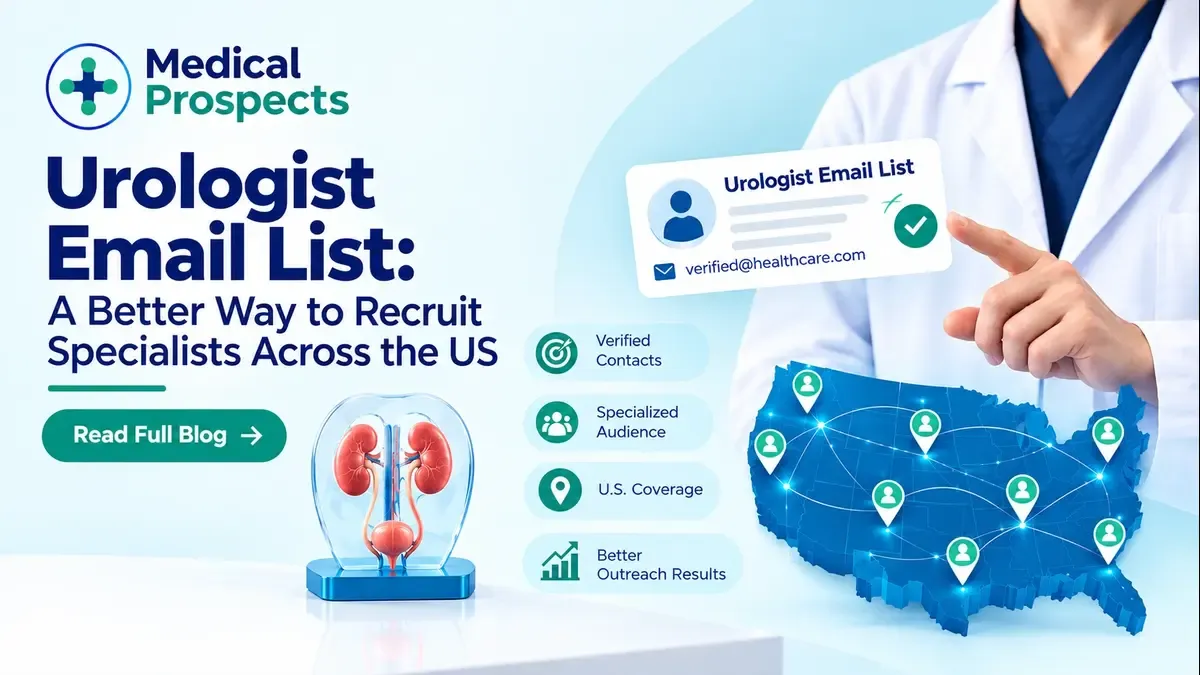
Urologist Email List: A Better Way to Recruit Specialists Across the US

VP of Marketing, MedicalProspects
September 15, 2026
Quick Summary
The shortage of urologists in the United States is a growing concern. The challenge is not only a general deficit. It stems from geographic maldistribution. Major metropolitan regions in the USA are heavily saturated; rural and mid-sized areas face acute shortages. A verified urologist email list can transform how recruiters navigate this gap. MedicalProspects offers a multi-verified contact database of urologists.
If you've tried to recruit a urologist recently, you already know the problem. Postings sit open for months, the candidates who do apply are often the wrong fit, and the urologists you'd most like to hire are already employed and not looking. Meanwhile, patients wait longer, existing urologists absorb more cases, and the strain feeds the very attrition you're trying to fix.
The numbers explain why. According to the American Urological Association's latest census, 62% of U.S. counties don't have a practicing urologist at all. A third of urologists are 65 or older, and the median urologist already works about 55 hours a week. Federal workforce projections cited in Urology Times put urology at roughly 82% of the supply it needs by 2037.
Technology helps at the margins. The same AUA census found that 37% of urologists now use AI routinely, mostly for documentation and chart summaries. But AI can't perform a cystoscopy or see a patient in a county with no urologist. For hospitals, health systems and the recruiters who serve them, the challenge is finding and reaching the urologists who exist, and the old methods aren't keeping up.
Why traditional recruitment can't solve the urology shortage
Most recruitment playbooks were built for roles where supply roughly matches demand. Urology isn't one of them, and the usual tools struggle for predictable reasons:
- Job boards are passive. They reach the small share of urologists who are actively looking, and miss the much larger group who'd move for the right offer but aren't browsing listings.
- Time to fill is too long. Specialist vacancies often stay open for months, and every month means patient backlogs and overworked colleagues.
- Agencies can be costly and broad. Fees are high, and candidate pools aren't always built around the specific subspecialty or practice setting you need.
- Generic messages fall flat. A urologic oncologist, a pediatric urologist and a general community urologist want very different things from a role. One job description can't speak to all of them.
- Referral networks are small. In a niche specialty, word of mouth only reaches so far before the pipeline runs dry.
None of these tools is useless. They're just not enough on their own in a market where the best candidates aren't looking.
What's changing in urology recruitment
The recruiters and health systems filling urology roles faster tend to share a few habits:
| Approach | What's changing | Why it matters |
|---|---|---|
| Direct outreach | Recruiters contact qualified urologists directly instead of waiting for applications | Reaches the passive candidates job boards miss |
| Verified, segmented contact data | Lists filtered by subspecialty, region and practice setting | Each message goes to someone who could realistically fill the role |
| Subspecialty-specific messaging | Role descriptions written for the exact subspecialty and setting | Urology hiring isn't the same as nursing or primary care hiring |
| Location-aware offers | Packages built around what underserved areas can offer: autonomy, case mix, loan repayment, lifestyle | Helps rural and mid-sized markets compete with metro systems |
| Technology-assisted sourcing | AI and automation used for screening, matching and scheduling | Frees recruiters to spend time on conversations, not admin |
The common thread isn't more effort. It's more precise effort: knowing exactly who you're trying to reach, reaching them directly, and giving them a reason to reply.
Why direct outreach works better for specialist hiring
Job portals like LinkedIn, Indeed or specialty healthcare boards work well when there are more candidates than openings. You post the role and the right person finds it. That model works for many entry-level and high-volume roles.
Urology is the opposite situation. Qualified candidates are scarce, and most of them are already employed, often busy and often well paid. They're not scrolling job boards. Some of them would still consider a move, for a better schedule, a stronger team, a chance to build a program or to be closer to family, but only if someone brings the opportunity to them.
Direct outreach flips the model. Instead of waiting for the right urologist to find your opening, you find them first, with a message that speaks to their subspecialty and situation. Done well, it shortens time to fill and helps you reach strong candidates before a competing health system does.
A few practical tips for urologist outreach:
- Lead with what's different about the role, such as call schedule, case mix, OR access, support staff or the chance to build a service line, not a generic "exciting opportunity."
- Segment by career stage. A fellowship graduate, a mid-career urologist and someone approaching retirement who might want a part-time role are three different conversations.
- Be specific about location. If the role is in an underserved area, say so and explain why it might appeal: community impact, autonomy, cost of living, loan repayment programs where available.
- Keep the first ask small. "Would you be open to a 15-minute call?" gets more replies than a request for a full CV.
What separates a useful urologist email list from a generic database
Direct outreach only works if your contact data is accurate. Generic databases are often scraped, rarely updated and full of physicians who've moved, retired or never practiced urology. That wastes outreach, damages your sending reputation and can create compliance headaches.
Here's what to look for:
| Factor | Generic contact database | Useful urologist email list |
|---|---|---|
| Sourcing | Scraped from directories or old databases | Built from named professional sources, such as the NPI registry and state licensing boards |
| Freshness | Rarely updated; often months out of date | Re-verified on a regular schedule, ideally monthly |
| Specialty accuracy | Specialty taken from job titles | Specialty based on provider taxonomy codes, with NPI on each record |
| Segmentation | One undifferentiated physician list | Filterable by subspecialty, region and practice setting |
| Deliverability | High bounce rates, no remedy | A stated deliverability guarantee with replacement of bounces |
| Compliance | No clear sourcing record | Documented sourcing and opt-out handling aligned with CAN-SPAM and state privacy laws |
| Record depth | Name and email only | Title, location, practice type and affiliation |
Before you buy any list, ask for a sample built on your criteria and check it yourself. Our healthcare email list buyer's playbook walks through exactly how.
How a verified urologist list helps
The hardest part of urology recruitment often isn't strategy. It's access: knowing who the qualified urologists are, where they practice and how to reach them. A verified, segmented urologist email list addresses that directly.
- Less guesswork: Contacts are already segmented by subspecialty and region, so recruiters spend their time on outreach instead of research.
- Faster launches: Campaigns can start immediately instead of from a blank spreadsheet.
- Better deliverability: Regularly re-verified data means fewer bounces and more conversations.
- Reach into underserved areas: You can identify urologists in neighboring regions who might relocate, or who could cover outreach clinics in counties without a urologist.
Related specialties are worth considering too. Urogynecologists and advanced practice providers can extend urology capacity in some settings, and many health systems are building teams that combine them.
Final thoughts
The urology shortage isn't going away soon. With most counties lacking a urologist and a large share of the workforce nearing retirement, every health system competing for the same small pool of candidates needs a better way to reach them.
Technology will help with documentation and screening, but it won't create more urologists. What recruiters can control is how precisely and how early they reach the ones who exist. That starts with accurate, segmented contact data and messages written for the specific urologists you want to hire.
If you'd like to see the quality before you commit, request a free sample from MedicalProspects built around the subspecialty and region you're hiring for.
Frequently Asked Questions (FAQs)
Is it legal to purchase a urologist email list for recruitment outreach?
Yes, it is absolutely legal to buy a urologist email list as long as it complies with the CAN-SPAM Act for commercial email and relevant state privacy laws such as California's CCPA/CPRA. However, HIPAA does not restrict it, as it protects only patient health information, not a physician's professional contact database.
What percentage of US counties lack a practicing urologist?
62% of US counties lack a practicing urologist, according to the 2025 AUA Census. This geographic maldistribution is one of the biggest drivers behind the current urology staffing shortage.
How is urologist recruitment different from general physician recruitment?
Urologist recruitment requires subspecialty-level targeting such as pediatric urology, uro-oncology, or andrology, unlike general physician hiring, which can rely on broader outreach. Because the talent pool is smaller and more geographically concentrated, generic recruitment channels like job boards are less effective for urology-specific roles.
What should I look for in a quality urologist email list?
Look for named professional sources such as the NPI registry and state licensing boards, regular re-verification, subspecialty segmentation, transparent deliverability/bounce rate data, and firmographic depth (practice setting, years of experience, location).
Does HIPAA apply to urologist contact information used for recruitment?
No. HIPAA governs protected health information (PHI) related to patients, not a physician's name, specialty, or work email address, so it doesn't restrict the use of professional contact lists for recruitment purposes.
Ready to Build Your Targeted Healthcare Audience?
Connect directly with verified healthcare professionals, urologists, and medical executives with our NPI-verified database.
Get a Custom Provider Count →
John Britton
VP of Marketing, MedicalProspects
John works with healthcare sales and marketing teams on precision targeting, campaign strategy, and audience intelligence solutions at MedicalProspects.
Related Insights