Strategy
7 min read
The "Decision-Maker" Doesn't Exist: Why Healthcare Sales Runs on Committees, Not Titles

VP of Marketing, MedicalProspects • Published August 18, 2026
TL;DR Summary
Healthcare purchases aren't decided by one executive; a buying committee decides them. Every deal has to clear three filters: a clinical evaluator assessing whether it improves patient outcomes, a financial evaluator demanding cost justification, and a technical evaluator checking integration and compliance risks. Skip any one of them, and the deal stalls no matter how strong your relationship is with a sole decision-maker. MedicalProspects puts every evaluator in the room within reach, so no deal stalls on a missing contact.
In over a decade of working across healthcare marketing, I have argued the same point again and again: sales teams cannot pour all their energy into the final decision-maker, whether that's a Hospital CIO, CFO, COO, Chief Medical Officer, Chief Nursing Officer, or senior procurement executive, and expect the deal to close.
It is the end users, such as physicians, nurses, surgeons, radiologists, pharmacists, laboratory professionals, and other clinical staff, who you're actually solving a problem for. The influencers around them, such as CMIOs, Clinical Informatics Directors, Department Heads, Nursing Directors, Biomedical Engineering leaders, and Value Analysis Committee members, often the people managing those end users, are the ones accountable for productivity and ROI once the purchase is made.
Both groups only recommend your solution to the final decision-makers, such as Hospital CIOs, CFOs, COOs, and other executive stakeholders, if they believe you're genuinely the right fit.
I've seen this play out more times than I can count, but one story a MedTech sales head shared with me still stands out as the clearest example of it.
The sales head had told me he had a very good relationship with five senior healthcare executives and decision-makers across healthcare systems his team had been targeting. They'd meet and greet over the weekend to discuss pitches, describing how their solution would benefit these systems, not just in this hypercompetitive market but also with long-term rewards.
His sales team remembered these executives' names by heart. They'd discuss them in boardrooms with tentative figures, contemplating who would bring immediate purchase and how quickly it would benefit them.
Nearly two months later, they set their target. The meetings were done. Even the negotiations were done. At 7:30 PM, notably when he was leaving work, he got a call from his colleague saying four of the five senior decision-makers had chosen another MedTech vendor.
This was not the only bafflement. All of them had chosen the same vendor.
The next day, his team sat together in the boardroom for nearly 3 hours to understand what actually went wrong in all four deals, despite having such strong relationships with the senior executives and decision-makers. They also discussed newer strategies to fix the last crucial deal.
┃ “The final decision-maker cannot be a jack of all trades” was the very first realization. ┃
That story confirmed what I have repeatedly seen throughout my own career, and it's exactly why targeting a single healthcare decision-maker alone doesn't work.
In this article, I will dismantle that misconception for good and show who is really in the room, what each of them needs, and how to build campaigns that resonate with the actual healthcare buying committee and lookalike audiences.
List of healthcare buying committees that trigger direct sales intervention
In MedTech marketing, it is one of the most common mistakes marketers make by believing that a single healthcare decision-maker, such as a Hospital CIO, CFO, CMO, or procurement executive, will close the purchase immediately.
It is way more complex than what you actually think. Why? Because the segment demands long sales cycles to pass various “litmus tests,” namely technical specifications, stringent regulatory compliance, and cross-departmental approvals.
All of these requirements are mandatory to augment necessary authority.
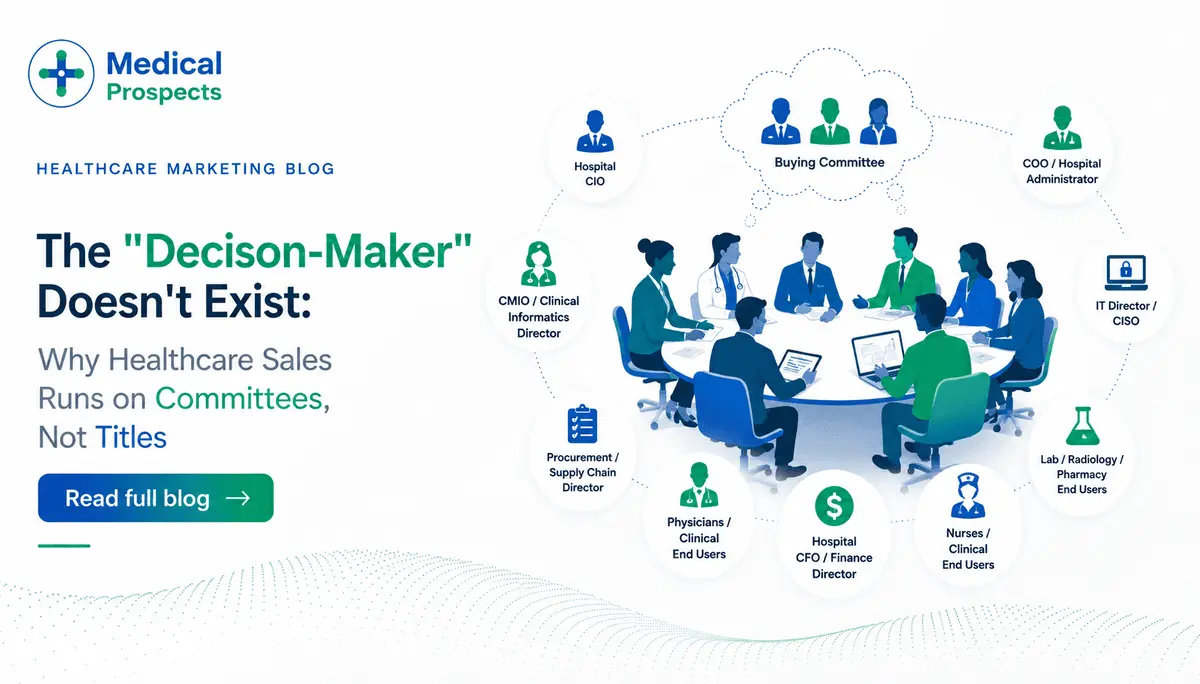
Here is a checklist of healthcare buying committee members that will directly affect your sales:
- Procurement experts: Professionals who scrutinize costs, contracts, documentation, and vendor risk.
- Hospitals and health systems: Large-size clinical companies/organizations that focus on cost management, compliance, and other related outcomes.
- Hospital admins: Professionals solely responsible for operational pain points, resource planning, and overall performance, including COOs, hospital administrators, and operations leaders.
- Healthcare IT and data managers: Technically-specific stakeholders evaluating integration, security (cybersecurity), and long-term sustainability, including Hospital CIOs, CISOs, IT Directors, Clinical Informatics leaders, and healthcare data managers.
- Clinicians and medical leaders: End-users who evaluate patient outcomes, workflow alignment, and clinical precision, including physicians, surgeons, nurses, radiologists, pharmacists, laboratory directors, and department heads.
Who really signs off: Mapping the clinical, financial, and technical evaluators
Every hospital procurement process passes through three separate filters before it becomes a signed contract, and each filter has its own priorities and veto power.
The clinical evaluator: A physician, department head, or clinical informaticist asks one question: does this actually improve patient outcomes without disrupting the workflow their team already runs on? Their approval doesn't close the deal. It just earns the pitch a hearing with everyone else. Basically, this evaluator initiates interest in the proposed pitch, but proof of results and minimal disruption earns the sign-off.
The financial evaluator: A CFO or finance director will address a completely different subject: does this justify its total cost of ownership? According to recent research, physician-preferred items alone account for 40–60% of a hospital's total supply budget. This is exactly why finance leaders inspect clinical enthusiasm so closely. They run cost modeling and demand structured price-to-value justification before giving fund approval.
The Technical Evaluator: IT, biomedical engineering, or a compliance officer asks whether the product integrates safely without creating security or compliance risk. This is the stage vendors most often underestimate, since it has nothing to do with clinical value. This evaluator holds real veto power, demanding clear answers on data privacy and system compatibility before anything moves forward (see MedicalProspects Security & Compliance).
AI fastens targeting, but hospitals' purchasing decision process still runs on humans
A B2B marketing influx podcast by an award-winning digital marketing agency, Somebody Digital, highlighted in a conversation with a seasoned CEO that despite reliance on AI to find vendors and target lists, B2B sales remain fundamentally human.
It is not hard to understand that Artificial Intelligence can automate names faster, but it cannot make humans agree with each other at a steady rate. That’s where deals actually get stalled. Pairing intent signals like Healthcare Intent Data and technographics (Healthcare Technology Intelligence) with buying committee mapping helps revenue teams prioritize accounts actively evaluating solutions.
According to Gartner, B2B buying groups have increased from 5 to 16 people across up to four functional departments, and a gigantic 74% of these groups reported real internal disagreements before closing a deal.
Procuring health-related systems, services, devices, or products involves several rounds of clinical, financial, and technical reviews by highly specialized professionals who test everything: from calculating the cost risks impact on patients, regulatory vetting, and overall impact.
It is basically going through multiple channels to serve multiple agendas of multiple people. Honestly, it is one deal that lives or dies on collective consensus.
Final Thoughts
You found a high-ranking healthcare decision maker, such as a Hospital CIO, CFO, COO, CMO, or senior procurement executive, on LinkedIn. You did all the background checks of the particular executive. You send the proposal after negotiation and await final closure.
That's the myth we're breaking today.
The real strategy is analyzing marketing intelligence and the core function of every assigned leader in the health-tech marketing industry. It is a committee-driven process, and different roles care about different things at different phases in B2B healthcare marketing.
No lone hero is signing the check. So stop chasing a ghost. Let’s map the room instead, comprising a CMIO or clinical informatics leader evaluating whether your product will wreck clinical workflows. A CFO or finance leader doing cost planning you'll never see. A Hospital CIO, CISO, IT Director, or compliance officer scrutinizing the HIPAA Act before you've finished your pitch.
Mastering all these people’s needs in the room may not only close pending deals but also allow your sales team to upsell, delivering measurable ROI.
Those unsure about a prospect's buying committee, MedicalProspects offers verified contacts across the full hospital buying committee, including hospital executives, IT leaders, clinical and medical leaders, procurement and supply chain professionals, influencers, and MedTech end users, so you're never pitching to just one name in the room. Learn how to map your healthcare ICP or explore why healthcare ABM sales cycles require committee coverage.
Frequently Asked Questions
Q:
What is a value analysis committee in hospitals?
A Value Analysis Committee (VAC) is a formal, cross-functional group that reviews new products or services before a hospital approves them for use. It typically includes physicians, nurses, administrators, supply chain specialists, risk mitigation specialists, and purchasing agents who evaluate clinical and cost benefits together.
Q:
Who approves medical device purchases in hospitals?
No single person approves device purchases; it moves through a clinical evaluator (efficacy, workflow fit), a financial evaluator (cost justification), and a technical evaluator (integration, compliance), often formalized through the hospital's VAC before purchasing executes the contract.
Q:
Who signs off on new healthcare software purchases?
Software purchases follow a similar multi-stakeholder path: a clinical or department champion identifies the need, IT/security vets integration and data privacy (like HIPAA compliance), and finance approves total cost of ownership. All three sign-offs are required, not just one.
Q:
How to identify healthcare buying committee members?
Start by mapping the three functional lenses every purchase passes through: clinical, financial, and technical/compliance. Then identify the specific titles within each at your target hospital (e.g., Hospital CIO, CFO, CMIO, CNO, IT Director, Clinical Informatics Director, Department Head, Procurement Director, or Supply Chain leader), since exact roles vary by organization size and structure.
Q:
What departments are involved in hospital purchasing decisions?
Purchasing decisions typically pull in clinical departments (physicians, nursing), finance, IT/security or biomedical engineering, supply chain/procurement, and compliance, with value analysis committees often coordinating input across all of them before a final decision is made.
Related Insights


Strategy
Why Surgical Robotics Sales Start With Knowing Which Type of Hospital Can Actually Buy
Which hospitals can actually buy surgical robotics? See how hospital type, volume, and budget shape your target accounts.
Read article
Strategy
How to Identify the Right Physicians Before a Medical Device Launch: A 5-Step Process
Learn how medical device companies can identify the right physicians before launch: define the clinical need, map buyers, rank targets, and test early.
Read article