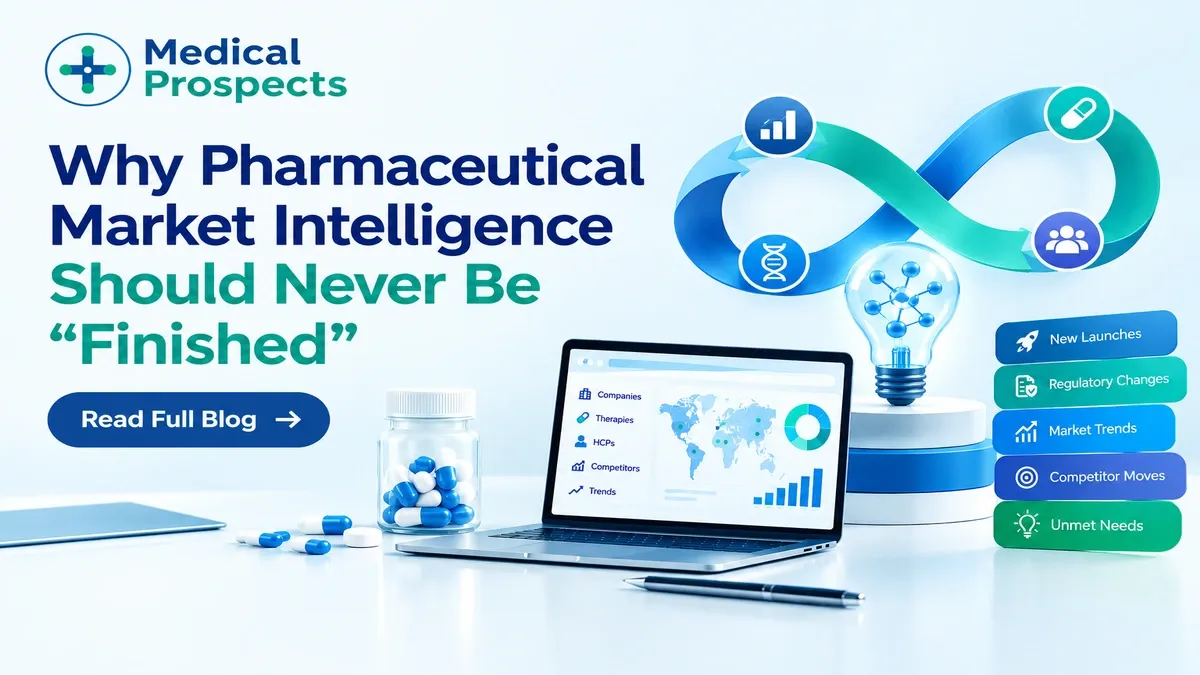
Why Market Intelligence Has an Expiration Date in Pharma

VP of Marketing, MedicalProspects
September 16, 2026
Quick Summary
Market intelligence in pharma has a short shelf life, and most companies don't realize it until they're already behind. This content piece breaks down why treating intelligence as a single deliverable, rather than a continuous habit, is what actually causes companies to lose their competitive edge.
Every industry has an expiry date on its market intelligence. It's just never printed on the label. Pharma's is one of the shortest in healthcare. Companies don't fall behind because they lack intelligence. They fall behind because they treat intelligence as a deliverable, not a habit.
Your HCP universe and KOL teams are always changing
The most common mistake vendors make is assuming their Healthcare Professional (HCP) list is static. In contrast, the population always keeps moving. New prescribers enter the industry, while others shift specialties or retire. Additionally, entire medical practices open in territories the company thought it already mapped.
Prescriber behavior itself is part of what defines this universe, and that behavior changes constantly, influenced by new guidelines, product launches, drug approvals, or shifts in patient volume.
This is why HCP targeting can't be a one-time exercise built off a database from last year. It needs a real-time data refresh to reflect who's actually prescribing, and who's actually relevant, right now.
This is where account intelligence matters as much as individual HCP data. A practice or health system can shift its formulary, its affiliations, or its prescribing culture, even when the individual physicians on your list haven't changed at all.
The same erosion happens at the Key Opinion Leader (KOL) level. It happens at a silent rate. Your team spent a whole quarter cultivating a KOL team. However, it might not be the one shaping opinion anymore.
Why? Because someone else got published. Someone else got invited to speak at a conference. Someone else's name started showing up in the conversations that actually matter, and nobody updated the organization chart.
TAKEAWAY: Only stays real if it is refreshed, keeping your targeting list tied to who's actually prescribing and influencing the medical world today, not someone who was in conversation six months ago.
Clinical and commercial intelligence must evolve as fast as the market does
According to a report by Capgemini, pharmaceutical industry leaders claim that in the traditional value chain, data remains closely limited to R&D, clinical, manufacturing, sales, and marketing functions, restricting vital insights from expanding across various functions.
This is the biggest loophole to scaling online and analytics initiatives in the pharmaceutical sector.
The answer is not more data but better-connected intelligence, in which insights can move seamlessly across clinical, commercial, and other functions as the pharmaceutical ecosystem evolves.
Clinical vs. Commercial Intelligence
You can also make the distinction clearer for readers:
| Clinical Intelligence | Commercial Intelligence |
|---|---|
| What is happening in clinical trials? | What is happening in the market? |
| Which therapies are emerging? | Who are the key competitors? |
| What new evidence is appearing? | How is market share changing? |
| What are physicians learning? | How are physicians prescribing? |
| Are safety or efficacy signals changing? | Are pricing/access conditions changing? |
| What could change the treatment landscape? | What could change product adoption? |
TAKEAWAY: The gap isn't a data problem. It is that no one is asking these questions together.
IBRANCE: An example of clinical trial data in the commercial stage [case study]
In 2019, the Food and Drug Administration (FDA) expanded IBRANCE's approval to include men with HR+, HER2- metastatic breast cancer, a population previously excluded from its label, despite the disease existing in men all along.
Notably, the decision was not pushed by a new clinical trial. It was built on real-world evidence sourced from Electronic Health Records (EHRs), insurance, and cancer-research databases- evidence that would have simply sat unused in a more siloed system.
IBRANCE, remarkably, shows that when data flows into commercial-grade evidence informing a clinical decision, moving beyond its traditional boundaries and becomes actionable clinical evidence.
What does the case study portray? Real-world data helped uncover an unmet need and supported a new clinical opportunity. That insight could then inform commercial strategy.
Product positioning becomes more grounded in real-world clinical needs. Sales teams can use evidence-backed insights rather than relying on scripted claims. KOLs can also carry that evidence further through publications, speaking engagements, and peer-to-peer discussions.
IBRANCE is a powerful prototype of how data distribution between commercial and clinical stakeholders can have a life-changing impact on people, and even on sales.
The best intelligence systems combine the market and the audience
Clinical context fills in the moment, but the sale still hinges on who you're reaching and when. That gap shows up most clearly as inadequate real-time patient context needed for engagement, which is the case for blending clinical and behavioral intelligence rather than relying on either alone.
And that’s why knowing what is happening in the pharmaceutical sector is only half the picture. It does not drive sales. However, if companies understand the people and organizations shaping that commercial environment, they can improve overall engagement, targeting, and even conversion.
This includes a comprehensive assessment of HCPs, healthcare organizations, decision-makers, and the patient populations. Market intelligence reveals where an opportunity exists. Audience intelligence identifies who's connected to it. Buyer intent shows when they're ready to act.
Final Thoughts
The pharmaceutical landscape is constantly evolving. In today's hyper-competitive market, commercial priorities shift, competitors reposition, prescriber behavior changes, and clinical research moves forward.
That is why pharmaceutical market intelligence should never be considered complete. The most valuable intelligence is persistently evolving and refining to reflect what is happening across the field, the audience, and the competitive landscape.
MedicalProspects provides verified healthcare data to help pharmaceutical companies better understand and reach the right HCP audiences.
For those looking to close that gap, MedicalProspects offers a free sample of verified HCP data built to keep pace with a market that never stays still.
Frequently Asked Questions (FAQs)
Why does pharmaceutical market intelligence need continuous updating?
Pharmaceutical markets are constantly changing due to new clinical evidence, competitors, regulations, treatment patterns, and HCP behavior. Continuous updates help companies work with current information and make more informed clinical, commercial, and strategic decisions.
How do pharmaceutical companies use market intelligence?
Pharmaceutical companies use market intelligence to track competitors, understand HCP and patient needs, identify trends, and assess opportunities. These insights support decisions across drug development, product launches, positioning, sales targeting, and commercial strategy.
How to build a pharmaceutical market intelligence strategy?
Start by defining the key business questions the intelligence needs to answer. Then identify reliable data sources, monitor competitors and trends, validate and refresh information regularly, and turn findings into actionable insights that support business decisions.
How do pharmaceutical companies identify market opportunities?
Companies analyze unmet patient needs, treatment gaps, competitor activity, clinical developments, prescribing patterns, and market access conditions. Combining these signals can reveal underserved patient populations, emerging therapy areas, and potential opportunities for growth.
How to improve pharmaceutical market intelligence?
Pharmaceutical companies can improve market intelligence by connecting clinical, commercial, competitive, and real-world data. Regularly refreshing information, validating sources, and using technology to identify emerging market signals can make intelligence more accurate, timely, and actionable.
Ready to Build Your Targeted Healthcare Audience?
Connect directly with verified healthcare professionals, physicians, and medical executives with our NPI-verified database.
Get a Custom Provider Count →
John Britton
VP of Marketing, MedicalProspects
John works with healthcare sales and marketing teams on precision targeting, campaign strategy, and audience intelligence solutions at MedicalProspects.
Related Insights