MedicalProspects vs. HealthVerity: Choosing the Right Healthcare Data Partner for B2B Outreach

VP of Marketing, MedicalProspects
September 17, 2026
Executive Summary (At a Glance)
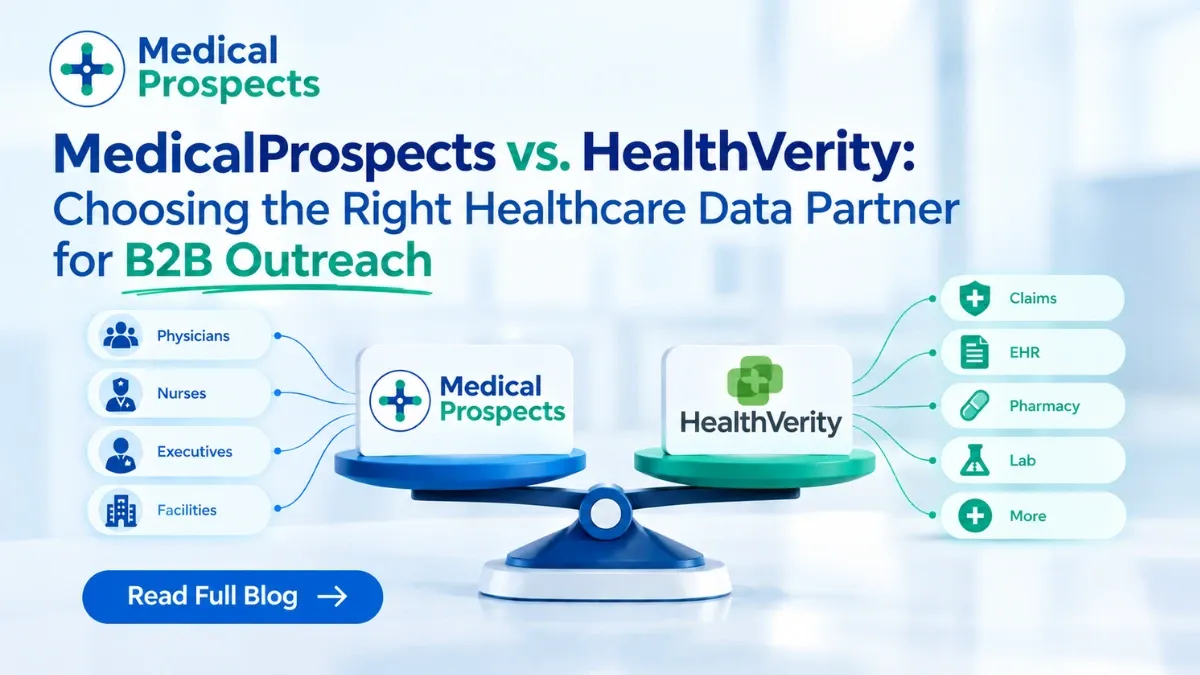
MedicalProspects and HealthVerity both offer healthcare audience capabilities, but their approaches differ. MedicalProspects centres on B2B contact and audience intelligence, helping teams identify and reach healthcare professionals, executives, organizations, and decision-makers with NPI-verified databases and 99% email deliverability guarantees in 24–48 hours. HealthVerity centres on real-world healthcare data: claims, pharmacy, EHR, lab, provider, and consumer datasets, using it to build patient and HCP audiences for clinical, commercial, and media use cases.
MedicalProspects and HealthVerity both offer healthcare audience capabilities, but their approaches differ.
MedicalProspects centres on B2B contact and audience intelligence, helping teams identify and reach healthcare professionals, executives, organizations, and decision-makers.
HealthVerity centres on real-world healthcare data: claims, pharmacy, EHR, lab, provider, and consumer datasets, using it to build patient and HCP audiences for commercial, research, and media use cases.
HealthVerity vs. MedicalProspects
A comparison of two healthcare data companies with different business models
| Category | HealthVerity | MedicalProspects |
|---|---|---|
| Core product | HealthVerity Marketplace / IPGE platform for discovering, licensing, and linking de-identified real-world healthcare data | Verified, campaign-ready healthcare contact and email lists |
| Primary data type | De-identified patient-level real-world data: medical/pharmacy claims, EHR, lab results, SDOH, consumer data | Business contact data: names, titles, emails, phone numbers, and organization details for healthcare professionals and facilities |
| Data scale | Sources data from a broad network of data providers and has processed an extensive volume of de-identified patient records | Access to over 12 million medical professionals and facilities across 300+ pre-built and custom databases |
| Core technology | Proprietary identity-resolution and cryptographic patient-matching technology that links disparate data sources at the patient level | Multi-step email verification and cross-validation against 120+ data sources and NPI registry data |
| Typical use case | Clinical trial recruitment, real-world evidence (RWE) studies, market access, HEOR, commercial analytics, and patient journey analysis | B2B outbound marketing and sales outreach: email campaigns, telemarketing, direct mail, and account-based marketing to healthcare buyers |
| Primary customers | Pharmaceutical and life sciences companies, payers, and government agencies | Pharmaceutical companies, medical device manufacturers, healthtech startups, healthcare recruiting agencies, and consulting firms |
| Compliance focus | HIPAA Safe Harbor privacy compliance via source-side de-identification before ingestion | CAN-SPAM, GDPR, and CCPA-conscious list processing with suppression handling |
| Company/customer size | Approximately 197 employees across North America, Europe, and South America | Backed by DataInfoMetrix, which has supported over 2,000 customers across industries |
Disclaimer & Transparency Notice: Information presented in this comparative evaluation was collected from publicly available vendor documentation, published product specifications, and market research conducted as of September 17, 2026. All product names, logos, trademarks, and registered trademarks (including HealthVerity, IPGE, Symphony HealthCloud, Synoma, Vantage, and Metys) are property of their respective owners. All company, product, and service names used on this website are for identification, comparative analysis, and educational purposes only. Use of these names, trademarks, and brands does not imply endorsement, sponsorship, or affiliation.
MedicalProspects and HealthVerity: Different approaches to healthcare audience data
The most important difference is the type of problem each of these platforms is designed to solve.
MedicalProspects, the contact database firm that fosters growth through healthcare intelligence, helps business enterprises find and reach particular professional and organizational audiences. Its contact database covers healthcare professionals (HCPs), healthcare executives, facilities, payers, HealthTech organizations, life sciences companies, and other healthcare-related audiences.
Its data can be filtered according to attributes such as specialty, role, geography, organization type, seniority, facility characteristics, and other campaign requirements.
HealthVerity approaches audience creation from a different direction.
Its marketplace brings together healthcare and consumer datasets that include medical claims, pharmacy claims, EHR/EMR data, laboratory data, provider data, SDOH data, mortality data, and specialty datasets. These sources can be combined to construct healthcare cohorts and understand patient journeys or healthcare activity.
That difference matters. A healthcare software company trying to identify hospital CIOs, CMIOs, IT leaders, or other technology buyers may need a very different dataset from a pharmaceutical company trying to identify patients with a specific clinical profile.
What MedicalProspects is designed to do
MedicalProspects is positioned around the needs of B2B healthcare sales and marketing teams. A company may already know its ideal customer profile (ICP) or target accounts but still face difficulty turning them into a usable audience.
For example, a healthtech company could want to reach:
- CIOs and CMIOs at health systems
- Hospitals using particular technologies
- Practice leaders in selected specialties
- Healthcare executives in specific geographic markets
- Organizations that match particular facility or business characteristics
- Healthcare companies that are actively researching relevant solutions
This requires contact-level and organization-level insights that can be used directly for campaign planning and outreach.
MedicalProspects' database combines over 120 verified source channels, using monthly refresh cycles, to map U.S. clinical contacts against CMS NPPES and NPI information. Notably, the company can deliver its audience data within the 24–48-hour window.
Its newer healthcare intent capability adds another layer. MedicalProspects’ intent data can be combined with verified healthcare contact information, facility intelligence, organizational insights, NPI information, and audience development to identify organizations actively researching products, technologies, and services.
This makes the platform particularly relevant when the commercial objective is to reach healthcare buyers who are already in-market, not just matching job titles, but prioritizing accounts and contacts showing active research behavior around relevant products or services.
The core strength: Purpose-built tools, not just a database
Most healthcare contact database vendors sell you a static list and call it a day. MedicalProspects' edge is that it pairs verified contact data with tools built specifically for how healthcare B2B teams actually plan and execute campaigns:
- NPI Discovery Engine: Search and validate NPI records instantly, with clinical specialty and practice location data built in, so you're targeting the right provider type from the start, not guessing.
- Event Audience Builder: Turns conference targeting into a real campaign blueprint: audience size estimates mapped to your ICP, buying roles, and specialties, before you commit budget to a booth or sponsorship.
- Healthcare Audience Estimator: Configure specialty, state, and channel filters and see your addressable database size instantly, so campaign scoping happens in minutes, not after a data request ticket.
Layered on top is a healthcare intent data signal covering 20+ data points, helping teams spot health systems, physician practices, and medical groups actively researching solutions right now, not just who fits a static ICP.
And because B2B healthcare timing is unforgiving, the data itself doesn't sit still: automated refresh cycles and 24–48-hour delivery replace the multi-week custom-pull model that kills campaign momentum.
The result: MedicalProspects isn't positioned as a list vendor. It's positioned as a healthcare audience intelligence layer, giving marketing and sales teams targeting precision, timing, and go-to-market ROI visibility (including installed-base data for tech marketers) in one platform.
What is healthverity designed to do
HealthVerity's core strength works in a fundamentally different way. Rather than starting with a contact list, it starts with healthcare activity and real-world data.
Drawing on years of data expertise, HealthVerity combines efficient management of complex healthcare data sources with HIPAA-compliant patient integration, predictive modeling, and machine learning. This gives companies/organizations immediate access to cloud-based, integrated data for deeper patient-journey insights.
For example, a life sciences company may need to understand a population based on:
- Diagnoses
- Procedures
- Prescription activity
- Treatment patterns
- Laboratory results
- Healthcare utilization
- Care settings
- Patient journeys
- Comorbidities
- Other clinical or consumer signals
HealthVerity connects these datasets through its identity-resolution capabilities to support cohort construction and healthcare analytics.
Its audience offering extends to patient, caregiver, and HCP audiences, which HealthVerity says can be activated through channels such as connected TV, social, mobile, search, and healthcare-specific DSPs.
Technology & tools provided by healthverity
HealthVerity's technology stack is organized into two layers.
On the infrastructure side, Symphony HealthCloud is the underlying data engine that powers the rest of the platform, with Synoma Patient Integration sitting on top of it as the patient-matching and identity-resolution layer.
On the analytics side, Vantage Applications provide the visualization and analysis layer, with configurable dashboards built around key commercial functions. These include sales, managed markets, and brand management.
Metys rounds this out as HealthVerity's market-measurement and competitive-intelligence tool, purpose-built for pharma audit data, consolidating 150+ metrics with faster refresh cycles than competitors.
A distinct edge over standard contact database providers: HealthVerity Identity Manager, a standalone De-ID as a Service offering. It delivers end-to-end, privacy-preserving identity resolution purpose-built for real-world data, consistently producing stronger match and linkage results.
Where MedicalProspects fits commercial sales and marketing
MedicalProspects is a credible healthcare database provider that can be very useful for vendors, as it offers commercial teams an audience that can move directly into a B2B campaign.
Its sales and marketing teams may want to identify hospitals, practices, specialists, executives, and purchasing stakeholders in a defined geographic market. The campaign could then be segmented according to specialty, organization type, facility characteristics, seniority, and other criteria.
The goal is not necessarily to understand a patient's entire healthcare journey.
The goal is to answer questions such as:
- Which organizations fit our ICP?
- Which decision-makers work there?
- How many potential contacts exist in a market?
- Which specialties should we prioritize?
- Which healthcare organizations should receive outreach?
- Can we build an audience quickly enough to support the campaign?
MedicalProspects' Healthcare Audience Estimator is designed around this type of planning. The company describes it as a free tool that allows B2B healthcare marketing, sales, and ABM teams to estimate database size and build target provider audiences before sourcing a list.
That can be valuable when the bottleneck is audience identification rather than complex healthcare analytics.
Where healthVerity fits commercial and life sciences strategy
HealthVerity becomes particularly relevant when commercial targeting depends on clinical or transactional evidence.
A pharmaceutical company launching a therapy, for instance, may need to identify a population based on diagnoses, prescriptions, procedures, laboratory results, or combinations of these signals.
A simple specialty-based contact list cannot answer those questions.
HealthVerity's Marketplace allows organizations to combine different real-world data sources to construct fit-for-purpose cohorts. Its Audience Manager similarly focuses on synchronizing healthcare and consumer data to create more precise audience segments.
This can support use cases such as patient journey analysis, commercial analytics, market access, HEOR, clinical development, and audience creation.
For life sciences organizations, this broader data environment can be important because the commercial question may extend beyond identifying a healthcare professional.
The organization may need to understand the relationship between providers, patients, treatments, healthcare activity, and market behavior.
How the platforms compare for different commercial use cases
The choice becomes easier when the use case is clearly defined.
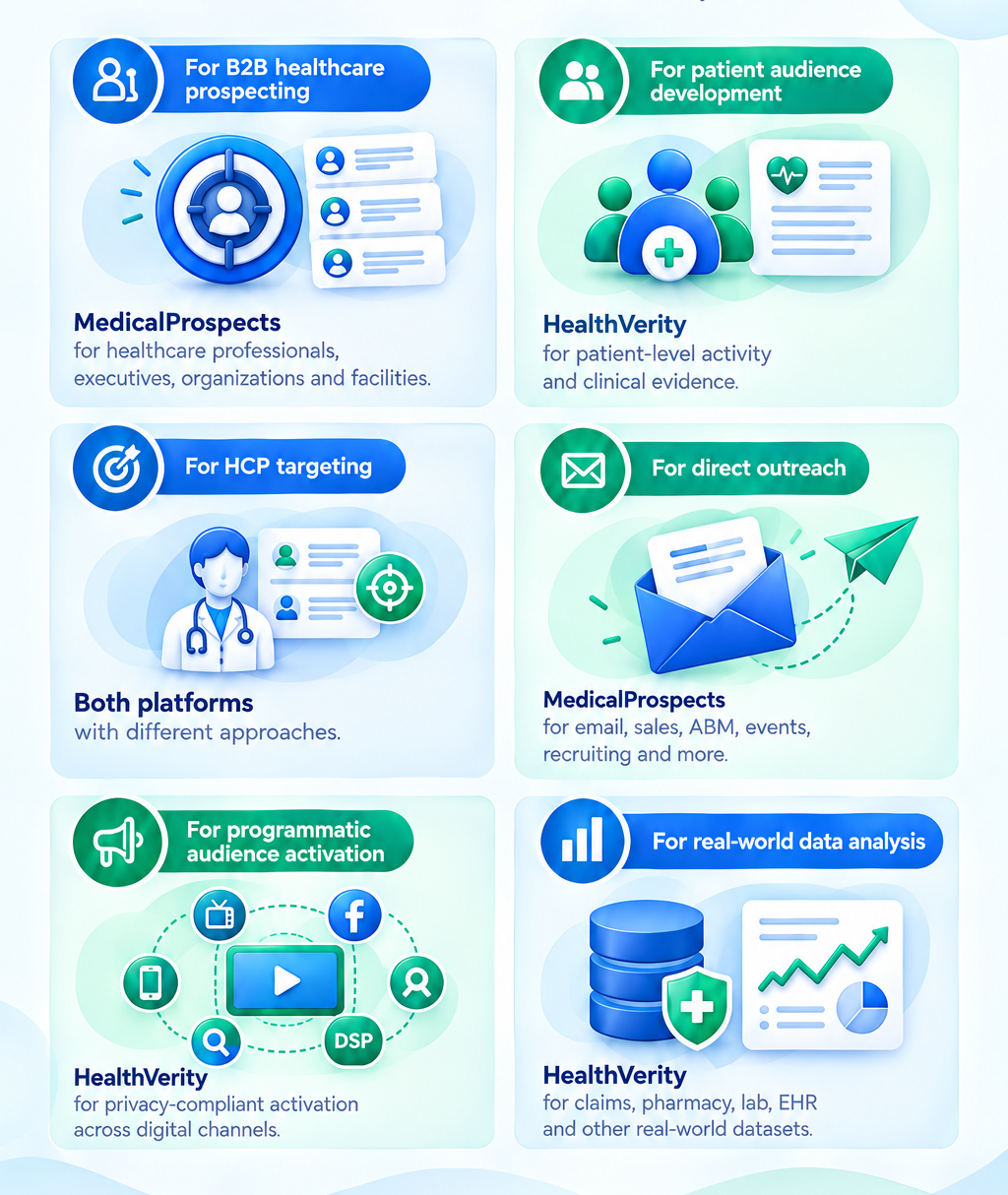
Final decision guide: Which healthcare provider fits your goals?
Choose MedicalProspects if:
- Your goal is to identify and reach healthcare professionals, executives, organizations, and decision-makers for B2B outreach and discuss your targeting requirements with our team.
- You need campaign-ready contact data (names, titles, emails, phone numbers) rather than patient-level data.
- You're running email campaigns, telemarketing, direct mail, or account-based marketing to healthcare buyers.
- You want fast turnaround, data delivery within 24–48 hours instead of a multi-week custom pull.
- You need to filter audiences by specialty, role, geography, organization type, seniority, or facility characteristics.
- You want to prioritize accounts already showing active research behavior, using the healthcare intent data layer.
- You're planning conference or event targeting and want audience size estimates mapped to your ICP before committing budget.
- Your bottleneck is audience identification, not complex clinical analytics
Choose HealthVerity if:
- Your strategy depends on clinical or transactional evidence, diagnoses, prescriptions, procedures, or lab results.
- You need patient-level real-world data (medical/pharmacy claims, EHR, lab, SDOH, consumer data) rather than business contact data.
- You're supporting clinical trial recruitment, real-world evidence (RWE) studies, market access, HEOR, or patient journey analysis.
- You need to construct cohorts by combining multiple healthcare and consumer datasets.
- You want to activate privacy-compliant patient or HCP audiences across channels like connected TV, social, mobile, search, or healthcare-specific DSPs
- You require HIPAA-compliant identity resolution and patient matching across disparate data sources.
- You're a pharmaceutical, life sciences, payer, or government organization working with real-world healthcare data at scale.
Frequently Asked Questions (FAQs)
Can MedicalProspects be used alongside HealthVerity?
Yes. Since the two platforms solve different problems, they can complement rather than compete. A life sciences or healthtech company could use HealthVerity's real-world data to understand patient populations, then use MedicalProspects' contact database to turn that insight into an actual outreach list of HCPs and organizations. Teams that need both often use each platform for what it does best.
How does MedicalProspects guarantee email deliverability?
MedicalProspects backs all healthcare lists with a strict 99% email deliverability guarantee and a 1:1 hard-bounce replacement policy within 30 days of purchase.
What is the main difference between MedicalProspects and HealthVerity?
MedicalProspects is built around verified B2B contact data: names, titles, emails, and organization details, for direct sales and marketing outreach. HealthVerity is built around de-identified, patient-level real-world data: claims, pharmacy, EHR, and lab data, for clinical and commercial analytics. In short: MedicalProspects helps you find and contact the right people; HealthVerity helps you understand healthcare activity and patient populations.
How large is MedicalProspects' contact database?
MedicalProspects provides access to over 12 million medical professionals and facilities across 300+ pre-built and custom databases, combining 120+ verified source channels with monthly refresh cycles and CMS NPPES/NPI mapping.
What data sources make up HealthVerity's Marketplace?
HealthVerity's Marketplace spans 75+ data sources, covering 340 million de-identified patients and over 200 billion transactions across medical claims, pharmacy, laboratory, EHR, provider, and consumer data.
Which platform is better suited for activating audiences through digital advertising channels?
HealthVerity is the stronger fit for programmatic activation, supporting privacy-compliant channels like connected TV, social, mobile, search, and healthcare-specific DSPs. MedicalProspects, by contrast, is built for direct outreach, email, telemarketing, direct mail, and ABM, rather than programmatic media.
Evaluate MedicalProspects Data Quality for Your Team
Request up to 50 free verified contact samples with direct dials tailored to your exact specialty, state, or intent criteria.
Request Free Sample Data
John Britton
VP of Marketing, MedicalProspects
John works with healthcare sales and marketing teams on precision targeting, campaign strategy, and audience intelligence solutions at MedicalProspects.
Related Insights