Healthcare Marketing Has Changed: Why Healthcare Email Lists Alone Are No Longer Enough

VP of Marketing, MedicalProspects
July 29, 2026
Healthcare data is still the foundation of B2B healthcare marketing. But between AI-assisted research, sprawling buying committees, and a purchasing journey that rarely runs in a straight line, a clean contact record isn't the whole job anymore. It's the starting point.
Bottom line up front
Buying committees have gotten bigger. Deals now routinely touch six or more stakeholders across clinical, IT, security, procurement, and finance, and most of that evaluation happens before your rep ever gets a call. A verified list tells you who fits your ideal customer profile. It doesn't tell you who's actually in motion right now, and that's a different question entirely. Most stolen healthcare data over the past couple of years didn't come out of a hospital's own systems. It came through vendors and business associates, which changes what "clean data" needs to account for. MedicalProspects layers organizational context, technology footprint, and buying signals on top of verified contact data, so campaigns land on accounts that are actually ready to talk. The teams that win the next few years of healthcare marketing won't have the biggest database. They'll know which fifty accounts matter this quarter, and why.
A List Used to Be Enough. I Watched It Stop Being Enough.
Early in my career, I ran outbound for a mid-sized device company, and our entire strategy fit on an index card. Buy the list, segment by specialty and facility type, and dial. It worked. Buyers hadn't done much homework before we called them, so we controlled a lot of the conversation. I remember closing a regional deal in under six weeks off nothing more than a title match and a decent opening line.
That playbook is gone, and it's been gone for a while now. Today's healthcare buyers show up to a first call already having read the analyst reports, compared peer reviews, sat through three webinars, and run their own research through an AI tool before they'll even take your meeting.
Gartner's data on B2B buying behavior puts a number on it: buyers now spend roughly 27% of their total purchase time researching independently online, more time than they spend with any vendor, including you. And when they do sit down with suppliers, that time gets split across three or four of you, not just your team.
That single shift is why the old approach breaks down. A bigger list used to mean a bigger funnel. Now it just means more names you have to figure out how to prioritize.
Healthcare Buying Got Crowded, Not Just Digital
Hospitals have never made purchasing decisions with one person in the room. But the room has gotten a lot bigger, and it's harder to see who's actually in it.
A hospital evaluating a revenue cycle platform, a cybersecurity tool, or an AI documentation product now routes that decision through clinical leadership, IT, security, procurement, finance, and often an executive sponsor who only shows up at the very end. Each one is weighing something different. Clinical wants to know it won't disrupt care. IT wants to know it won't break anything else. Security wants a risk assessment before anyone gets a demo.
I lost a deal a few years back that taught me this the hard way. We had a strong champion in the CFO's office at a regional health system, budget approved, verbal commitment, the whole thing. Then it stalled for four months because nobody had looped in the CISO early, and by the time security review started, a competitor had already gotten in front of them. Forrester's research on B2B purchasing backs up what that felt like from the inside: 86% of B2B purchases stall somewhere in the buying process, and in my experience, the stall almost always traces back to a stakeholder nobody mapped early enough.
A contact record tells you a name and a title. It doesn't tell you who else needs to sign off, or in what order. That's a mapping problem, and it's one most healthcare marketers are still solving with guesswork.
I'm Not Telling You to Abandon Your Email List
Every few years, somebody declares a marketing channel dead. I've heard it about SEO, about email, about outbound entirely. None of those predictions held up, and healthcare email lists aren't going to be the exception.
Verified physician data, hospital contacts, and executive records are still what make outbound, ABM, event promotion, and customer expansion possible in the first place. Without them, none of the rest of this matters. You can have the sharpest intent signal in the world, and it's useless if you don't have a working email address and the right title attached to it.
Think of it like a hospital's foundation. Nobody argues the foundation doesn't matter. But nobody mistakes the foundation for the finished building either. A verified database gets you the organizations and the people who match your ideal customer profile. It won't tell you why one of them is worth calling this week and the other isn't worth calling until next quarter.
Two Health Systems, Same Profile, Completely Different Reality
A few years ago I worked with two regional health systems that looked nearly identical on paper. Similar bed count, similar number of facilities, similar staffing levels, both a clean match for our ideal customer profile. If you'd handed our list to a traditional prospecting tool, it would have scored them the same.
They weren't the same at all. One was in the middle of an outpatient expansion and actively building out new service lines. The other had just brought on a new CISO after a compliance finding and was pouring budget into security instead. We ran the same campaign at both, and it landed completely differently. One turned into a pipeline conversation within three weeks. The other went nowhere, not because the fit was wrong, but because the timing was.
That's the gap between data and intelligence. Data tells you who resembles your best customers. Intelligence tells you where your outreach actually has a shot at landing on a real conversation right now.
If you're a pharmacy device manufacturer trying to reach the exact hospital pharmacy directors expanding their formulary teams this year, that's a very specific buyer, not a broad specialty segment. This is a place where MedicalProspects earns its keep for our clients. You can pull a list of your exact buyer profile inside that niche using our audience count calculator and run a campaign built for that specific moment, instead of a generic blast to everyone with a pharmacy title.
70–80% of the B2B buying journey is typically complete before a prospect ever contacts a vendor's sales team.
The Vendor Blind Spot Most List Quality Conversations Skip
There's a data quality conversation happening in healthcare marketing right now that almost nobody outside security teams is paying attention to, and it should worry marketers more than it does.
According to the American Hospital Association's review of HHS-reported breaches, over 80% of stolen protected health information in recent breach reports didn't come out of hospitals themselves, it came through third-party vendors, software platforms, and business associates working in the background. Most of it never touched an electronic health record system at all.
Why does that matter to a marketer instead of a CISO? Because health system buying committees now treat vendor risk as a first-round filter, not a final legal review. I've watched procurement teams ask about a vendor's own third-party exposure before they ask about pricing. If your outreach, your data enrichment tools, or your own list vendors can't answer basic questions about where contact data comes from and how it's maintained, that's a credibility problem before the conversation even starts. (Learn more about what CMOs need from data partners.)
It's also a reminder that breach recovery in healthcare is slow. The average breach lifecycle in the industry runs 279 days from intrusion to containment, the longest of any industry studied. Health IT vendors selling into this environment are dealing with buyers who've internalized that number. If you sell into hospital IT and security teams, MedicalProspects can help you find the exact compliance and security buyers evaluating tools right now, so your outreach goes to people who are already looking, not people you're hoping to educate cold.
Timing Is the Advantage Nobody's Database Gives You
Picture two hospital systems again. Same revenue, similar footprint, both a fit for your product. If your sales team only has bandwidth to chase one of them this quarter, which one do you pick?
Without more context, that's a coin flip. Now add in that one just hired a Chief Digital Officer and announced a virtual care expansion, and the other has made no comparable moves and is focused on internal cost containment. Neither has contacted your sales team. Neither has filled out a form. But one of them is clearly further along a path that leads toward buying something like what you sell.
McKinsey's recent survey of health system executives found that 88% ranked AI as the technology with the biggest potential impact, yet fewer than half had actually invested in it (see why AI can't fix stale provider data). That gap between stated priority and actual investment is exactly the kind of signal that tells you which accounts are close to moving and which ones are still circling the idea.
I built a QBR deck once around exactly this gap for a client selling into health IT staffing. We weren't chasing every hospital in our target list that quarter. We prioritized the dozen systems showing active hiring signals in the exact roles our client's staffing model was built to support. Response rates on that segment ran well ahead of the broader campaign, not because the message was better, but because the timing was already right before we sent it.
The same logic holds for staffing firms trying to reach specific hospital HR and workforce leaders during hiring surges, or medical device manufacturers wanting to market to procurement teams mid-evaluation cycle. In both cases, MedicalProspects clients build lists around the exact buyer type they need and run campaigns timed to when those buyers are actually active, not just when they fit a profile.
What We Mean by Healthcare Audience Intelligence
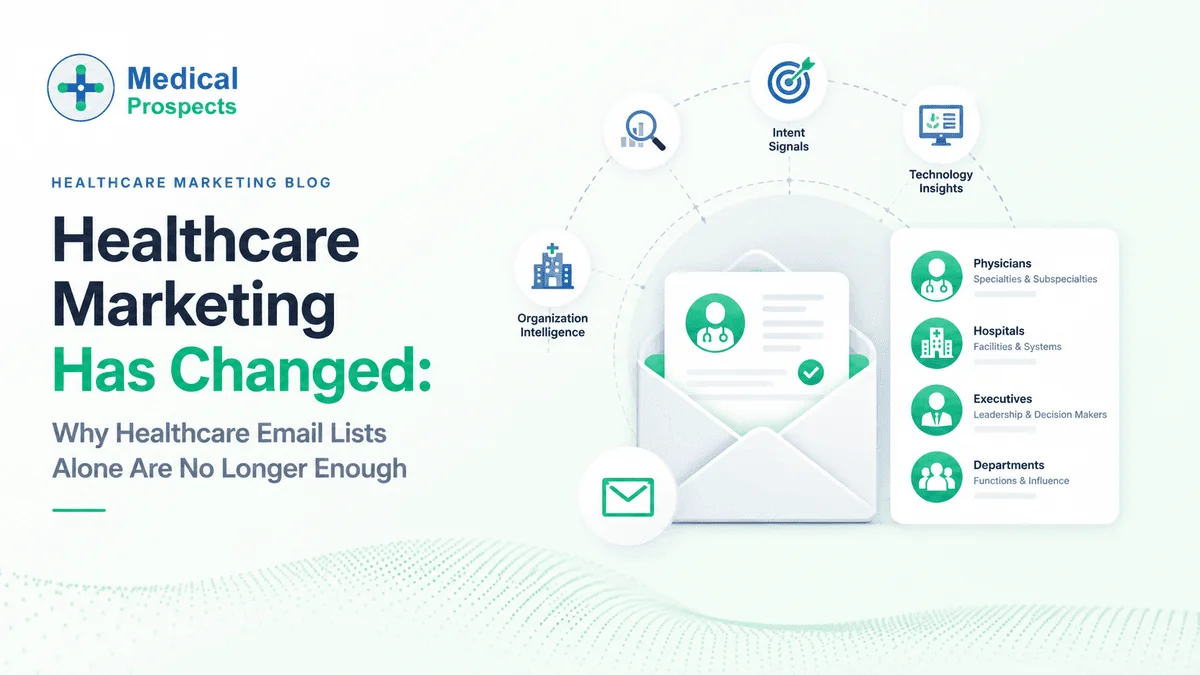
None of this replaces a verified healthcare database. It builds on top of one. Healthcare Audience Intelligence, as I think about it, combines verified contacts with organizational structure, technology footprint, strategic initiatives, and market signals, so marketing and sales teams know where to focus before they spend a single dollar on outreach.
It answers questions a contact record never could. What is this health system actually prioritizing this year? Who else in the organization influences a purchase like yours? Is this account actively evaluating solutions, or is it simply a good long-term fit worth nurturing quietly?
Healthcare organizations are navigating a lot right now. AI is reshaping clinical workflows. Cybersecurity has become a board-level topic instead of an IT one. Digital transformation budgets are stretched thinner than the ambition behind them. Every one of those pressures changes how a hospital evaluates a vendor, and a static list can't keep up with any of it on its own.
The question worth asking isn't how many healthcare contacts you have anymore. It's how well you understand the organizations behind those contacts, and whether you know which ones are worth calling this week.
Frequently Asked Questions
Isn't a verified healthcare list still the most important thing to get right?
Yes, and nothing in this changes that. Accurate contact data is still the foundation everything else sits on. The point isn't to deprioritize list quality. It's to recognize that list quality alone no longer tells you where to focus your limited sales and marketing time.
How is audience intelligence different from the firmographic data we already buy?
Firmographics tell you what an organization looks like on paper: bed count, revenue, facility type. Audience intelligence tells you what that organization is actually doing right now, its technology footprint, its recent leadership changes, its active initiatives, so you can tell which similar-looking accounts are worth prioritizing today.
Where do buying signals for hospitals and health systems actually come from?
Leadership changes, technology announcements, hiring patterns, regulatory filings, and public strategic initiatives all leave a trail. The work is in pulling that trail together consistently across thousands of organizations and connecting it back to a verified contact, which is exactly the layer MedicalProspects adds on top of core list data.
Does this matter for small, targeted ABM campaigns or only large-scale email programs?
It matters more for targeted ABM, in my experience running both. When you're only pursuing a few dozen accounts, picking the wrong dozen because they merely fit a profile instead of showing real signal is a far more expensive mistake than sending one more mediocre mass email.
Ready to Partner with a Specialized Healthcare Data Provider?
Discover how MedicalProspects can power your campaigns with high-fidelity, specialty-level healthcare intelligence.
Request Custom Healthcare Data Consult →
John Britton
VP of Marketing, MedicalProspects
John Britton is VP of Marketing at MedicalProspects, where he works with healthcare technology, staffing, pharmacy device, and medical device companies to turn verified provider data into targeted, timed go-to-market campaigns. He has spent more than twenty years in healthcare marketing and sales.
Related Insights