Why Chief Medical Officers Often Ignore Vendor Outreach, And What Gets Through

VP of Marketing, MedicalProspects
September 8, 2026
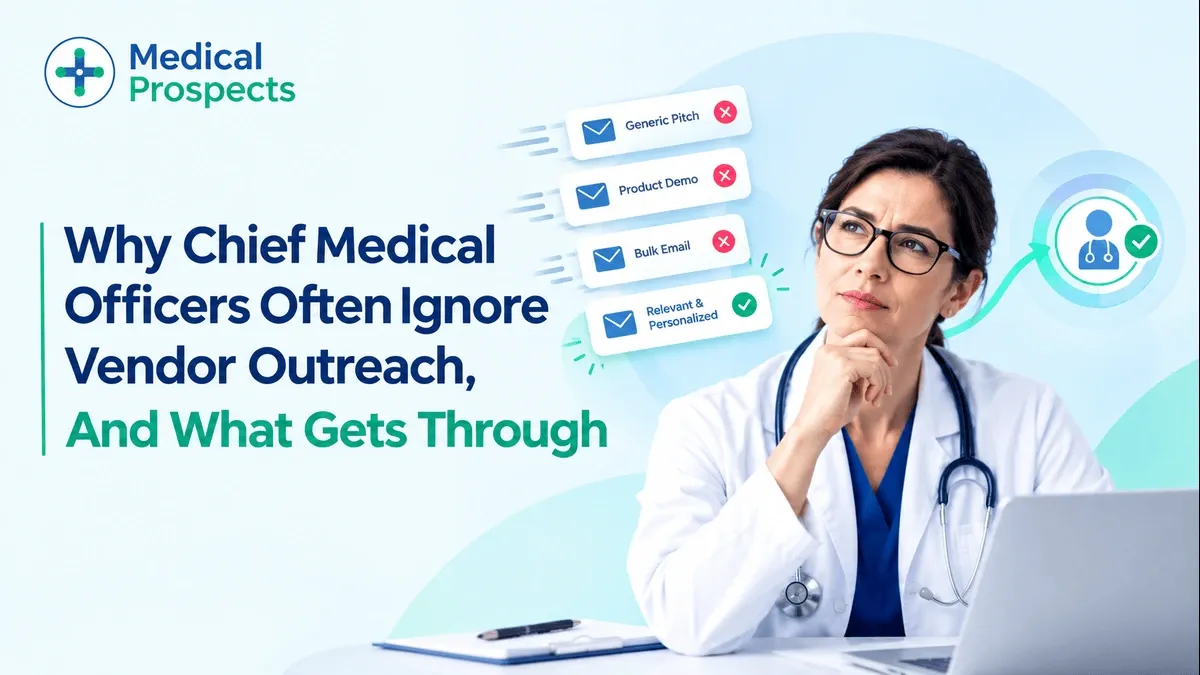
Quick Summary
Chief Medical Officers ignore most vendor outreach not because of weak messaging, but because of weak targeting. CMOs evaluate every pitch the way they evaluate clinical evidence: for relevance, proof, and fit, and generic, unsegmented campaigns get filtered out immediately. The vendors who do get through aren't more persistent; they're working from accurate, verified contact data. Precision targeting, built on a real Chief Medical Officer Email List, is what separates outreach that gets read from outreach that gets ignored.
Today, the healthcare industry stands as one of the most ambitious sectors where cracking a deal means getting a “yes” from multiple stakeholders and buying committees.
Additionally, the industry has the toughest cold email vertical, wherein a mere 2 to 3% reply rate with proper targeting is actually considered “good”.
Now imagine getting a Chief Medical Officer’s attention, scrutinizing every clinical strategy, quality check, and medical operational fit with sharp binoculars. There is little time for unsolicited conversations.
You made it to the CMO’s inbox. But did your message hold up against their read on clinical need, strategic priorities, and actual value?
That’s where most outreach is filtered out before it even gets a response.
So, if you sent a “revolutionary pitch” to a chief medical officer and it went unnoticed, that's a sign your message never earned their attention in the first place.
That's not a messaging problem. It's a targeting problem. And honestly, no one is talking about it. This article addresses why vendor outreach fails to grab CMOs’ attention.
Why Chief Medical Officers ignore vendor outreach
A CMO doesn't evaluate a pitch the way a financial executive or marketing team would.
They rely on evidence: clinical relevance, operational fit, and proof that the vendor’s product actually solves the problem.
The riddle arises when a vendor email opens with a “generic value proposition”, with no signs of the organization's specialty mix, patient size, or clinical informatics initiatives. That message reads as “noise”, not as a substantial solution.
It is filtered the same way an unsupported clinical claim would be. This is why volume-based outreach so often backfires with this audience.
CMOs notice, and once a sender is filed as noise, it's difficult to earn a second chance.
What can you do differently? The Industry-wide evidence
According to a 2026 marketing analysis on healthcare, account-based marketing (ABM) has moved from an “experimental tactic” to the “foundation of B2B healthcare strategy”, with organizations reporting higher engagement and lead conversions.
This isn't just theory. In one healthcare technology rollout (Nuvolo's 2026 ABM campaign), a vendor moved from generic mass outreach to 1:1 account-based messaging tailored to each stakeholder's specific interests.
The study showed that precision-targeted campaigns focused on specific organizations and personas displayed far better results than mass outreach.
This dynamic shift, which no one is talking about, toward precision isn't unique to CMO outreach. It describes where business healthcare marketing is heading, and the vendors who benefit from it share one single trait: they are not guessing.
They're working on accurate, current, and verified contact data for a real Chief Medical Officer.
Email List, not a scraped or outdated directory.
Ultimately, this means precision targeting starts before the message is even written.
Takeaway: Instead of a broad pitch sent to thousands of executive titles, the message can speak directly to the clinical and operational priorities of a specific CMO segment, rural hospital systems, academic medical centers, multi-specialty groups, or ambulatory networks.
That specificity is what separates outreach that gets opened from outreach that gets ignored.
Start with the account, not just the executive
A CMO's title alone doesn't tell a MedTech company whether an account is worth pursuing.
Relevance depends on the organization they lead, the clinical specialties it serves, the care settings it operates in, and the type of solution being introduced.
For example: a company selling cardiovascular devices may need to prioritize health systems with established cardiac programs before building its executive audience.
A surgical technology company, meanwhile, may need to identify hospitals with the right surgical specialties and then map clinical leadership, surgeons, procurement teams, and other stakeholders within those accounts.
What a message that gets through actually looks like
For MedTech, medical device sales and marketing teams, reaching a Chief Medical Officer is not simply a matter of finding the right executive title and sending an email.
CMOs are often part of broader clinical, operational, and purchasing conversations, which means outreach needs to reflect the specific organization, care environment, and challenge being addressed.
Teams that generate stronger engagement typically get three things right. Here are the following:
- First, they lead with relevance, not features, naming the specific operational or clinical challenge their product addresses, rather than opening with what the product does.
- Second, they keep the ask small: a short answer, a resource, or a brief conversation, not an immediate demo request.
- Third, they follow up sparingly and with new information each time, rather than repeating the same pitch.
Additionally, vendors must note one overlooked truth about healthcare decision-makers, accuracy matters as much as eloquence.
The best-written email in the world still fails if it reaches a CMO who left the organization eighteen months ago, or a CMO whose specialty focus has nothing to do with the product being offered.
What gets the attention of chief medical officers: Quick checklist
- Relevance first: Address their specialty, setting, or specific challenge.
- Accurate targeting: Reach verified, current CMOs, not generic executives.
- Clear clinical value: Make the impact on care, quality, or workflow obvious.
- Purposeful follow-up: Add value instead of repeating the same pitch.
- Evidence over hype: Lead with data and proven outcomes.
The real filter isn't your pitch: It's your mailing list
It is important to know that CMOs are not ignoring vendor outreach because they are unreachable. They are probably a particular outreach that was unfortunately not built for them.
A well-researched, relevant message sent to an accurate, up-to-date Chief Medical Officer Email List has a fundamentally different chance of landing than a broad campaign sent to a generic executive database.
For B2B healthcare vendors, the path to a CMO's attention isn't more persistence; it's better precision.
Start with a verified Chief Medical mailing contact, segment it by specialty and setting, and build the message around what that specific CMO actually needs to hear.
Final thoughts
CMOs do not evaluate vendor outreach the way most marketing teams hope they will.
Every claim is measured against evidence, every solution against clinical and operational priorities, and every message against the simple question: is this worth my attention?
That is why effective CMO outreach starts long before the pitch. It starts with reaching the right executive, in the right role, with a message relevant to the decisions they can influence.
For CMOs, the data behind a campaign matters as much as the message itself, and understanding what they actually expect from their data partners can sharpen that outreach even further. What Healthcare CMOs Need from Their Data Partners breaks this down in more detail.
A verified Chief Medical Officer Email List does more than improve deliverability. It changes the entire framing of the outreach.
Those seeking the right platform for chief medical officer contact database, MedicalProspects is your go-to list provider, offering multi-verified mailing lists built for precise, high-value outreach.
Frequently Asked Questions (FAQs)
How to reach chief medical officers?
Reach Chief Medical Officers with concise, highly relevant outreach focused on clinical outcomes, patient care, quality, and strategic priorities. Personalize the message to their organization and avoid generic vendor pitches. Use verified contact data and a multichannel approach to improve engagement.
What gets the attention of chief medical officers?
Chief Medical Officers respond to information that connects directly to clinical outcomes, patient safety, operational efficiency, or measurable healthcare improvements. Clear evidence, relevant insights, and a strong understanding of their priorities are more effective than broad promotional messaging.
How chief medical officers evaluate healthcare vendors?
Chief Medical Officers typically assess vendors based on clinical value, evidence, patient impact, implementation requirements, and alignment with organizational goals. They may also consider input from clinical, IT, procurement, and executive stakeholders before making a decision.
How chief medical officers influence medical device decisions?
Chief Medical Officers can influence medical device decisions by evaluating clinical effectiveness, patient safety, physician adoption, and alignment with care standards. Their clinical perspective often helps shape recommendations, while final purchasing decisions may involve procurement and other stakeholders.
Ready to Build Your Targeted Healthcare Audience?
Connect directly with verified healthcare professionals, physicians, and executives with our NPI-verified database.
Get a Custom Provider Count →
John Britton
VP of Marketing, MedicalProspects
John works with healthcare sales and marketing teams on precision targeting, campaign strategy, and audience intelligence solutions at MedicalProspects.
Related Insights