What Healthcare CMOs Need from Their Data Partners (And Why Most Vendors Fall Short)

VP of Marketing, MedicalProspects
July 21, 2026
Quick Summary
Healthcare marketers have more automation, AI, and analytics than any generation before them, and campaigns still underperform because the contact and account data underneath all of it is stale, mismatched, or wrong. I've watched this play out for two decades. Physicians change practices, hospitals merge, and buying committees keep growing, so a database that was accurate in January is often shaky by summer. The CMOs who win aren't the ones with the biggest lists. They're the ones with data partners who verify constantly, segment by more than job title, and help answer the question of who to target next, not just how many records they have.
I've spent more than twenty years in healthcare marketing and sales, and in that time I've sat through pitch after pitch promising to fix pipeline overnight. Marketing automation was going to fix it. Then predictive lead scoring. Now it's AI, and the pitch sounds almost identical to the ones I heard in 2008.
None of those tools ever solved the problem I kept running into, because the problem was never really the tool. It was whether the person on the other end of the campaign still worked where we thought they worked, still held the title we had on file, and still cared about the thing we were selling.
You can see the symptoms everywhere once you know what to look for. Campaign engagement that never quite lands. Account-based programs that can't agree on which accounts actually matter. Sales reps who quietly stop trusting the leads marketing hands them. Event budgets that produce a nice booth and not much pipeline. And now, AI writing beautifully personalized emails to people who left the organization eighteen months ago.
That last one keeps me up more than the others. AI didn't create the data problem in healthcare marketing. It just made the consequences of bad data move a lot faster.
Marketing Became a Revenue Function Whether We Asked for It or Not
Fifteen years ago my job was mostly about awareness. Get the brand in front of people, fill the top of the funnel, show up at the right conferences. Nobody expected me to own pipeline math.
That world is gone. Today a healthcare CMO is expected to have a point of view on revenue pipeline, ABM, sales enablement, digital transformation, retention, and increasingly on how AI gets adopted across the commercial org. Marketing sits at the revenue table now, not next to it.
The budget picture makes this harder than it sounds. Gartner's 2025 CMO Spend Survey found that marketing budgets have flatlined at 7.7 percent of company revenue for a second straight year, and 59 percent of CMOs say they don't have enough budget to execute their strategy. That number is actually an improvement from the year before. Most of us are being asked to do more with a budget that isn't growing, which means every campaign dollar has to work harder.
You cannot get more out of a flat budget by buying more technology. You get more out of it by making sure the audience you're spending against is the right one.
CMOs Don't Need More Contacts. They Need to Trust the Ones They Have.
A few years ago I sat in on a QBR with the marketing team at a mid-Atlantic health system client of ours, a pharmacy device manufacturer trying to expand its footprint into hospital pharmacy departments. Their target list looked full. Thousands of names, titles, emails. On paper it was a strong list.
We pulled a sample and started calling. About four in ten records were wrong in some way that mattered. Titles that had changed. Pharmacy directors who'd moved to a different system entirely. One person on the list had retired two years earlier. Nobody caught it because nobody was looking, and the campaign kept running on autopilot the whole time.
That's not a rare story. It's the norm I've seen across most healthcare organizations I've worked with. The shortage isn't contacts. It's confidence in what you already have.
If you're a pharmacy device manufacturer trying to reach hospital pharmacy directors, you don't need a bigger list. You need a list of your exact buyers, verified and current, so your campaigns run against people who are actually still in the role. That's the kind of targeted list MedicalProspects builds for clients in that exact position.
Every marketing and sales initiative starts with the same quiet question underneath it. Do we actually know who our buyers are right now, not who they were when the database was built?
Healthcare Data Goes Stale Faster Than Most Teams Realize
This isn't a hunch. It's measurable. A study published in the Annals of Internal Medicine tracked physician turnover using Medicare billing data and found the annual rate at which physicians left or moved practices climbed from 5.3 percent in 2010 to 7.6 percent by 2018, a 43 percent increase. That's before you even factor in retirements, mergers, or specialty changes.
Layer on what's happening at the organizational level and the picture gets worse. A GAO review published in 2025 found that at least 47 percent of physicians were affiliated with or employed by hospital systems in 2024, up from less than 30 percent in 2012. Practices you mapped a few years ago may not even be independent anymore.
+43%
Physician turnover rate increase between 2010 and 2018 (Annals of Internal Medicine)
47%
Physicians consolidated with hospital systems in 2024, up from under 30% in 2012 (GAO)
7.7%
Marketing budgets flat as percentage of revenue for the second year running (Gartner)
Static databases cannot keep pace with an industry that moves this fast. A list that was 90 percent accurate in January can easily be sitting at 75 percent by the third quarter, and most teams don't find out until a rep tells them a prospect bounced back or a campaign report shows engagement quietly sliding.
Job Titles Are Not a Segmentation Strategy
I've made this mistake myself early in my career. Pull everyone with a certain title, write one message, send it to all of them, and call it targeted marketing. It never worked as well as it should have, and now I understand why.
A cardiologist doesn't evaluate a new solution the way an orthopedic surgeon does. A hospital CFO reads a value proposition completely differently than a Chief Nursing Officer does. Even inside the same health system, the person who influences a purchasing decision often isn't the person whose title suggests they should.
Real segmentation stacks several layers together. Specialty. Clinical role versus administrative role. Facility type and size. Whether the organization has recently adopted a competing or complementary technology. Geographic market. Health system affiliation. Put those together and messaging stops feeling generic and starts feeling like it was written for the person reading it, because it was.
If you're a health IT vendor trying to reach hospital CIOs, blasting every executive with the title "Chief Information Officer" wastes budget on people who aren't your buyer. MedicalProspects can build you a list of your exact buyers segmented by facility type, system size, and technology adoption, so your campaigns reach the CIOs who actually fit your ICP.
One Data Foundation Across Every Channel, Not Five Different Ones
I've watched marketing run off one dataset while sales prospects off another, and business development works a spreadsheet nobody else has seen in months. The inconsistencies show up fast. A prospect gets three different messages from three different teams, sometimes in the same week, and it doesn't take much of that before a health system stops taking your calls seriously.
The commercial teams that execute well share one source of truth across email, sales outreach, LinkedIn advertising, ABM, conference marketing, and territory planning. It sounds obvious written down. In practice it's rare, because most organizations built their data infrastructure in pieces over the years rather than as a single system.
AI Doesn't Fix Bad Data. It Just Executes on It Faster.
I had a conversation with a CMO last year who'd just rolled out an AI tool to personalize outreach across her whole database. She was excited about it, and the tool itself was genuinely good.
Three weeks in, her team noticed reply rates dropping instead of climbing. We dug into it together. The AI was writing sharp, specific, well-personalized messages. It was just sending a good number of them to people who'd changed roles or left the organization entirely. The tool did exactly what it was built to do. It just did it on top of a foundation that hadn't been checked in over a year.
If your physician specialty field is wrong, AI will personalize the wrong message with total confidence. If your executive contact left six months ago, AI will automate a beautifully written email to an inbox nobody checks anymore. The technology amplifies whatever you feed it, good or bad, and it doesn't know the difference.
If you're a staffing company trying to reach nurse managers across a specific region, you can pull a verified list of your exact buyers from MedicalProspects and point your AI-driven campaigns at people who are actually in the building today, not people who held that title two staffing cycles ago.
Buying Committees Have Gotten Bigger, and Slower to Convince
It's not just data decay working against marketers right now. Forrester's State Of Business Buying, 2026 report found the typical B2B purchase now involves 13 internal stakeholders and 9 external influencers, and that number climbs further for complex or strategic purchases. Healthcare deals, with their compliance requirements and clinical stakeholders layered on top of the usual finance and IT sign-off, tend to land on the higher end of that range.
That means a single accurate contact record isn't enough anymore. You need to understand the whole committee around a health system's decision, which is exactly where intent data has started to matter. Firmographics and specialty tell you who fits your ideal customer profile. Intent signals tell you when an organization might actually be in market, which is a very different and much more useful question.
Combine verified contact data with intent signals and a commercial team can stop spraying campaigns across every possible buyer and start prioritizing the accounts showing real signs of movement. That shift alone changes how a sales team spends its week.
If you're a medical device manufacturer trying to reach orthopedic practice administrators ahead of a major conference, you can build a targeted audience of your exact buyers through MedicalProspects and start outreach and meeting scheduling weeks before the show floor opens, instead of hoping the right people walk past your booth.
What a Real Data Partner Actually Does
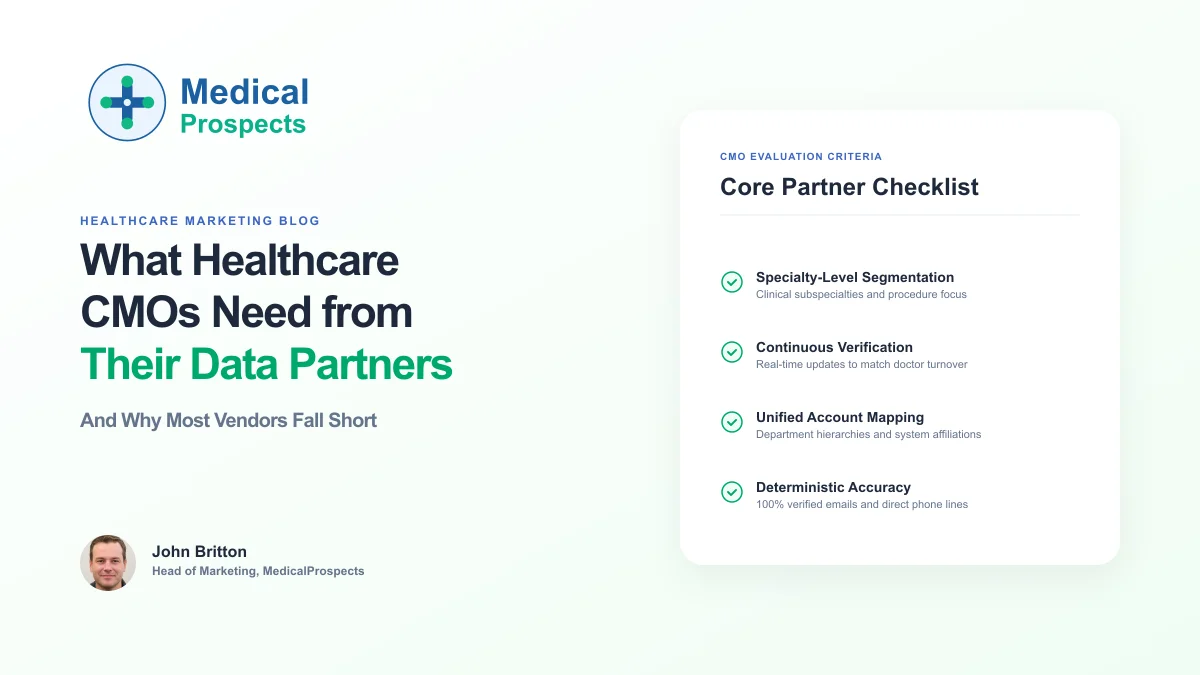
Accuracy used to be the whole conversation with a data vendor. It's still necessary, but it's not sufficient anymore. The partners worth working with go further: ongoing verification instead of a one-time upload, specialty and role validation, visibility into organizational hierarchy and health system affiliation, transparent sourcing you can actually explain to compliance, and a willingness to replace bad records rather than argue about them.
The best ones also answer different questions than a traditional vendor would. Instead of "how many cardiologists do you have," the conversation becomes "which cardiologists should we prioritize for this campaign." Instead of "send us a hospital database," it's "which health systems are most likely to buy in the next twelve months." That's a fundamentally different kind of partnership, and it's the one I'd want if I were sitting in the CMO chair evaluating vendors today.
Revenue Is Still the Only Scoreboard That Matters
No CMO I respect brags about owning the biggest physician database. They talk about qualified meetings booked, campaign engagement that actually moved, accounts prioritized correctly, and pipeline that closed faster because sales and marketing were finally working off the same information.
Technology gave healthcare marketers more capability than any generation before us. It didn't remove the need to know, specifically and currently, who we're selling to. If anything it raised the stakes, because bad data now gets automated at scale instead of just sitting quietly in a spreadsheet. The organizations that pull ahead over the next few years won't be the ones with the biggest tech stack. They'll be the ones who treated their data as seriously as they treated everything else in the revenue engine.
Frequently Asked Questions
How often should healthcare contact data be verified?
Given how fast physicians change practices and health systems consolidate, I'd push back on anyone treating a healthcare database as a one-time purchase. Continuous or at minimum quarterly verification is closer to the reality of how fast this market moves.
What's the real difference between a contact database and commercial intelligence?
A contact database answers how many. Commercial intelligence answers which ones matter, which accounts are showing buying signals, and who on a buying committee actually influences the decision. One is a list. The other is a strategy input.
Can intent data actually help with healthcare-specific targeting?
Yes, when it's paired with accurate specialty and role data rather than used on its own. Intent tells you an organization is researching something relevant. Verified contact data tells you exactly who to talk to about it.
How does this apply to event and conference marketing?
The exhibitors who get real ROI from healthcare conferences aren't waiting for foot traffic anymore. They're identifying likely attendees ahead of time, building pre-event outreach, and locking in meetings before the show even opens.
Ready to Fix Your Targeting?
If your healthcare campaigns are generating weak engagement or stalling in the funnel, the problem is probably not your messaging. It is your audience data. MedicalProspects specializes exclusively in healthcare provider data — built around the specialty-level depth that MedTech and healthcare marketing teams need to reach the right clinicians with campaigns that actually land.
Request Live Counts by Specialty →
John Britton
VP of Marketing, MedicalProspects
John works with healthcare sales and marketing teams on precision targeting, campaign strategy, and high-fidelity healthcare data solutions.
Related Insights