Medical Device Sales Territories: How to Target the Right Geographic Markets

VP of Marketing, MedicalProspects
September 3, 2026
Quick Summary
Medical device sales territories should be built around real market opportunities, not geography alone. This article explains how market, account, procedure, and buyer intelligence can guide better territory planning. It covers account prioritization, competitive whitespace, procedure demand, and decision-maker mapping. It also shows how healthcare data can help sales leaders identify gaps and continuously improve territory performance.
What is the difference between “everyday” and “every day”? Apparently, they appear identical, but they have different meanings.
We believe they have the same meaning, and this assumption is so common it's mistaken for truth.
Sometimes a common belief is so strong that we end up accepting it as an “absolute truth”.
The metaphor leads directly into the argument that two concepts may look very similar or be connected, but confusing them can lead to the wrong outcome.
Medical device sales planning faces a similar problem. Sales territory and sales planning are often treated as if they are the same starting point, but they are not. A territory is where sales activity happens. It should not automatically determine where planning begins.
This article examines common strategic errors made by medical device companies around geographic sales territories before understanding where the real opportunities, target accounts, buyers, and healthcare organizations are.
Why medical device territory planning alone misses the bigger picture
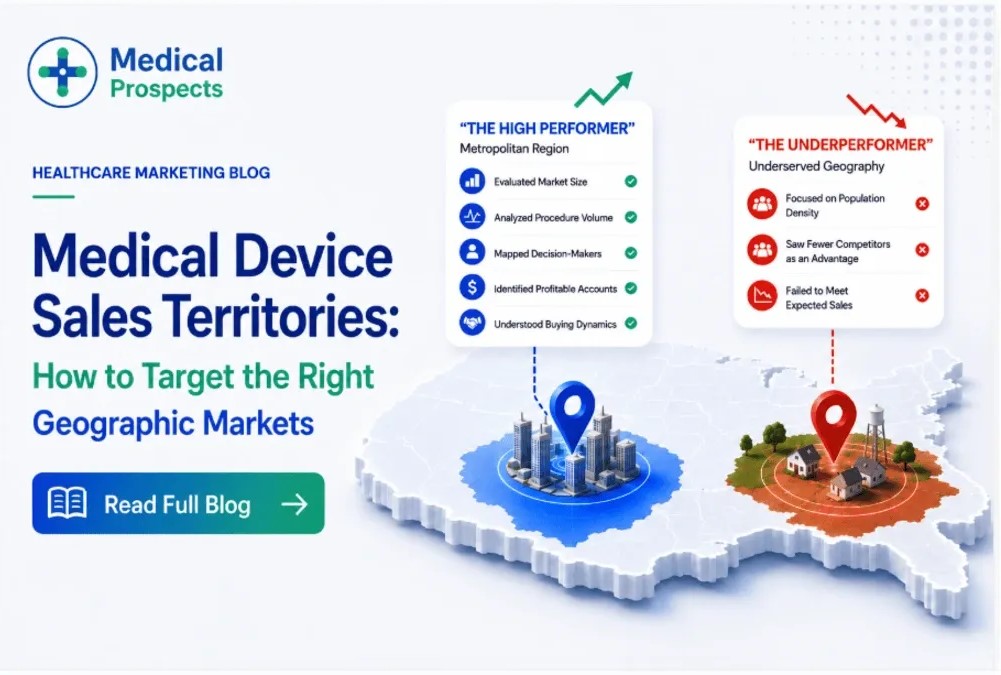
Consider a hypothetical scenario: Two different reps working at the same firm and selling the same medical device.
Let’s examine the two cases:
Case 1
The higher performer worked in a metropolitan region and began by evaluating its market size. Additionally, utmost attention was given to a detailed analysis of procedure volume, purchasing decision-makers, profitable accounts, and buying dynamics before prioritizing outreach.
Case 2
The underperformer chose an underserved geography. While the rural region promised sizable results, citing population density and fewer competitors, it failed to meet expected sales.
The strategic implication: Where this hypothetical story leaves the sales leaders
A sales territory can tell you where your sales team should operate; however, it does not necessarily indicate where the best opportunities are.
In situations like case 2, territories were built primarily around geography, account counts, or historical purchases; the rep overlooked significant factors such as number of procedures, account size, and provider distribution.
In medical device territory planning, two geographies that may look equal on a map can represent very different commercial opportunities.
The missing bigger picture starts with understanding the market within the territory.
- Which facilities have the right patient or procedure volume?
- Which providers influence purchasing decisions?
- Which accounts have room for growth?
- Which are already highly penetrated?
These pivotal factors can reveal opportunities that a geographic boundary alone cannot.
Takeaway: Territory planning should come after opportunity identification and account prioritization, rather than serving as the foundation.
Once companies understand the demand, high-value accounts, and relevant stakeholders, they can build territories around those realities, not just draw lines around them.
The actual intelligence mapping: What medical device sales leaders should plan first
Territory should be the output of market, account, and buyer intelligence, not the starting point. Here's the sequence.
| Step | Focus | What to Do |
|---|---|---|
| 1. Define the market | Specialty, procedure, care setting, geography | Pin down the exact market your device serves to keep the territory plan from becoming too broad. |
| 2. Identify high-potential accounts | Hospitals, ASCs, practices, health systems | Evaluate procedure activity, account size, growth potential, and current penetration. |
| 3. Map competitive whitespace | Competitor strength vs. underserved accounts | Distinguish real market opportunity from simply available geography. |
| 4. Assess procedure demand | Where procedures happen, and at what volume | Procedure activity can reveal markets stronger than their geographic size suggests. |
| 5. Map the buying committee | Clinical, admin, financial, procurement stakeholders | Go beyond physicians, modern medtech deals involve multiple influencers. |
| 6. Tier the accounts | High-priority, growth, lower-priority | Group accounts by potential and strategic importance to guide rep time before territories are set. |
| 7. Turn intelligence into territories | Territory as output, not input | Only after these inputs are understood should leaders decide how to divide and assign territories. |
Medical device territory optimization: Use data to improve your territory performance
According to a report by Clarivate, medtech companies often miss significant opportunities when it comes to sales. The report states that factors like network affiliations, referral influence, and stakeholder relationships must also be considered while prioritizing accounts.
Compare territory performance with opportunity: Track down actual rep results against the market potential calculated during planning, not just against quota.
Identify territories that are hypercompetitive or under-covered: Closely monitor territories where sales rep capacity does not match account volume or complexity, in either direction.
Make sure to reassign accounts when the market alters: Keep moving accounts between territories as procedure volume, ownership, or facility status shifts, rather than leaving them untouched or static.
Track procedure growth and new facilities: Examine shifts in procedure volume and new facility openings that can turn a low-priority territory into a high-value one.
Monitor account penetration and whitespace: Keep a close eye on which accounts are already taken and which are not touched, ensuring the sales team isn't overloading the same providers.
Adjust territories based on real-time results, not assumptions: Treat the territory model as a “living structure” that gets revamped with performance scores, not a fixed plan set once a year.
Final thoughts
The right medical device territory planning that outperforms does not happen with limited knowledge or mere statistical figures.
It happens when you know exactly who to target, where to target, and when to target. While many sales leaders excel at “how” to target, the other “Ws” go unattended.
In a nutshell, build medical device sales territories around real market opportunities, and not mere assumptions. Your go-to medical device sales strategy.
Your go-to medical device sales strategy should start with market intelligence to turn real opportunities into smarter, more effective territories.
Get the right healthcare data from MedicalProspects to identify the accounts, providers, procedures, and decision-makers that matter most.
Frequently Asked Questions (FAQs)
How to plan sales territories for medical device companies?
Start by analyzing the market, target accounts, procedure volume, and key decision-makers. Then assess account potential, provider concentration, existing sales coverage, and rep capacity. Use these insights to create territories that balance opportunity, workload, and geographic practicality.
How to identify high-potential medical device territories?
Look beyond territory size or population. Identify areas with high procedure demand, relevant hospitals and facilities, strong provider presence, and accounts with growth potential. Prioritize territories where market demand and buyer opportunity overlap.
How to use healthcare data for territory planning?
Healthcare data can reveal where target providers, hospitals, procedures, and potential buyers are concentrated. Combining this information with account and sales data helps identify underserved or high-value markets. This allows companies to build territories around actual opportunity rather than assumptions.
How to identify new territories for medical device sales?
Look for markets showing unmet demand, growing procedure volumes, new facilities, or increasing provider presence. Analyze existing account penetration to find areas where competitors or your own sales team have limited coverage. New territories should be created based on market opportunity, not simply uncovered geography.
How physician and hospital density affects medical device territories?
Physician and hospital density can indicate where potential customers and procedures are concentrated. However, density alone does not determine territory value, specialty, procedure volume, account potential, and buying influence also matter. A smaller, highly concentrated market can sometimes offer more opportunity than a larger but less active territory.
Ready to Build Your Targeted Healthcare Audience?
Connect directly with verified healthcare professionals, physicians, and executives with our NPI-verified database.
Get a Custom Provider Count →
John Britton
VP of Marketing, MedicalProspects
John works with healthcare sales and marketing teams on precision targeting, campaign strategy, and audience intelligence solutions at MedicalProspects.
Related Insights