TLDR:
AI is speeding up medical research by compressing vaccine and drug discovery timelines and is already used across most US healthcare systems. But faster research means less scrutiny time, and researchers warn that the same AI tools accelerating breakthroughs also introduce biosecurity risks: data bias, regulatory gaps, and blurred lines between legitimate research and misuse. The fix isn't slowing AI down. It is building stronger governance, tiered oversight, and biotech AI compliance into the process from the start. Read this article by Medical Prospects to dive deeper into the subject.
Artificial Intelligence has moved far beyond the corridor of research to large-scale science laboratories for clinical trials, academic purposes, and even vaccine breakthroughs.
That shift is already gaining astounding visibility in the figures.
Today, a whopping 75% of US healthcare systems reportedly depend on at least 1 AI application. The data is based on the current year.
The trend holds at the industry level too.
According to a recent report by Medidata, a clinical trial technology firm, one-third of pharma and biotech organizations are already using Artificial Intelligence in a handful of their clinical trials or in the majority of them.
Scientific AI experts claim that this amalgamation of AI and biology holds phenomenal promise for medical discoveries, economic growth, and medical leadership
But faster research and results also mean faster data, broader digital accessibility, and limited time for scrutiny.
An industry that sets a benchmark for trust, care, and hands-on experience cannot depend just on Large Language Model (LLM)-generated probabilities.
While AI-driven chatbots apparently promise to deliver revolutionary “tech-savvy” paradigms in medicine via a swift four-step framework (Design-Build-Test-Learn or DBTL), this article decodes an independent overview of the AI-induced risks in 2026.
The objective is to educate medical professionals, policymakers, security advisors, and healthcare business decision-makers and help them design safer strategies to address potential AI risks.
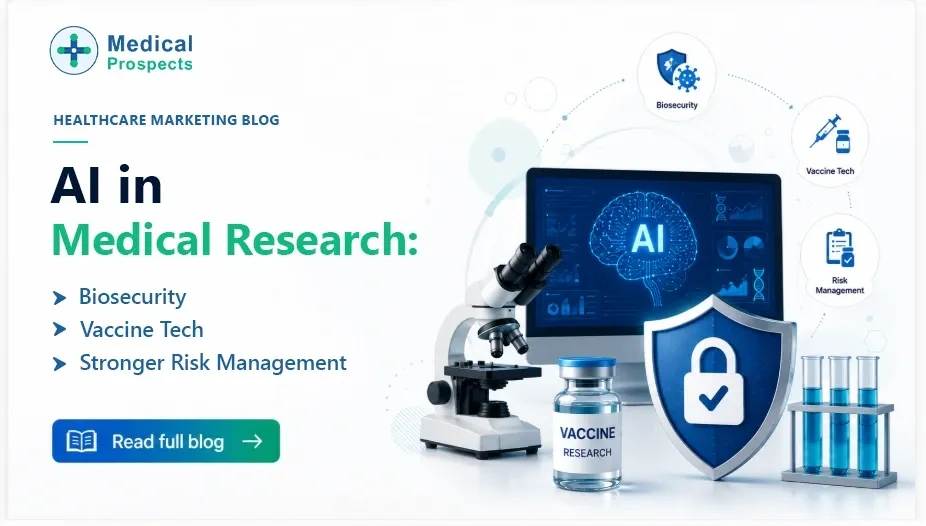
AI in medical research: Examining the risk interface of Artificial Intelligence and healthcare biosecurity
Biosecurity is a term that resonates with prevention. It is not about any single dramatic scenario. It's the everyday discipline of strengthening our defences against research breaches, biological information risks, and institutional systemic leaks.
Researchers studying the intersection of AI and synthetic biology have indicated that the same LLMs capable of intensifying vaccine and drug findings can also yield consequential outcomes.
The larger concern is that AI agents can design these relatively controversial outcomes without adequate protocols.
The 2026 International AI Safety Report, backed by 100+ independent experts across 30+ countries, found that current technical safeguards are improving. However, they still fall short on safety concerns.
The report, chaired by Montreal Professor Yoshua Bengio and other global experts across the EU, OECD, and UN, recommended “defence-in-depth” that adds robust layering of multiple safeguards, instead of relying on just one.
And that's why several AI developers have added extra layers of review specifically for biology-related capabilities.
In early May 2025, the White House passed an executive order titled Improving the Safety and Security of Biological Research, directing federal science policy bodies to update “dual-use research” oversight, particularly to account for AI-assisted tools in the US.
As AI drug discovery risks grow more complex, biotech AI compliance is no longer optional; it's becoming the foundation of trustworthy research.
Vaccine technology is where the upside meets. Here's how.
The AI-discovered compounds have arguably benefited vaccine development. This is also one of the most crucial areas of biotech/ pharmaceutical R&D that demand safer deployment.
Let's consider the classic prototype of AI-enabled antigen design and clinical trial optimization. Moderna's mRNA platform, a technological paradigm for the deadly coronavirus (COVID-19 virus), was created in record time using AI.
Research now backs the idea that this isn't a one-time success story from AI. The same platform technology is already being extended in other medical areas such as treating cancer.
Moderna's mRNA-4157, combined with an existing cancer treatment, showed a 44% reduction in melanoma recurrence risk in trial data, with regulatory submissions expected in 2026.
Other areas that expanded the technology include flu, developing vaccines that don't need constant refrigeration, and combining several vaccines into fewer doses.
The “underrated” blind spot in AI, modern vaccinology, and safety assessment
Ironically, the oversight challenge stems from the same AI tools that amplify vaccine discoveries and also come with a caution worth noting. This murkier yet sensitive angle is not being noticed by many.
A 2025 umbrella review published in Frontiers in Immunology indicates protracted challenges that come from quicker adoption of AI.
The study, compiling multiple reviews on AI, pointed to the emergence of complex challenges that could be the genesis of AI tools, namely “data heterogeneity, algorithmic bias, fewer regulatory guidelines, and questions around transparency and equal distribution”.
This riddle makes it extraordinarily tough to separate legitimate AI-designed drugs from potential misuse spewed by automated systems alone.
Final Thoughts
There are biosecurity concerns that probably stem from AI, and researchers have backed that. Nonetheless, it does not mean slowing down innovation. It just means mindful use and consumption of LLMs in clinical tests, lab work, and practical analysis.
This article outlines a handful of practical actions and safer strategies to limit AI use in biology, backed by credible medical journals and publications.
Why? Because if science laboratories become aggressively AI-automated, hands-on experience will eventually shrink, and we may need to step forward to preserve the discoveries while prioritizing protections.
For business healthcare enterprises, organizations, and agencies, the realistic takeaway is simple: biosecurity planning now belongs in the same conversation as IT security, data governance, and compliance, not as a separate entity.
To sum up, precautionary measures helmed by policymakers can soften the “translucent line” between progress and safety.

MedicalProspects Editorial
MedicalProspects Editorial covers important developments shaping healthcare, medicine, life sciences, public health, healthcare technology and the global healthcare industry.