TLDR:
The state of Pennsylvania, USA, has registered three measles deaths in 2026, all unvaccinated, amid a nationwide rare outbreak that's hit 3,294 cases. The article covers what measles is, how it spreads, its symptoms and complications, and why the MMR vaccine remains the best prevention against this highly contagious disease.
The United States is currently witnessing a rare outbreak of measles, a preventable disease, which has now claimed three lives in the country, all reported in Pennsylvania. According to the Centres for Disease Control, the country has registered 3,294 measles cases so far in 2026.
All three deaths involved unvaccinated individuals. The most recent fatality, an unidentified woman who died on Saturday from complications related to measles, has not yet been publicly named by health officials, though the Washington Post reported she was unvaccinated.
This followed two earlier deaths in August, both reported from Lancaster County, a largely rural area known for lower vaccination rates than the general US population.
State health authorities confirmed that those two individuals were also unvaccinated.
2026 is the worst year for measles in the U.S. since the disease was declared eliminated in 2000. For healthcare data teams, it’s a reminder that case counts, outbreak maps, and vaccination trends are never “final”- they update every week.
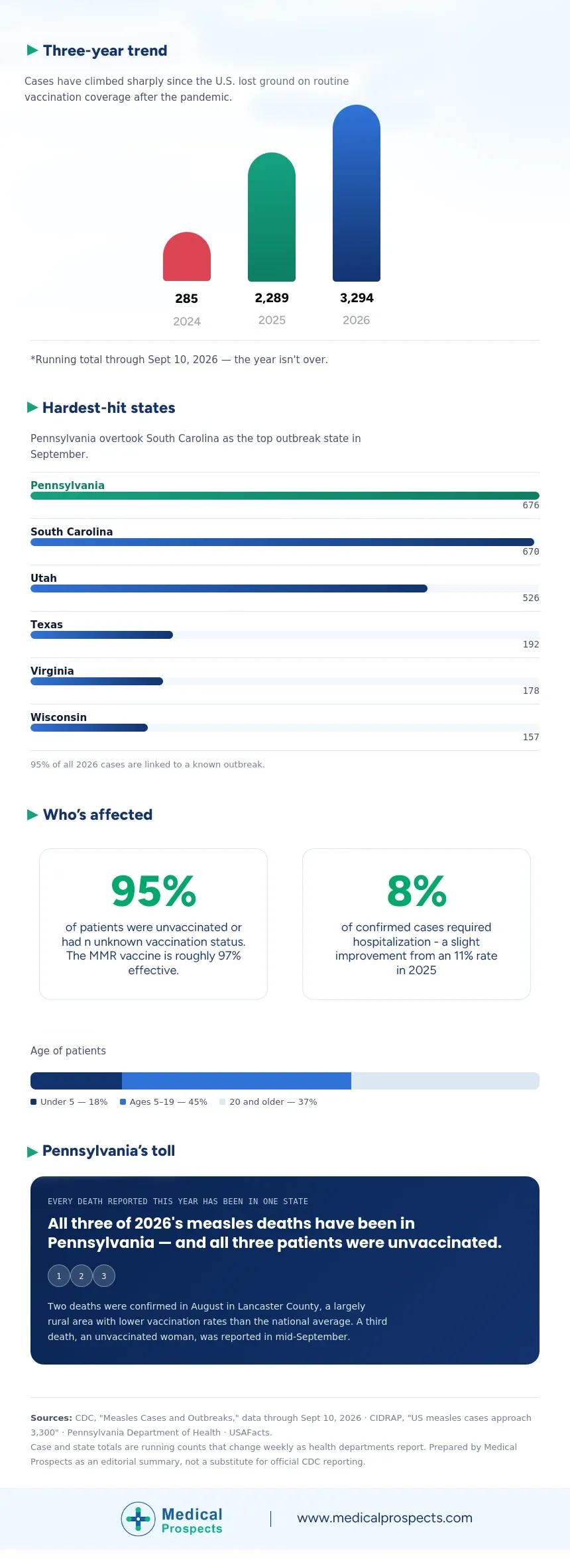
Across all three cases, the common thread officials have pointed to: is the absence of vaccination, reinforcing county warnings that measles remains a highly contagious and potentially deadly disease.
What is measles?
Measles ranks as the most contagious infectious disease known, transmitting with remarkable speed and capable of triggering serious complications such as encephalitis and, in severe cases, death.
How does measles spread?
A measles infection stems from a virus that travels through the air whenever an infected person coughs, sneezes, or simply speaks, remaining airborne for up to two hours. As a result, someone can contract the virus even after the infected individual has already left the space.
What are the symptoms of measles?
The most common symptoms of measles are:
- High fever
- Runny nose
- Red eyes
- Cough
- Small white spots inside the cheeks
- Skin rashes
Additionally, respiratory symptoms are commonly present by day ten, with the rash typically appearing on day 14 after exposure.
What complications can arise from a measles infection?
Measles is associated with several health complications. These are as follows:
- Diarrhea
- Ear infections
- Pneumonia
- Croup
- Weakened immune system
- Encephalitis (swelling of the brain; rarer forms occurring even years later)
Contracting measles during pregnancy raises the likelihood of early delivery and low-birth-weight infants. Those at greatest risk of severe complications include young children, pregnant individuals, and people whose immune systems are weakened.
What is the effective vaccine for measles?
- The MMR (measles, mumps, rubella) vaccine is the best protection against measles. Children may instead receive the MMRV vaccine, which also protects against chickenpox.
- Two doses of the MMR vaccine are recommended as the best way to protect against measles, mumps, and rubella, and most vaccinated people are protected for life.
- Children are recommended to get 2 doses: the first at 12–15 months old, and the second at 4-6 years old.
- Adults are recommended to have at least 1 documented dose of MMR, with some higher-risk adults recommended to get 2 doses if they lack other evidence of immunity.
How well does the MMR vaccine protect against measles?
- One dose of MMR vaccine is 93% effective against measles.
- Two doses of MMR vaccine are 97% effective against measles.
- Getting the MMR vaccine within 72 hours of measles exposure may still offer some protection or result in a milder illness.
- Vaccinated people who still get measles generally experience milder symptoms and are less likely to spread the disease to others.
How can measles be prevented?
- Get fully vaccinated with two doses of the MMR vaccine, the most effective way to prevent measles.
- Maintain community immunity by keeping vaccination coverage above 95%. Lower rates raise outbreak risk, as seen in Pennsylvania.
- Check your vaccination records if unsure of your status. Get vaccinated if you have none, especially before international travel.
- Contact a doctor promptly after measles exposure. An MMR dose within 72 hours, or immune globulin within 6 days, may still help.
- Isolate immediately if symptomatic. Avoid public spaces, schools, or clinics without notifying providers first.
- Get an additional MMR dose during outbreaks if recommended by health authorities, including for infants as young as 6 months.
- Rely on vaccination, not hygiene alone. Measles spreads through the air, so handwashing offers limited protection.
Which adults should get a second MMR dose?
While one MMR dose is the baseline for adults without evidence of immunity, certain groups should get two doses for stronger protection:
- College and post-high school students
- Healthcare workers
- International travelers
- Close contacts of immunocompromised individuals
- People living with HIV (not severely immunocompromised)
- Anyone in an outbreak-affected group
Final thoughts
The three measles deaths in Pennsylvania this year are a sobering reminder that this disease hasn't gone away. It's simply been waiting for vaccination rates to slip.
Checking your family's MMR vaccination records can make the difference between exposure and immunity. This is especially important if you live in or near a community with lower coverage rates.
This rare outbreak is proof that vaccination isn't only a personal health decision. It's what keeps vulnerable groups such as infants, pregnant individuals, and immunocompromised people safe from the disease.

MedicalProspects Editorial
MedicalProspects Editorial covers important developments shaping healthcare, medicine, life sciences, public health, healthcare technology and the global healthcare industry.