Strategy
6 min read
Not All Mental Health Buyers Are Equal: Segmenting Psychologists and Therapists for Smarter Sales

VP of Marketing, MedicalProspects • Published August 27, 2026
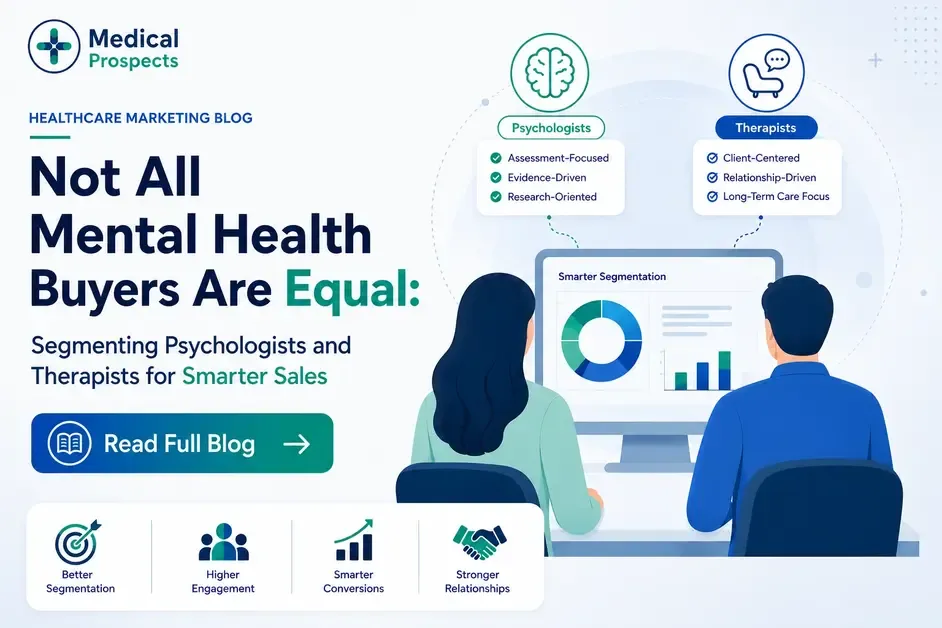
TL;DR Summary
Treat every psychologist, therapist, and counselor as one interchangeable buyer, and the numbers will punish you for it. A solo psychologist deciding a single phone call is not the same as a clinical director weighing a vendor against three other stakeholders within a forty-provider group practice. The two don't just have different budgets. They move at different speeds, answer to different people, and respond to completely different messaging. Segmenting by license type, practice size, and specialty isn't an extra step before the real work of outreach starts. It is the real work. Skip it, and your list becomes a mass mailing dressed up as targeted sales. Get it right with this meticulous article by Medical Prospects and the response rate stops being a mystery.
Sales teams often love a clean list, assuming that “mental health providers" is a neatly segmented category.
Not just that.
They also assume that this niche is easy to load into a CRM, easy to write one email template for. However, that’s the wrong approach.
Let’s decode the classic myth.
The mental health market is not small anymore in the United States. Additionally, it is not simple either.
The complexity comes from diversification. Different licenses, different specialties, and different ways of practicing.
For example: a psychologist with a doctorate, hospital privileges, and a solo diagnostic practice is not the same buyer as a licensed therapist employed inside a 40-provider behavioral health firm.
They do not have the same purchasing power, and most importantly, they do not answer to the same decision-makers.
This is exactly why mental health provider segmentation matters more than most sales teams realize.
Ultimately, if you are thinking of pitching the same deck to both of them, it is quite obvious that you won’t get a response.
Know your Buyer: Meet the mental health workforce, and what each role means for sales
According to the US Bureau of Labor Statistics (BLS) 2026, approximately 400,000 substance abuse, behavioral disorder, and mental health counselors in the United States are separate from psychologists, social workers, and marriage/family therapists.
The report also claims that each one of them is tracked as a “distinct occupational category”.
Here is the categorization of mental health professionals by role and responsibilities.
Psychologists
The American Psychological Association (APA) states that psychologists’ education involves extensive training in research-focused branches, personality and developmental psychology.
According to the most recently published BLS data, psychologists held about 204,300 jobs.
This figure spans across clinical, counseling, school, and industrial-organizational psychologists, a doctoral-level workforce that often holds hospital privileges, runs independent practices, and makes purchasing decisions with little to no oversight.
Psychologists are often considered the fastest-moving buyer in the mental health market.
Marriage and family therapists
Therapists usually receive training in “therapeutic techniques and theoretical models” rather than academic research. Their education cycle is often shorter and more practice-based.
Marriage and family therapists held about 77,800 jobs, as reported in the United States’ recent employment release. This occupation is expected to increase 13% by 2034, much faster than average.
Most work in offices of other health practitioners, individual and family services, or as self-employed mental health professionals.
For a sales pitch, this means a valuable share of this group is also involved in independent buying decisions.
Substance abuse, behavioral disorder, and mental health counselors
This is where the mental health workforce gets harder to segregate and more diverse than a spreadsheet suggests.
BLS groups, under the categorization of substance abuse counselors, addiction counselors, behavioral disorder counselors, and mental health counselors, are recognized as a single occupational category.
This group reportedly held about 483,500 jobs.
That's the largest segment of the mental health workforce by far, and also the least uniform: it moves across bachelor's-level substance abuse counselors working in correctional facilities and master's-level licensed mental health counselors in private practice.
For the sales department, this means anyone trading into this space is really pitching scores of buyer types under just one label.
These are three completely different sets of purchasing authority, work settings, and sales cycles. And that is before segmenting by practice size or specialty, which is where the real targeting work begins.
Solo practice vs. group practice: Two completely different sales cycles
Practice size changes the buying process as much as license type does.
A solo psychologist can say yes to a new vendor in just a single call.
There's no buying committee to enter the complex process, no serpentine budget cycles to climb, just one person deciding whether the tool, service, or list is worth the cost.
This can be classified as a short sales cycle where only a psychologist can make a decision.
However, it will vary depending on whether a group practice enters the buying space.
A 20- or 40-provider behavioral health group has a practice manager fielding first contact and a clinical director weighing in on patient care.
Sometimes a finance or operations lead also signs off on the purchase.
A solo practitioner might need one conversation.
However, a group practice may need three or four. In such circumstances, your sales pitch has to change too, from “here's why this helps you” to “here's why this helps your team, and here's the expected ROI”.
In a nutshell, selling to a solo psychologist and a forty-provider group practice (both) with the same script is not just a wasted effort. It is the fastest way to lose the deal that should've been easy to close.
┃ Takeaway: A mental health professional database is only as useful as the segmentation behind it. ┃
Skip specialty, pay the price. Here's how to read it right
Specialty is the layer sales teams skip most, and it shows fast.
An addiction-focused psychologist has different documentation needs, compliance concerns, and daily pressure points than one running general counseling or family therapy.
A generic "streamline your practice" pitch reads as a vendor who's never worked with anyone like them.
The mismatch shows even when the terminology is close.
For example: A pitch built for family therapy workflows, sent to a solo trauma counselor, can use the right vocabulary and still miss because the underlying need doesn't apply.
Mental health buyers read outreach with the same close attention they bring to a case file, and they notice fast.
Reading specialty right means going one layer deeper than license type.
It is important to know whether the psychologist treats addiction, runs family sessions, or handles general counseling, as each has a different bottleneck a vendor could actually solve.
Putting it together: A segmented approach to mental health outreach
Mental health outreach is more effective when it recognizes that different audiences have different needs, experiences, and barriers to seeking support.
By segmenting audiences based on demographics, professional roles, geographic regions, or specific interests, organizations can create messaging that feels more relevant and timely.
It also helps in delivering the right information through the right channels. For an extremely fragmented healthcare segment like this, a go-to-market (GTM) strategy is the ideal way forward.
Some audiences may respond better to educational content, while others may be looking for information about available resources and support options.
Ultimately, a focused and segmented approach makes outreach more meaningful.
Relevant, respectful communication can improve awareness and help connect the right people with valuable mental health resources.
Final Thoughts
In essence, the mental health segment is not one buyer donning multiple job titles. It is several discrete buyers who happen to share the same industry label.
A psychologist and a therapist don't just hold different credentials and responsibilities; they think about problems differently too.
A Psychologist email list is very different from a Marriage and Family Therapist List, as each targets different mental health professionals with specialized roles and areas of expertise.
That difference shows up in how each one evaluates a vendor, not just how they treat a patient.
If you treat them the same, the response will reflect not just in your sales numbers but also in your ROI.
┃ Takeaway: Don’t sell louder, sell smarter. ┃
For smarter targeting, vendors can rely on MedicalProspects, a healthcare database provider that segments every contact by license type, practice size, and specialty. Explore how to build a healthcare ICP or why specialty-level targeting makes all the difference in outbound campaign performance.
Frequently Asked Questions
Q:
How do you segment mental health providers for B2B outreach?
Start with license type (psychologist, LPC, LCSW, LMFT), then layer in practice size (solo vs. group) and specialty. These three factors determine who holds purchasing authority, how long the sales cycle runs, and what messaging will actually land; treating the whole vertical as one list leads to weak response rates.
Q:
Who buys behavioral health software?
It depends on practice size. In a solo practice, the clinician themselves usually makes the call. In a group practice, a practice manager typically fields outreach first, with a clinical director or operations lead signing off on the final purchase.
Q:
What do buyer personas for behavioral health vendors actually look like?
At minimum, vendors need personas split by license type and practice setting; for example, "solo psychologist, independent decision-maker" versus "group practice clinical director, committee-based purchasing." A single generic "mental health provider" persona misses how differently these buyers actually operate.
Q:
What's the difference between a psychologist and a therapist for B2B marketing purposes?
Psychologists typically hold doctoral degrees, often work independently, and may make faster purchasing decisions. “Therapist” is a broader term covering LPCs, LMFTs, and LCSWs, professionals who may be more likely to work within larger practices with multi-step buying processes. For sales teams, this distinction matters more for targeting and segmentation than for clinical purposes, helping platforms like MedicalProspects deliver more relevant healthcare professional data for focused outreach.
Q:
Why does specialty matter when targeting mental health providers?
A provider's specialty (addiction, family therapy, general counseling) shapes what tools and services they actually need. Pitching the same product to every specialty without adjusting the message signals a vendor doesn't understand the buyer, and that's usually enough to lose the deal.
Related Insights


Strategy
Why Surgical Robotics Sales Start With Knowing Which Type of Hospital Can Actually Buy
Which hospitals can actually buy surgical robotics? See how hospital type, volume, and budget shape your target accounts.
Read article
Strategy
How to Identify the Right Physicians Before a Medical Device Launch: A 5-Step Process
Learn how medical device companies can identify the right physicians before launch: define the clinical need, map buyers, rank targets, and test early.
Read article