What is an EHR, and who buys EHR-related software?
Also called: EHR / EMR Integration Buyer, EMR, electronic medical record
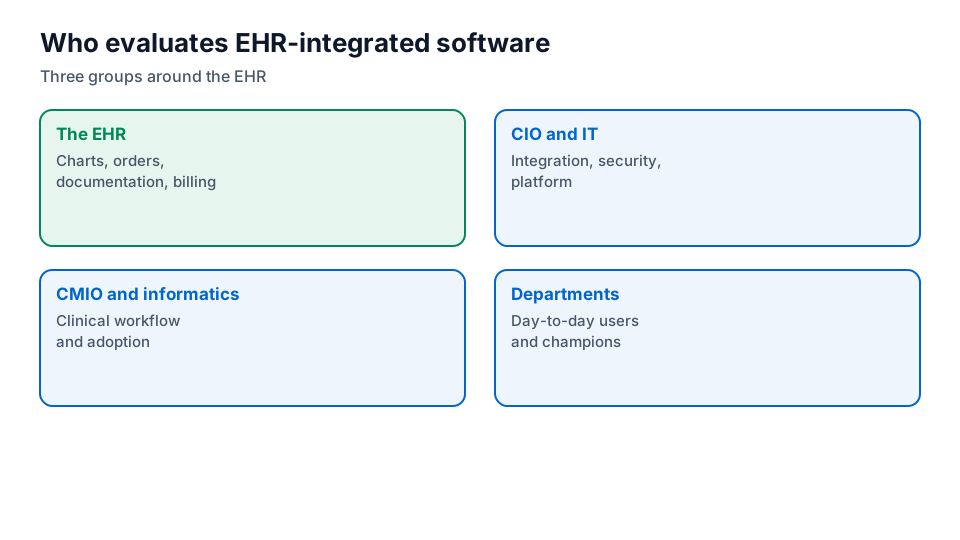
An electronic health record (EHR) is the digital system a hospital or practice uses for patient charts, orders, documentation and billing. Products that integrate with the EHR are usually evaluated by IT, clinical informatics and the departments that use them.
Why it matters for healthcare sales and marketing
The EHR sits at the center of hospital and practice operations. Many health IT products succeed or fail on how well they work with it, and knowing which EHR an account runs is one of the most useful pieces of technographic data.
How it works
- EHR vs EMR: the terms are often used interchangeably; EHR usually implies records shared across organizations, EMR a single practice's chart.
- Who owns it: the CIO and IT run the platform; the CMIO and clinical informatics shape clinical use.
- Who evaluates add-ons: IT for integration and security, informatics for workflow, and the department that will use the product.
- Integration: increasingly through standard FHIR APIs.
Example
Illustrative scenario. A documentation tool vendor targets hospitals running a specific EHR it integrates with, reaching CMIOs, clinical informatics specialists and department chairs, with a message about time saved inside the existing workflow.
Common mistakes
- Ignoring which EHR an account runs. It often decides fit.
- Selling only to IT. Clinical informatics and users shape adoption.
- Underestimating EHR change cycles. Replacing an EHR is rare and slow.
Related terms
Put it to work
- EHR users list: contacts across EHR platforms
- Epic EHR users list: contacts at Epic organizations
- EHR migrations use case: selling around platform changes