Who is in a hospital C-suite?
Also called: C-Suite Healthcare Buyer, hospital executives, health system executives
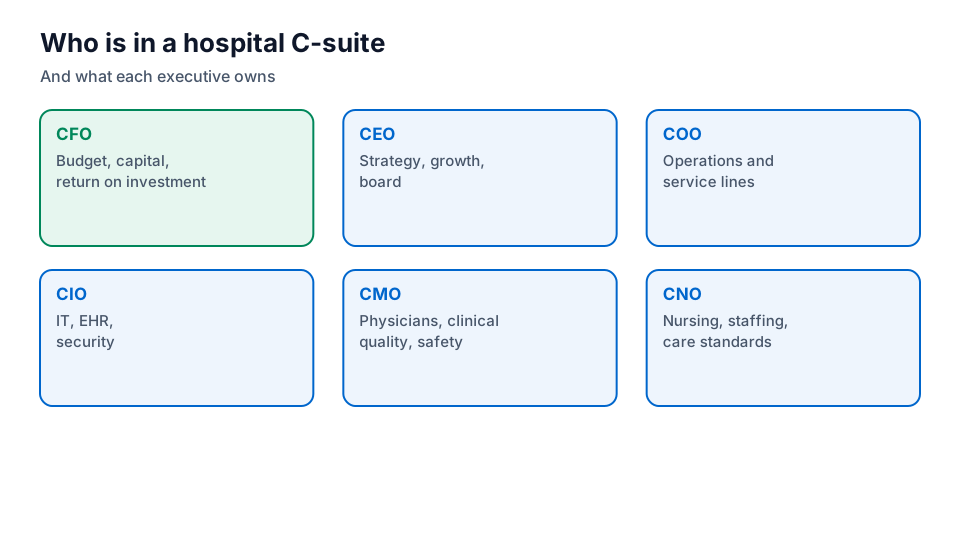
The hospital C-suite is the senior executive team of a hospital or health system, typically the CEO, CFO, COO, CIO, chief medical officer (CMO) and chief nursing officer (CNO), who approve major budgets and strategy.
Why it matters for healthcare sales and marketing
Large purchases, such as enterprise software, major equipment and system-wide services, need C-suite approval. Each executive weighs a deal through their own lens, so knowing who owns what helps vendors bring the right business case to the right person.
How it works
| Role | Owns |
|---|---|
| CEO | Strategy, growth, board relationships |
| CFO | Budget, capital, revenue cycle, return on investment |
| COO | Operations, efficiency, service lines |
| CIO | IT, EHR, infrastructure, security |
| CMO | Physicians, clinical quality, patient safety |
| CNO | Nursing, staffing, patient care standards |
Larger systems add roles such as a chief medical information officer (CMIO), chief digital officer or chief strategy officer.
Example
Illustrative scenario. A company selling a patient flow platform builds a separate message for each executive: capacity and length-of-stay for the COO, integration and security for the CIO, cost per case for the CFO, and nurse workload for the CNO. Marketing targets all six roles at each target health system.
Common mistakes
- Pitching only the CEO. Other executives often own the budget and the decision.
- One message for everyone. Each role needs its own business case.
- Confusing CMO roles. In hospitals, CMO usually means chief medical officer, not chief marketing officer.
Related terms
Put it to work
- Hospital C-suite lists: CEOs, CFOs, CIOs, CMOs and other executives
- Hospital CFOs list: financial decision makers
- Mapping the hospital buying committee (ebook): who to reach, and in what order