What is FHIR?
Also called: HL7 FHIR, FHIR Interoperability Standard, FHIR API
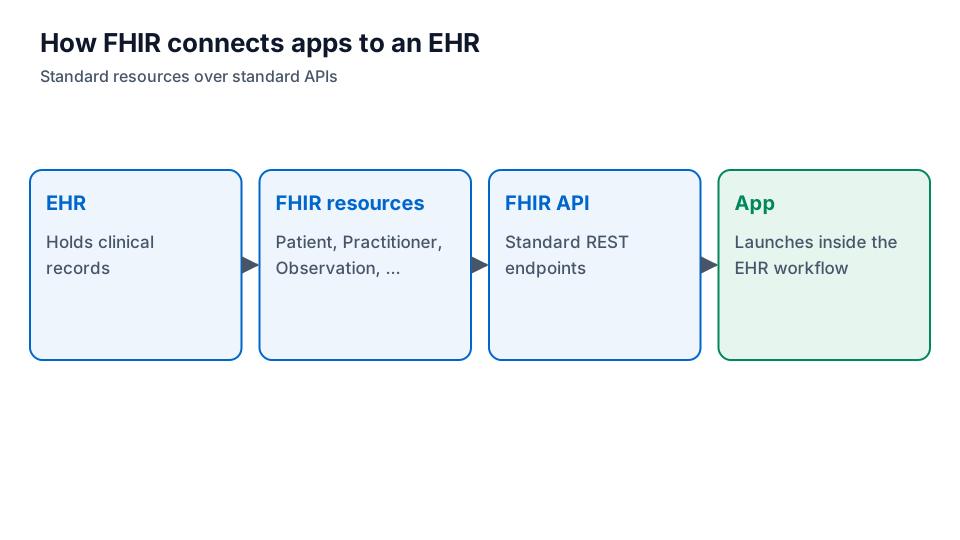
FHIR (Fast Healthcare Interoperability Resources) is the HL7 standard for exchanging healthcare data through web APIs. It defines common building blocks, called resources, such as Patient, Practitioner and Observation, so different systems can share data.
Why it matters for healthcare sales and marketing
For health IT companies, FHIR support often decides whether a product can plug into a hospital's EHR without a long custom integration. U.S. regulations require certified health IT to support standardized FHIR APIs, which has made FHIR the default way new apps connect to clinical systems. Buyers in IT and informatics ask about it early.
How it works
- Resources: standard data objects, such as Patient, Practitioner, Encounter and Observation.
- APIs: resources are read and written over standard web (REST) APIs.
- Apps: the SMART on FHIR framework lets apps launch inside EHRs with secure authorization.
- U.S. rules: federal health IT certification includes standardized FHIR API requirements.
Example
Illustrative scenario. A clinical decision support start-up builds on SMART on FHIR so its app can launch inside several major EHRs. Its sales team targets CMIOs and clinical informatics leaders at hospitals running those EHRs, leading with "works inside your EHR" rather than a custom integration project.
Common mistakes
- Assuming FHIR means instant integration. Hospitals still review security, workflow and data scope.
- Pitching only to IT. Clinical informatics and end users shape adoption.
- Confusing FHIR with a product. It is a standard; each EHR implements it in its own way.
Related terms
Put it to work
- Clinical informatics specialists list: the people who evaluate integrations
- HealthTech and EHR migrations use case: selling into EHR environments
- Epic EHR users list: contacts at Epic organizations
Sources
- FHIR overview, HL7 International
- Health IT certification program, ASTP/ONC