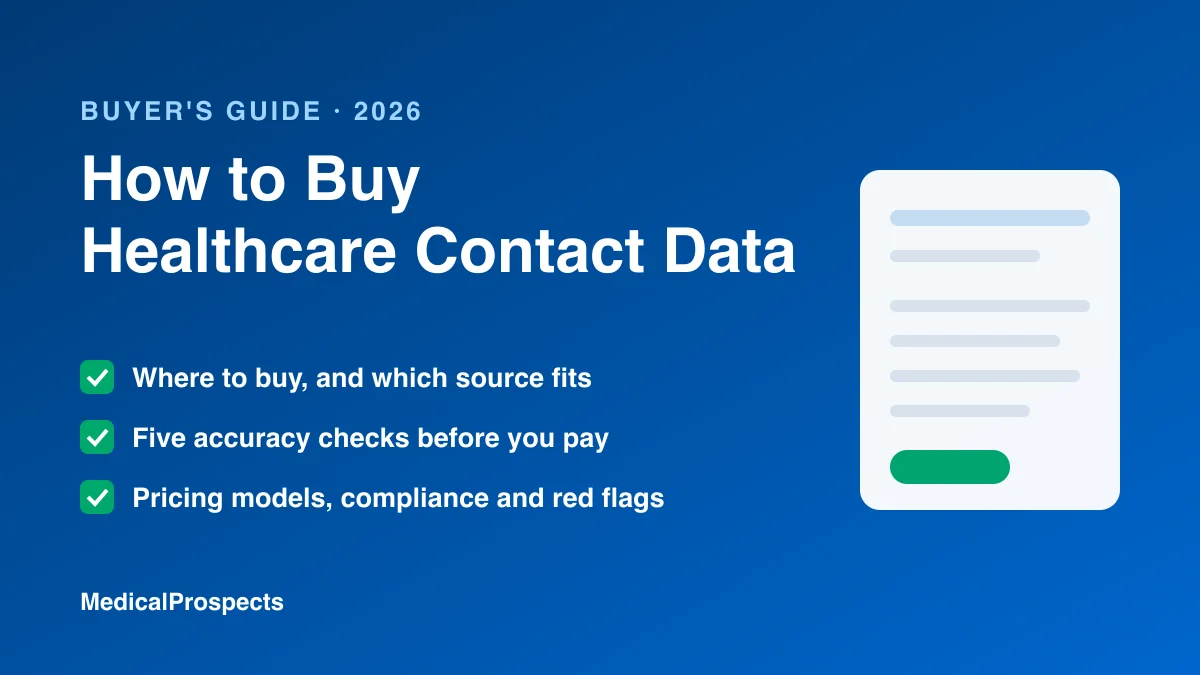
How to Buy Healthcare Contact Data: A Buyer's Guide for 2026

VP of Marketing, MedicalProspects
November 4, 2026
TLDR
You can buy healthcare contact data from specialist healthcare data providers, general B2B sales intelligence platforms or list brokers, or start from free public registries such as NPPES, which have no emails. Decide first whether you need a ready-made list, enrichment of records you already hold, or a custom audience build. Before you pay, check five things: NPI matching, the refresh date, how emails are verified, the bounce guarantee and a free sample you test yourself. In the U.S., emailing healthcare professionals is governed by CAN-SPAM, not HIPAA.
Most healthcare sales and marketing teams buy contact data at some point: to launch a product, open a territory, fill a pipeline gap, or fix a CRM that has drifted out of date. The decision looks simple and rarely is. Lists that look identical on a pricing page can differ enormously in how current they are, how they were verified, and whether they reach the people who actually make decisions.
This guide answers the questions buyers ask most: where to buy, which kind of data you need, how to check accuracy before paying, what drives price, whether it's legal, whether free lists are worth it, and when it's time to change providers.
1. Where can you buy healthcare contact data?
There are four main places to get it, and each fits a different need.
| Source | Best for | Watch out for |
|---|---|---|
| Specialist healthcare data providers | Clinician and facility audiences defined by specialty, taxonomy code, care setting and organization | Large differences in refresh frequency and verification between providers |
| General B2B sales intelligence platforms | Corporate roles at healthcare companies, combined with your wider B2B prospecting | Thinner coverage of clinicians, few NPI or taxonomy fields, specialty inferred from job titles |
| List brokers | Access to many list owners through one contact, including postal lists | Data quality depends on the underlying list owner. Ask who that is. |
| Free public registries (such as NPPES) | Confirming who is a provider, their specialty and practice location | No marketing email addresses, job titles or buying roles |
If your audience is clinicians or healthcare facilities, a specialist healthcare provider will usually give you better coverage and precision. If you mainly sell to corporate roles inside healthcare companies, a general platform may be enough, and many teams use both.
2. List, enrichment or custom build: which do you need?
- A ready-made list fits when your audience matches a standard segment, such as cardiologists or ambulatory surgery centers, and you need to move quickly.
- Enrichment fits when you already have records, for example from events or your CRM, but they are missing specialty, NPI, email or phone, or may be out of date.
- A custom audience build fits when your target is a combination: interventional cardiologists at hospitals with a cath lab in six states, say, or revenue cycle leaders at health systems running a particular EHR.
Start from your ideal customer profile, not from the list catalog. Write down the specialties (ideally as taxonomy codes), roles, care settings, geography and any technology criteria, then ask providers for a count against that definition.
3. How do you check a healthcare list's accuracy before you pay?
Ask every provider the same five questions, and test the answers with a sample.
- Is each U.S. clinician matched to an active NPI? NPI matching confirms the person is a real, currently enumerated provider and anchors their specialty.
- When was the data last refreshed, and how often is it refreshed? Healthcare contacts change constantly as clinicians move, retire and change roles. A monthly refresh is a reasonable standard to ask for.
- How are emails verified, and when? Ask whether emails are checked before each delivery, not just when they were first collected.
- What happens if emails bounce? A clear deliverability guarantee, with replacement of hard bounces, shows the provider stands behind its data.
- Can I test a free sample? Ask for a sample matched to your own filters, then check it yourself: look up a few NPIs in the public registry, confirm titles on organization websites, and send a small test.
Also check field completeness. A list of 50,000 records where only half have a verified email reaches fewer people than a smaller list where every record does.
4. What does healthcare contact data cost?
Pricing models vary, and the same audience can be priced very differently depending on how it's licensed. The main models are:
- Per-record or per-list pricing, common for one-time list purchases.
- Subscriptions or platform licenses, common with sales intelligence tools, usually priced per user or by credits.
- Custom project pricing, for enrichment jobs and custom audience builds.
Within any model, price is driven by audience size, how niche the audience is, which fields you need (direct phones and technology data usually cost more), how long you may use the data, and whether updates are included. The most reliable way to compare is to send every provider the same audience definition and ask for a count and a written quote.
5. Email list or mailing list: which do you need?
It depends on the channel. Email lists need verified business email addresses and are the main choice for demand generation and nurture. Mailing lists for direct mail need clean, current practice or facility addresses, and work well for high-value accounts, product samples and event invitations. Phone outreach needs direct dials. Most campaigns that reach clinicians or hospital buyers combine channels, so ask for every field you'll use in one file rather than buying separate lists that don't match.
6. Is it legal to buy and email healthcare contact data?
In the U.S., yes, when you follow the rules. Commercial email, including B2B email, is governed by the CAN-SPAM Act, which doesn't require prior consent but does require honest sender information and subject lines, a physical postal address, a clear opt-out, and honoring opt-outs within 10 business days. HIPAA protects patient health information, not clinicians' professional contact details, so it doesn't govern B2B email to healthcare professionals.
Outside the U.S. the rules are stricter. Canada's CASL generally requires consent, the UK applies GDPR and PECR, and some EU countries restrict unsolicited B2B email further. Separately, mailbox providers have their own requirements: Google, for example, requires bulk senders to authenticate their email, offer one-click unsubscribe and keep spam complaint rates low. This is general information, not legal advice, so check with your counsel for your situation.
7. Are free healthcare email lists worth it?
Usually not for email. Free provider data from public registries such as NPPES is genuinely useful for confirming identity, specialty and location, but it contains no marketing email addresses. Free or cheap downloadable email lists, often sold as spreadsheets or PDFs, tend to be old, scraped and unverified. Sending to them risks high bounce rates and spam traps, which can damage your sending domain's reputation for every future campaign. If you want to test a provider without paying, ask for a free sample matched to your filters instead.
8. Red flags when choosing a healthcare data vendor
- No free sample, or a sample that isn't matched to your filters.
- No stated refresh date or verification method.
- Counts that are hard to believe for the audience, with no explanation of what's included or how overlapping lists are counted.
- Promises of "100% accuracy" or "100% opt-in" B2B lists, with no explanation of how that's achieved.
- No physical address, named team or way to reach a person.
- Look-alike domains or names. Confirm you're dealing with the company you think you are; see how to spot impersonation.
9. When is it time to replace your data provider?
Look for patterns rather than one bad send:
- Bounce rates creeping up from campaign to campaign.
- Reps reporting wrong titles, departed contacts or the wrong specialty.
- Gaps in the specialties, care settings or roles you need, with no way to fill them.
- No NPI or taxonomy fields, so you can't match the data to your CRM reliably.
- No way to enrich or refresh the records you already have.
If several of these apply, run a side-by-side test: give two providers the same audience definition, compare counts, sample accuracy and field completeness, and send a small, identical campaign to each.
Final Thoughts
Buying healthcare contact data well comes down to three habits: define the audience precisely before you shop, verify what you're buying with a sample you test yourself, and keep the data fresh after you buy it. The provider that wins your business should be the one whose data still holds up after that scrutiny.
To see how MedicalProspects data compares, send us your audience definition and request a free count and 20 sample records, or browse our FAQ for answers on sourcing, refresh, pricing and delivery.
Build a High-Precision Healthcare Target List
Reach verified healthcare decision-makers, buying groups, and clinical specialists segmented by specialty, organization type, technology, and geography.
Talk to Our Experts Today →Frequently Asked Questions (FAQs)
Q:
Where is the best place to buy healthcare contact data?
For clinicians and healthcare facilities, a specialist healthcare data provider usually gives the best coverage, because its data is organized by specialty, taxonomy code and care setting. General B2B platforms work better for corporate roles at healthcare companies. Whichever you choose, compare providers on NPI matching, refresh frequency, email verification and a free sample you test yourself.
Q:
How can I tell if a healthcare email list is accurate?
Ask whether U.S. clinicians are matched to an active NPI, when the data was last refreshed, how and when emails are verified, and what happens if emails bounce. Then test a free sample matched to your filters: look up a few NPIs in the public NPPES registry, confirm titles on organization websites, and send a small test campaign.
Q:
Is it legal to buy a physician email list and email doctors?
In the U.S., B2B email to physicians is governed by the CAN-SPAM Act, which allows email without prior consent as long as you use honest sender details and subject lines, include a physical address and a clear opt-out, and honor opt-outs within 10 business days. HIPAA covers patient information, not doctors' professional contact details. Rules are stricter in Canada, the UK and the EU. This is general information, not legal advice.
Q:
Can I get healthcare email lists for free?
Public registries such as NPPES are free and useful for confirming identity, specialty and location, but they don't include marketing email addresses. Free downloadable email lists are usually outdated and unverified, and sending to them can damage your sender reputation. A free sample from a provider is a safer way to test before you buy.
Q:
Should I buy a list or enrich my existing CRM data?
Buy a ready-made list when your audience matches a standard segment and you need to move quickly. Choose enrichment when you already hold records that are missing specialty, NPI, email or phone. Choose a custom build when your audience combines several criteria, such as specialty, care setting, geography and technology.
John Britton
VP of Marketing, MedicalProspects
John works with healthcare sales and marketing teams on precision targeting, campaign strategy, and audience intelligence solutions at MedicalProspects.
Related Insights