What is a National Provider Identifier (NPI)?
Also called: NPI, NPI number
A National Provider Identifier (NPI) is a unique, permanent 10-digit number that identifies a U.S. healthcare provider or healthcare organization. CMS issues it through NPPES, and it identifies who the provider is, not their specialty or contact details.
Why it matters for healthcare sales and marketing
The NPI is the closest thing U.S. healthcare has to a universal ID for clinicians and provider organizations. For sales and marketing teams it does three jobs:
- It proves a record is a real provider. An active NPI means the person or organization exists in the federal registry. A list that is "NPI-matched" has been checked against that registry instead of being scraped or guessed.
- It joins data together. Names repeat and emails change, but an NPI doesn't. It is the most reliable key for de-duplicating a CRM, matching a purchased list to your existing contacts, or connecting a clinician to their specialty and practice location.
- It flags change. When a provider retires or an NPI is deactivated, the registry shows it, which is an early signal that a contact should come off your list.
How it works
CMS assigns NPIs through the National Plan and Provider Enumeration System (NPPES). HIPAA requires healthcare providers who conduct standard electronic transactions, such as billing a health plan, to get one, and other providers can apply too.
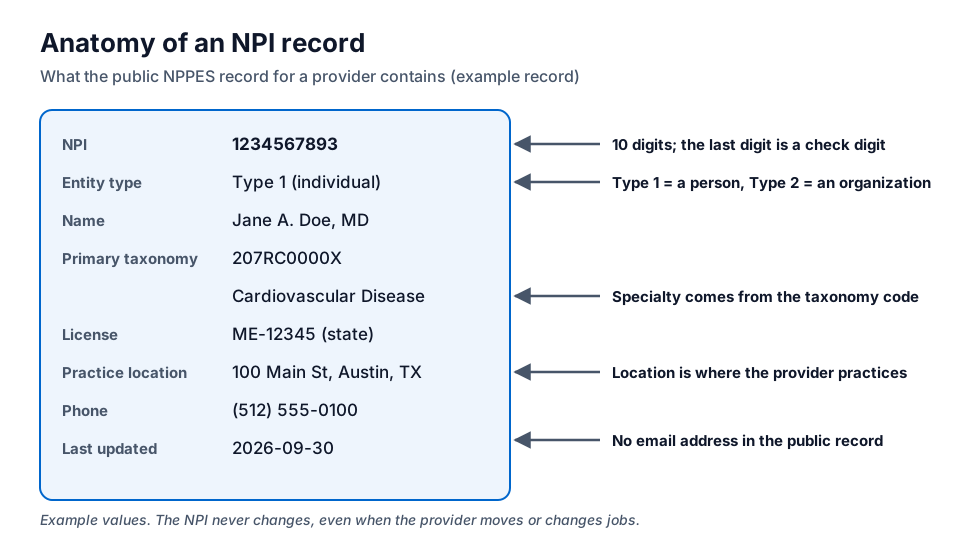
- Two types. Type 1 NPIs belong to individuals: physicians, nurse practitioners, dentists, pharmacists and other clinicians. Type 2 NPIs belong to organizations: hospitals, group practices, pharmacies and labs. A large organization can hold several Type 2 NPIs for its subparts.
- The number carries no meaning. It is 10 digits, and the last digit is a check digit that catches typos. Nothing in the number encodes specialty, state or employer.
- It is permanent. A provider keeps the same NPI when they move, change jobs or change specialty.
- The record carries the detail. Each NPI record lists the provider's name, entity type, one or more taxonomy codes (which describe specialty), license numbers, practice location, mailing address and phone. Providers are required to report changes within 30 days, but the data is self-reported, so some records lag reality.
Anyone can look up a record in the public NPI Registry, query it through the registry API, or download the full file that CMS publishes every month.
Example
Illustrative scenario. A cardiac device company has several thousand contacts in its CRM tagged "cardiology", gathered from trade shows and old purchased lists. Marketing Ops matches every record that has an NPI against the registry. The match shows that some contacts are nurse practitioners, not physicians, that some NPIs have been deactivated, and that the taxonomy codes split the physicians into general cardiologists and interventional cardiologists. The team removes the inactive records, routes nurse practitioners to a separate nurture track, and builds its launch audience around the interventional cardiology taxonomy code.
Common mistakes
- Assuming the NPI tells you the specialty. It doesn't. Specialty comes from the NUCC taxonomy code on the NPI record.
- Expecting an email address. The public NPI record has no marketing email address. Contact details for outreach come from other, verified sources.
- Treating "has an NPI" as "is active". NPIs can be deactivated. Check the status and the last-updated date before you rely on a record.
- Assuming one NPI per organization. Health systems often hold many Type 2 NPIs, one per hospital, clinic or department that bills separately.
How MedicalProspects does it
Every U.S. clinical record on MedicalProspects lists is matched to an active NPI and its primary NUCC taxonomy code, and the match is checked again at each monthly refresh. Records whose NPI is deactivated are removed.
Related terms
Put it to work
- Free NPI lookup tool: look up any provider's NPI record
- Physician email list: physician contacts matched to an active NPI
- Data quality methodology: how NPI matching fits into our verification