Does HIPAA apply to B2B healthcare outreach?
Also called: HIPAA Compliance in B2B Outreach, HIPAA for marketers
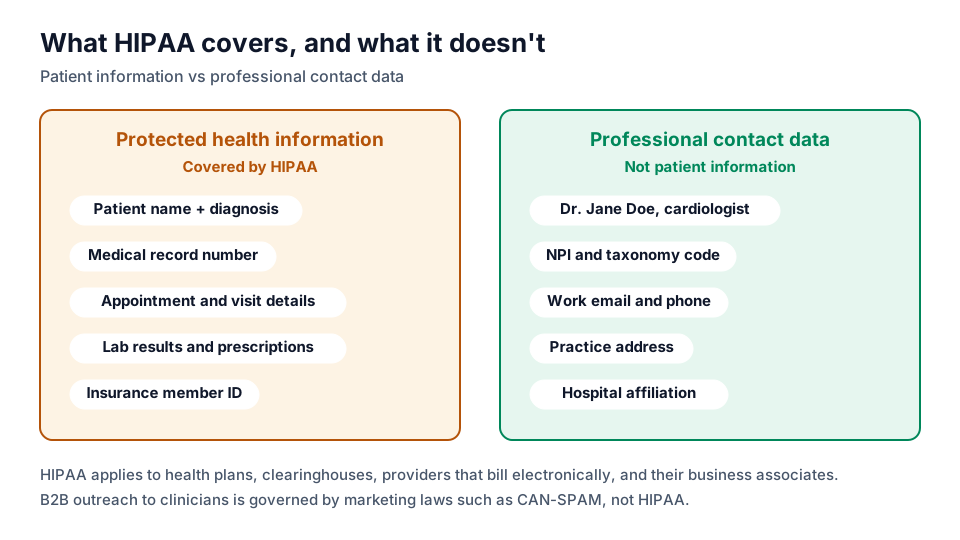
HIPAA protects patients' health information held by health plans, healthcare clearinghouses, most healthcare providers and their business associates. A clinician's professional contact details are not patient health information, so B2B email to healthcare professionals is governed by marketing laws such as CAN-SPAM rather than by HIPAA.
Why it matters for healthcare sales and marketing
"Is this HIPAA compliant?" is one of the first questions healthcare marketers ask about contact data. The answer depends on what kind of information is involved:
- Professional contact data, such as a cardiologist's name, NPI, work email and practice address, describes a professional in their business role. It isn't patient information.
- Patient information, such as a person's diagnosis, appointments or medical record number, is protected health information (PHI) when a covered entity or business associate holds it.
Knowing the difference keeps teams from over-restricting legitimate B2B outreach, and from under-protecting patient data when a project does touch it.
How it works
- Who HIPAA applies to. Covered entities (health plans, healthcare clearinghouses and providers that conduct standard electronic transactions) and their business associates, meaning vendors that handle PHI on their behalf.
- What it protects. Individually identifiable health information about patients that those entities create, receive, maintain or transmit.
- Marketing under HIPAA. HIPAA's marketing rules restrict how covered entities use patients' PHI to market to those patients. They don't govern a vendor emailing clinicians about a product.
- When a vendor is pulled in. If your product or service will handle a customer's PHI, for example a software pilot that touches patient records, you'll likely need a business associate agreement and HIPAA safeguards for that work.
Example
Illustrative scenario. A health IT company emails chief medical information officers about its clinical documentation tool. Those emails are B2B marketing, governed by CAN-SPAM, and use professional contact data, not PHI. When a hospital agrees to a pilot that will process real patient notes, the situation changes: the company signs a business associate agreement and applies HIPAA safeguards to the pilot data. The marketing list itself never contains patient information.
Common mistakes
- Assuming anything in healthcare is HIPAA data. HIPAA protects patient information held by covered entities and business associates, not clinicians' business contact details.
- Asking for a BAA to buy HCP contact data. A business associate agreement is for vendors handling PHI, not for buying professional contact lists.
- Thinking "not HIPAA" means "no rules". CAN-SPAM, state privacy laws and, outside the U.S., GDPR and CASL still apply.
- Mixing patient data into marketing systems. If a project involves PHI, keep it out of your marketing tools and follow HIPAA.
How MedicalProspects does it
MedicalProspects sells business contact data about healthcare professionals and organizations only. It contains no patient information or PHI.
Related terms
Put it to work
- Security and compliance: how our data is sourced and handled
- Compliance questions in our FAQ: short answers on HIPAA and email rules
- Compliant healthcare outreach handbook (ebook): a full guide to compliant campaigns
Sources
- Covered Entities and Business Associates, U.S. Department of Health and Human Services
- Summary of the HIPAA Privacy Rule, U.S. Department of Health and Human Services
- Marketing (HIPAA Privacy Rule guidance), U.S. Department of Health and Human Services