What is a NUCC taxonomy code?
Also called: Healthcare Provider Taxonomy Code, provider taxonomy code, taxonomy code, Clinical Taxonomy Code
A NUCC taxonomy code is a 10-character code from the Health Care Provider Taxonomy code set that describes what kind of provider someone is and their area of specialization, for example 207RC0000X for Cardiovascular Disease.
Why it matters for healthcare sales and marketing
An NPI tells you who a provider is. The taxonomy code tells you what they do. For anyone selling to clinicians, that is the difference between "all physicians" and "the interventional cardiologists who will actually use our device".
- Precise audiences. Taxonomy codes separate closely related specialties, such as general cardiology from interventional cardiology, or general internal medicine from gastroenterology.
- A shared definition of scope. When marketing, sales and a data provider agree on the taxonomy codes for a campaign, everyone means the same thing by "our target specialists".
- Cleaner reporting. Coding contacts by taxonomy lets you report pipeline and response by specialty instead of by inconsistent free-text titles.
How it works
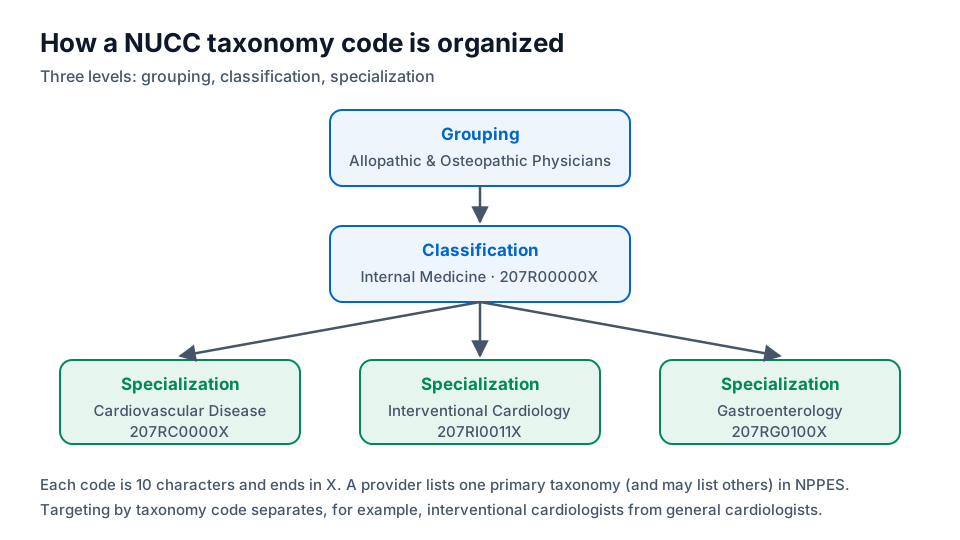
The National Uniform Claim Committee (NUCC) maintains the Health Care Provider Taxonomy code set and publishes updates twice a year, adding new codes and retiring old ones. The set is organized in three levels:
- Grouping, a broad provider type such as Allopathic & Osteopathic Physicians.
- Classification, a field within it such as Internal Medicine (207R00000X).
- Specialization, a narrower area such as Cardiovascular Disease (207RC0000X) or Gastroenterology (207RG0100X).
Each code is 10 characters long and ends in X. When providers register in NPPES they choose a primary taxonomy and can list others. The selection is made by the provider: it describes how they practice, and it is not proof of board certification.
Example
Illustrative scenario. A company launching a new coronary device wants physicians who perform catheter-based procedures. Targeting the Internal Medicine classification code would pull in hundreds of thousands of internists who will never use the product. Targeting Cardiovascular Disease (207RC0000X) is closer, but it still includes general cardiologists who don't work in the cath lab. The team builds its core audience on Interventional Cardiology (207RI0011X), then adds general cardiologists with hospital cath lab affiliations as a secondary audience.
Common mistakes
- Treating taxonomy as board certification. Providers choose their own taxonomy. To confirm certification, check the certifying board or a verified data source.
- Using only the primary taxonomy. Some subspecialists list their subspecialty as a secondary code. Checking every taxonomy on the record finds them.
- Targeting the classification code alone. A record coded at the specialization level (207RC0000X) won't match a filter for the classification code (207R00000X) unless your filter includes both.
- Using an old code list. NUCC updates the code set twice a year, so a list of codes from a few years ago can miss newer specialties.
How MedicalProspects does it
MedicalProspects lists define their scope by taxonomy code. Each list page shows the codes it includes, and U.S. records are matched to those codes through the provider's NPI record at every monthly refresh.
Related terms
Put it to work
- Interventional cardiologists list: scoped by the Interventional Cardiology taxonomy code
- Cardiologists list: scoped by Cardiovascular Disease and its subspecialty codes
- Physicians and internal medicine lists: every internal medicine specialty, each with its codes
Sources
- Health Care Provider Taxonomy code set, National Uniform Claim Committee
- Taxonomy code lookup, National Uniform Claim Committee
- NPPES NPI Registry, CMS