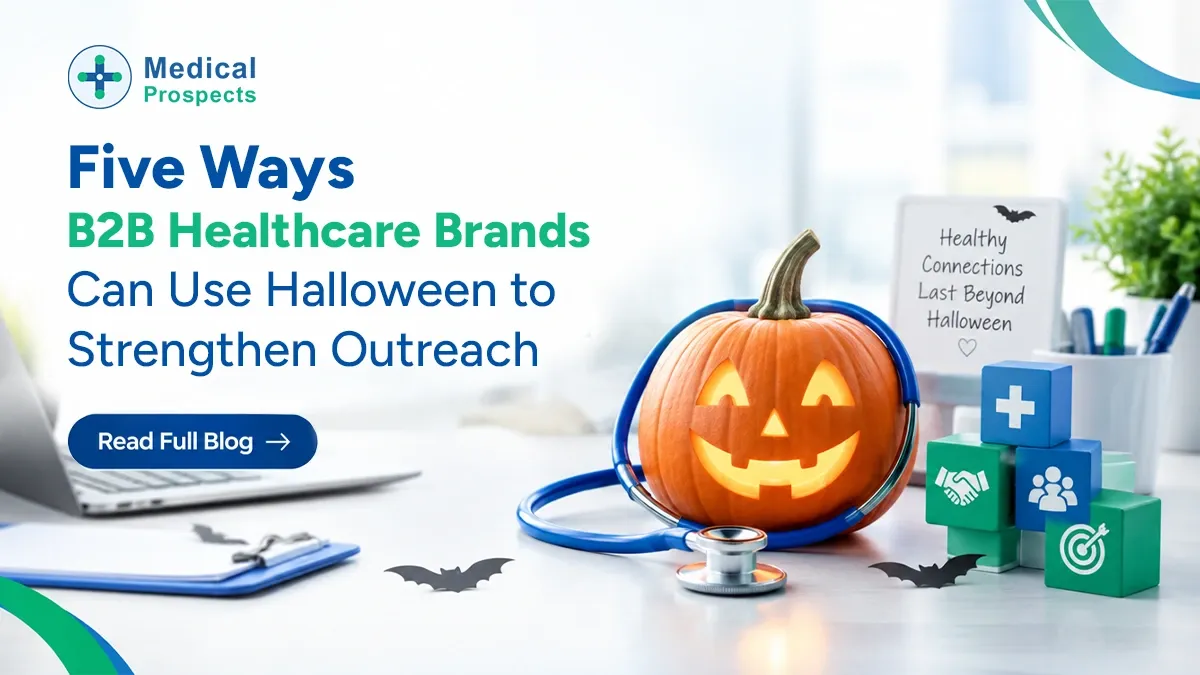
Five Ways B2B Healthcare Brands Can Use Halloween to Strengthen Outreach

VP of Marketing, MedicalProspects
October 29, 2026
TLDR
Halloween is a timely but underused opportunity for B2B healthcare outreach. A $13.5 billion consumer market shows how early planning, segmentation, and clear value shape seasonal engagement, and the same principles apply to email marketing. This listicle article covers five practical ideas, from refreshing contact data and testing subject lines to timing campaigns by specialty and offering a sample list or buying committee guide. Each is chosen for results, not novelty.
Halloween traces its roots to Samhain, an ancient Celtic festival that marked the end of the harvest and the start of winter. Today it is one of the most recognized dates on the calendar, yet B2B healthcare marketers and companies rarely build outreach around it. Many assume the topic is too light for an industry defined by clinical rigor and regulatory care, but that caution overlooks a practical point that can strengthen their outreach.
Such seasonal moments give U.S. marketers a natural reason to start a conversation with buyers and industry professionals. A well-timed message that speaks to the recipient’s role is more likely to be remembered, and healthcare decision-makers are no exception.
This article outlines five ways B2B healthcare brands can use the Halloween season to strengthen outreach, from refreshing contact data to timing campaigns by specialty. It’s not about spooky visuals or gimmicks. Each idea stays professional and focuses on measurable value.
1. Halloween Economy Shapes Seasonal Outreach for B2B Healthcare Brands
Halloween is a consumer market, but its scale shows how strongly one season can shape planning. The National Retail Federation expects U.S. consumers to spend $13.5 billion on the holiday this year, and about half of surveyed consumers plan to begin shopping in September or earlier.
Seasonal attention builds well before the date itself, which matters for B2B healthcare email marketing, where buyers are professionals with their own planning cycles.
Three themes from this market carry over and run through the five ideas that follow:
- Timing: Early, staged outreach builds attention more reliably than a single late send.
- Segmentation: Spending divides across distinct categories, each with its own audience. In healthcare, specialty, role, and facility type serve the same purpose.
- Value: Consumers weigh affordability, and healthcare buyers weigh what each message offers them, so a practical resource earns more engagement than a seasonal theme alone.
Each depends on accurate, well-segmented contact data.
2. Refresh Contact Data Before Seasonal Campaigns Begin
Every seasonal campaign is only as strong as the list behind it. Healthcare contact data changes constantly as clinicians move between practices, administrators change roles, and organizations consolidate.
A message sent to an outdated record reaches no one, and repeated bounces can damage sender reputation over time.
Treat the weeks before a seasonal send as an audit window. Remove bounced addresses, confirm job titles and affiliations, and flag records that have gone unverified for a long period. Clean data improves deliverability and ensures the right person at the right facility receives the message.
How does it Work During the Season of Halloween?
| Factor | How It Works During Halloween |
|---|---|
| The season has a short window | A seasonal send has a natural end date, so a message that bounces or lands with the wrong person cannot simply be resent later. Cleaning the list beforehand protects that window. |
| Deliverability protects the whole campaign | Repeated bounces can hurt sender reputation, which affects whether later messages reach the inbox. Since a staged campaign has more than one send, a poor first send can weaken the second. |
| Accurate records make the other ideas possible | Segmentation by specialty and role, subject line tests, and follow-up waves all assume the title, facility, and specialty fields are right. Test results are also only meaningful if the list is accurate. |
| It strongly improves relevance | A message that names the right role and speaks to that person's responsibilities is more likely to be remembered, which is the point made in the introduction. |
3. Test Seasonal Subject Lines Against a Plain, Professional Control
A light seasonal phrase can lift attention in a crowded inbox, but healthcare audiences respond to clarity and credibility first.
The safest approach is to test rather than assume. Run a simple A/B split in which one subject line carries a restrained seasonal reference, and the other states the value plainly.
Keep the wording professional, avoid imagery tied to illness or injury, and let the results show which tone your audience prefers. Over time, the data will indicate whether seasonal language earns its place in your outreach.
For instance, consider a campaign promoting a checklist on contact data quality:
- Version A (seasonal): Before Halloween: A quick checklist for cleaner healthcare contact data.
- Version B (plain control): A quick checklist for cleaner healthcare contact data.
Send both versions to randomly split halves of the same segment, at the same time of day, with the same email body.
Because the only difference is the seasonal phrase, any gap in open rate or click rate can be traced to that phrase and not to the offer, the audience, or the timing.
4. Time Outreach to Each Specialty’s Operating Calendar
Healthcare providers do not share a single calendar. Dental practices, pediatric clinics, urgent care centers, and eye care practices each experience busier and quieter periods, and their planning and budget cycles differ as well.
Segment campaigns by specialty and send when decision-makers are most likely to be considering new vendors or planning ahead.
Halloween offers a visible reminder to review this timing across your target segments, and the same discipline applies to every other seasonal moment in the year.
For example, let's consider a company that is selling scheduling software to dental practices as well as urgent care centers. It has planned one seasonal campaign for each audience.
- Dental practice administrators: Send an educational email in early October on managing appointment demand, followed by a seasoned message in the final week of the month offering a short planning checklist.
- Urgent care directors: Send a different message, focused on staffing and patient flow during busier periods, timed to when your own engagement data shows this audience opens and clicks most often.
5. Make Complex Healthcare Topics More Approachable with a Seasonal Theme
Healthcare buyers manage complex subject matter every day, so outreach that adds further complexity rarely earns their attention, however valuable the content may be.
A seasonal theme can lower that barrier by giving a demanding topic a more approachable entry point.
During the Halloween season, a distinctive but restrained design in an email header, webinar slide, or LinkedIn graphic helps a message stand out in a crowded inbox and earns it a first look.
The design only opens the door; the message’s substance keeps the reader engaged once they arrive.
- Natural urgency: Halloween’s short season creates timeliness without needing an artificial deadline.
- Staged content: Launch educational content early, then follow with a second wave closer to Halloween.
- Targeted follow-up: Use initial engagement to identify decision-makers and follow up with role- and specialty-specific resources.
What B2B Healthcare Marketers Can Take Away from These Five Ideas?
- Audit the list first: Confirm titles, facilities, and specialties, and remove bounced addresses to protect sender reputation.
- Test the seasonal tone: Compare a restrained seasonal subject line against a plain one, changing only the subject line.
- Offer something practical: A sample list or buying committee guide gives decision-makers a reason to respond and you a reason to follow up.
- Time sends by specialty: Dental administrators and urgent care directors plan at different times, so segment by specialty and role.
- Keep the theme light: A subtle seasonal design earns a first look, but the value of the message keeps the reader engaged.
- Stage the campaign: Send educational content early, then follow up with role-specific resources for contacts who engaged.
Final Thoughts
A seasonal moment like Halloween does not automatically transform a healthcare marketing B2B program on its own. However, it gives a timely reason to review how they can reach decision-makers and important stakeholders involved in the process.
Accurate data, tested messaging, credible insights, timely outreach, and useful incentives matter in any season. Halloween spending simply adds a useful market reference.
Given its scale, attention builds well before Halloween itself. Audiences also respond more effectively when the message reaches the right segment with a clear, relevant benefit.
These five strategic ideas in this listicle article by MedicalProspects share one concrete principle: a seasonal moment is most useful when it prompts discipline and, most importantly, practical work.
Ready to put these ideas into practice? Explore the right healthcare contacts and request a free sample from MedicalProspects today.
Build a High-Precision Healthcare Target List
Reach verified healthcare decision-makers, buying groups, and clinical specialists segmented by specialty, organization type, technology, and geography.
Talk to Our Experts Today →Frequently Asked Questions (FAQs)
Q:
Why should B2B healthcare brands build outreach around Halloween?
Seasonal moments give marketers a natural reason to start a conversation, and Halloween is a widely recognised date that few B2B healthcare companies use. A well-timed message that speaks to the recipient's role is more likely to be remembered. The goal is not novelty but a timely reason to apply sound practices such as clean data, segmentation, and useful content.
Q:
Is a Halloween-themed message appropriate for healthcare decision-makers?
It can be, provided the tone stays professional and restrained. A light seasonal phrase or a subtle design touch works, while imagery tied to illness, injury, or patient outcomes does not. The substance of the message should remain practical and credible, with the seasonal reference serving only as an entry point.
Q:
When should healthcare brands start their Halloween outreach?
Earlier than the week of the holiday. According to the NRF survey of 2026, about half of consumers (49%) plan to begin Halloween shopping in September or earlier. Seasonal attention builds well in advance, so a staged approach works best: an educational message early in the season, followed by a targeted second send to contacts who engaged.
Q:
How can brands tell whether seasonal subject lines work?
Run a simple A/B test. Send one version with a restrained seasonal phrase and another that states the same value plainly, to randomly split halves of the same segment, at the same time, with identical content. Any difference in open or click rates can then be traced to the seasonal phrase. If your segment is small, treat the result as directional and repeat the test.
Q:
Why does contact data quality matter so much for seasonal campaigns?
The season is short, so there is little room to correct a poor first send. Outdated records cause bounces that can harm sender reputation, and inaccurate titles or facilities undermine segmentation, testing, and follow-up waves. Refreshing the list before the season protects deliverability and helps each message reach the right person.
John Britton
VP of Marketing, MedicalProspects
John works with healthcare sales and marketing teams on precision targeting, campaign strategy, and audience intelligence solutions at MedicalProspects.
Related Insights