What is email sender reputation?
Also called: domain reputation, IP reputation, email reputation
Sender reputation is how mailbox providers such as Gmail and Outlook judge the trustworthiness of your sending domain and IP addresses, based on signals like spam complaints, bounces, spam trap hits, engagement and authentication.
Why it matters for healthcare sales and marketing
Reputation decides whether your emails reach the inbox or the spam folder, for every campaign you send. One careless send to an old, unverified list can hurt it for weeks.
How it works
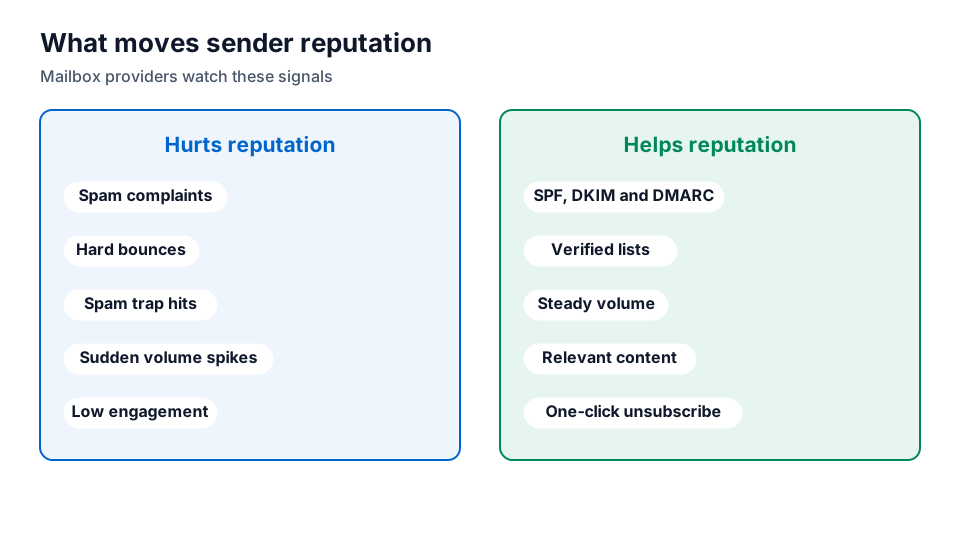
- Hurts it: spam complaints, hard bounces, spam trap hits, sudden volume spikes, low engagement.
- Helps it: authenticated mail (SPF, DKIM, DMARC), verified lists, steady volume, relevant content, easy unsubscribe.
- Monitoring: tools such as Google Postmaster Tools show how Gmail sees your domain.
Google and Yahoo now require bulk senders to authenticate their mail, offer one-click unsubscribe and keep spam complaint rates low.
Example
Illustrative scenario. A company launches outreach from a brand-new domain at full volume and sees most emails land in spam. It pauses, sets up authentication, warms the domain gradually with its most engaged contacts, and only then adds new verified lists.
Common mistakes
- Blasting from a new domain. Warm up gradually.
- Sending to old, unverified lists. Verify close to the send.
- Making unsubscribing hard. Frustrated recipients click "spam" instead.
Related terms
Put it to work
- Email verification, explained: protecting reputation before you send
- Delivery and guarantee in our FAQ: how we verify emails
- Data quality methodology: our verification process
Sources
- Email sender guidelines, Google
- Postmaster Tools, Google