What is an email bounce rate?
Also called: hard bounce, soft bounce, email bounce, Zero-Bounce Deliverability Benchmark
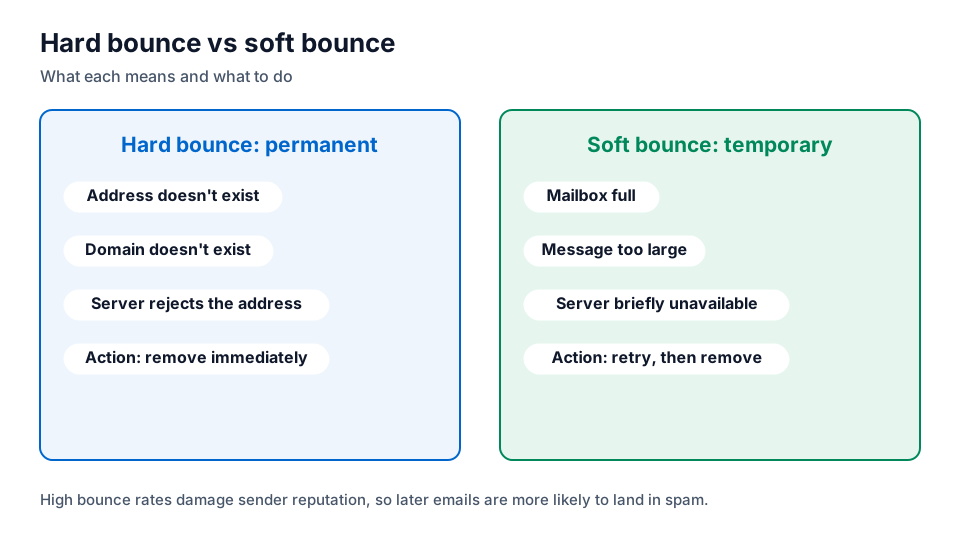
Bounce rate is the share of sent emails that were returned as undeliverable. Hard bounces are permanent failures, such as an address that doesn't exist; soft bounces are temporary, such as a full mailbox or a server that is briefly unavailable.
Why it matters for healthcare sales and marketing
Mailbox providers read high bounce rates as a sign of a poor-quality or purchased-and-unverified list. That damages your sender reputation, so later emails, even to good addresses, are more likely to land in spam. Email service providers also monitor bounces and can suspend accounts that bounce too much.
How it works
- Hard bounce: permanent. The address or domain doesn't exist, or the server rejects it outright. Remove hard-bounced addresses immediately and never mail them again.
- Soft bounce: temporary. The mailbox is full, the message is too large, or the server is down. Retry a few times; if it keeps soft-bouncing, treat it as bad.
- Bounce rate = bounced emails divided by emails sent. Track hard and soft bounces separately.
The main levers are verifying addresses close to the send, removing old records, and warming up new sending domains gradually.
Example
Illustrative scenario. A team sends to a list it hasn't touched in a year and sees hard bounces several times higher than usual. It pauses the campaign, re-verifies the remaining addresses, removes failures and restarts in smaller batches. Bounces return to normal and later campaigns reach the inbox again.
Common mistakes
- Retrying hard bounces. They won't succeed, and each attempt hurts your reputation.
- Looking only at averages. One bad segment can hide inside a good overall rate. Check bounces by list and source.
- Sending a big list from a new domain. Warm up gradually so mailbox providers learn to trust you.
- Not suppressing bounced addresses across tools. Share your suppression list between your CRM, marketing automation and sales engagement tools.
How MedicalProspects does it
MedicalProspects verifies emails before every delivery and replaces hard bounces one-for-one under its 99% deliverability guarantee. The house phrase "zero-bounce benchmark" describes the same goal: keep hard bounces as close to zero as possible.
Related terms
Put it to work
- Delivery and guarantee in our FAQ: how verification and replacements work
- Data quality methodology: our full verification process
- How to buy healthcare contact data: checking bounce guarantees before you buy