What is email verification?
Also called: email validation, contact verification, Physician Email Verification, Triple-Verification Methodology
Email verification is checking that an email address is correctly formed, belongs to a domain that accepts mail, and points to a mailbox that exists, before you send to it. For healthcare lists it also means confirming the address still belongs to the right person in the right role.
Why it matters for healthcare sales and marketing
Every bounce hurts the sender's reputation with mailbox providers, and a poor reputation sends future campaigns to spam. In healthcare the risk is higher than in most B2B markets because clinicians and administrators move between practices, hospitals and health systems often, and organizations change email domains after mergers.
Verification is what turns a list of addresses into an audience you can actually reach. It is also the main thing to ask any data provider about: when were these emails last checked, and how?
How it works
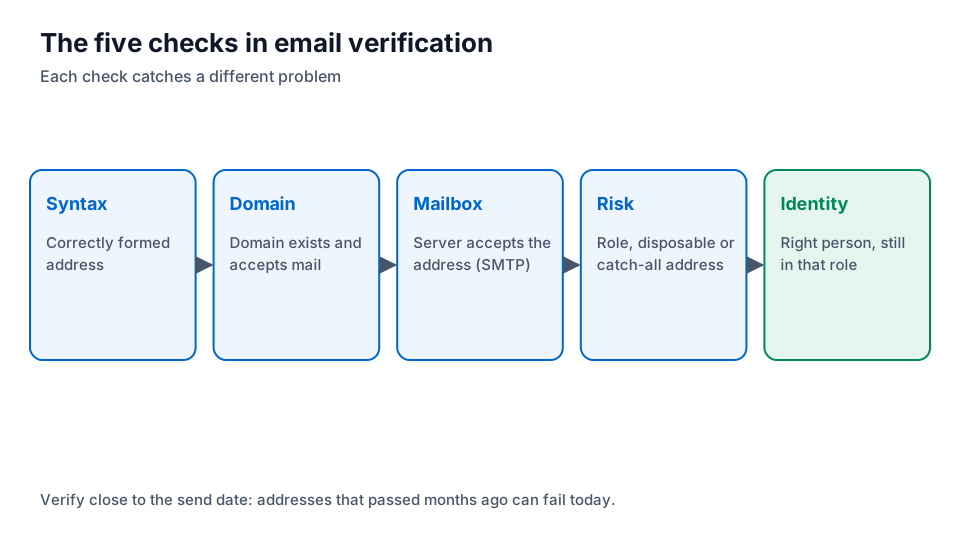
Verification usually runs as a series of checks, each catching a different problem:
- Syntax. Is the address correctly formed?
- Domain. Does the domain exist and have mail (MX) records?
- Mailbox. Does the mail server accept the address? This is the SMTP check.
- Risk. Is it a role address (info@), a disposable address, or on a catch-all domain where the server accepts everything?
- Identity. Does the person still work there in that role? This needs registry, organization or research checks, not just a mail-server test.
The first four checks tell you an address works. Only the fifth tells you it reaches the right person.
Example
Illustrative scenario. A marketing team buys a cardiology list and plans to send three months later. Before launch it re-verifies the file: a small share of addresses now fail the mailbox check because some physicians changed practices, and others sit on catch-all hospital domains. The team removes the failures, sends to the catch-all addresses in a smaller first wave to watch bounces, and keeps its bounce rate low.
Common mistakes
- Verifying once. An address that passed six months ago may fail today. Re-verify close to the send.
- Treating a mailbox check as proof of identity. A valid inbox can belong to someone who has left the role.
- Ignoring catch-all domains. Mail servers that accept everything can't confirm a mailbox, so treat those addresses as higher risk.
- Not asking how a vendor verifies. "Verified" means little without the method and the date.
How MedicalProspects does it
MedicalProspects runs three layers: U.S. clinicians are matched to an active NPI and state license records, titles and employers are checked against organization sources, and every email is re-checked before each delivery. That is what the house name "triple verification" refers to. Each order carries a 99% deliverability guarantee with 1:1 replacement of hard bounces.
Related terms
Put it to work
- Data quality methodology: our full verification process
- Delivery and guarantee in our FAQ: how verification and replacements work
- How to buy healthcare contact data: questions to ask any vendor about verification