What is the difference between opt-in and opt-out email?
Also called: opt-in permission marketing, email consent, Opt-In Permission Marketing (B2B)
Opt-in means a person agrees before you email them; opt-out means you may email them until they ask you to stop. U.S. law (CAN-SPAM) is an opt-out system, while Canada's CASL is largely opt-in and the UK and EU have their own rules.
Why it matters for healthcare sales and marketing
Whether you need consent before the first email depends on where the recipient is. Getting it wrong can mean regulatory risk and complaints, and ignoring opt-outs is a violation almost everywhere.
How it works
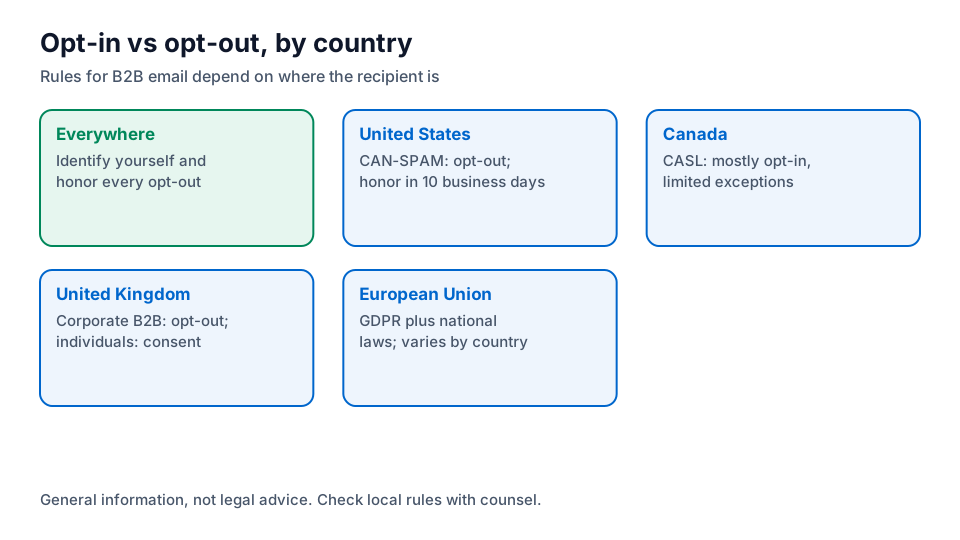
- United States (CAN-SPAM): opt-out. You can send commercial email without prior consent, but you must honor opt-outs within 10 business days.
- Canada (CASL): largely opt-in. You generally need express or implied consent, with limited exceptions, for example for addresses conspicuously published for business with no "no marketing" statement, when the message relates to the person's role.
- United Kingdom (UK GDPR and PECR): B2B emails to corporate addresses can rely on legitimate interests with a clear opt-out; individual and sole-trader addresses need consent.
- European Union (GDPR plus national laws): varies by country; some, such as Germany, restrict unsolicited B2B email more tightly.
Everywhere: identify yourself, include an opt-out, and keep one suppression list across all your tools.
Example
Illustrative scenario. A company emailing physicians in the U.S. and Canada splits its list by country. U.S. contacts get its standard CAN-SPAM-compliant campaign. Canadian contacts only receive email where the company can document consent or a valid exception, and everyone else is invited to opt in through other channels.
Common mistakes
- Using U.S. rules everywhere. Check the recipient's country.
- Separate suppression lists per tool. An opt-out must apply everywhere you send from.
- Assuming B2B is always exempt. It isn't under CASL, and EU rules vary.
- Hiding the opt-out. Make it clear and easy.
Related terms
Put it to work
- Compliance questions in our FAQ: short answers on email and privacy rules
- Security and compliance: how our data is sourced and handled
- Compliant healthcare outreach handbook (ebook): a full guide
Sources
- CAN-SPAM Act: A Compliance Guide for Business, Federal Trade Commission
- Canada's Anti-Spam Legislation, CRTC
- Guide to PECR: electronic mail marketing, Information Commissioner's Office