What is CASL, and how does it affect emailing Canadian healthcare professionals?
Also called: Canada anti-spam law, CASL
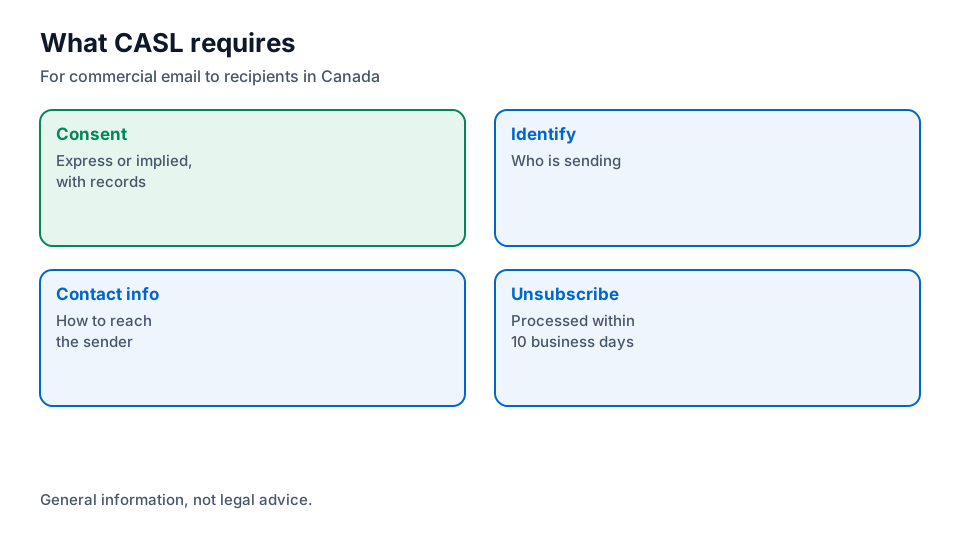
CASL is Canada's Anti-Spam Legislation. It generally requires consent, express or implied, before sending commercial electronic messages, along with sender identification and a working unsubscribe, and it applies to B2B email sent to recipients in Canada.
Why it matters for healthcare sales and marketing
Unlike the U.S. CAN-SPAM Act, CASL is largely a consent-based law, and penalties can be significant. Teams emailing Canadian clinicians or hospitals need a different approach from their U.S. campaigns.
How it works
- Consent: express (they agreed) or implied (for example, an existing business relationship within set time limits).
- Published address exception: implied consent can apply when someone conspicuously publishes their business email without saying they don't want marketing, and the message relates to their role.
- Every message: identify the sender, include contact information and a working unsubscribe.
- Unsubscribes: must be processed within 10 business days.
- Enforcement: led by the CRTC.
Example
Illustrative scenario. A U.S. device company expanding into Canada separates its Canadian contacts, emails only those where it can document consent or a valid exception, and invites others to opt in through events and its website.
Common mistakes
- Applying U.S. rules to Canada. CASL needs consent in most cases.
- Not recording consent. You may need to prove it.
- Assuming B2B is exempt. CASL covers B2B messages.
Related terms
Put it to work
- Compliance questions in our FAQ: short answers on email rules
- International healthcare data: reaching professionals outside the U.S.
- Security and compliance: our compliance guidelines
Sources
- Canada's Anti-Spam Legislation, CRTC
- Fight Spam, Government of Canada