The Compliant Healthcare Outreach Handbook
CAN-SPAM, GDPR, CCPA and What HIPAA Does (and Doesn't) Cover
This MedicalProspects handbook gives healthcare marketing, sales and compliance teams a clear map of the rules that apply to B2B outreach. It explains why HIPAA is usually the wrong question, covers U.S., EU, UK and Canadian email and privacy rules, channel-by-channel requirements and healthcare-specific rules on incentives and promotion, and ends with a workflow and legal sign-off template. It is general guidance, not legal advice.
Key points
- HIPAA protects patient data, not clinicians' professional contact details; the real question is where the data came from.
- CAN-SPAM's seven requirements apply to every commercial email, including B2B, with a compliant footer you can adapt.
- California is the outlier: since 2023, B2B contacts have full CCPA/CPRA privacy rights.
- International rules differ: GDPR legitimate interests, UK PECR corporate subscribers and Canada's CASL consent.
- Each channel has its own rules, especially automated calls and texts to mobile numbers.
- Healthcare-specific rules on kickbacks, Open Payments, industry codes and FDA promotion shape what outreach can offer and claim.
What's inside this ebook
-
Introduction: Compliance Gets Campaigns Approved
Very few healthcare campaigns are stopped by a regulator. Far more are stopped earlier, by an internal review that can't get clear answers. The list has been bought, the emails are written, the launch date is on the calendar, and then someone in legal asks, "Is this HIPAA-compliant?" Nobody is quite sure how to answer, and the launch slips by weeks.
-
Chapter 1: Professional Data vs. Patient Data, and What HIPAA Covers
HIPAA protects patients' health information. It doesn't govern the business contact details of the clinicians who treat them. That sounds obvious when written down, but in practice it's the most common source of confusion in healthcare list purchases, and clearing it up early removes the biggest single blocker in most reviews.
-
Chapter 2: CAN-SPAM in Practice for Healthcare B2B Email
CAN-SPAM is the U.S. law most people think of first, and the good news is that it's fairly straightforward. It lets you email U.S. healthcare professionals without prior consent, as long as every message follows its rules. There's no B2B exemption, though: the rules apply to every commercial email, including those sent to work addresses.
-
Chapter 3: U.S. State Privacy Laws and B2B Contacts
Most U.S. state privacy laws don't affect B2B outreach much. California is the exception, and it's an important one. Since January 1, 2023, when the employee and B2B exemptions expired, the CCPA, as amended by the CPRA, has given business contacts the same privacy rights as consumers. Most other state privacy laws still exclude people acting in a business or employment role.
-
Chapter 4: International Outreach: GDPR, UK PECR and CASL
Outside the U.S., the key question changes. It's no longer just "is the message compliant?" but "do we need consent before the first email at all?" The answer differs by country, sometimes by type of recipient within a country, so it pays to plan each market separately rather than applying one rule everywhere.
-
Chapter 5: Channel-by-Channel Rules
Multi-channel campaigns are effective, but each channel comes with its own rules. A contact you can email freely may still need consent before you text them, and a call that's fine from a rep's phone may not be fine from an automated dialer. Check the rules for every channel before you build a sequence that uses them.
-
Chapter 6: Healthcare-Specific Rules: Incentives, Transfers of Value and Promotion
This is the chapter general B2B marketing guides leave out, and it's where healthcare is genuinely different. The biggest risk usually isn't the email itself. It's what the email offers and what it claims. A $50 gift card for booking a demo is routine in SaaS marketing. Offered to a prescribing physician, the same gift card can create legal and reporting obligations that nobody on the campaign team anticipated.
-
Chapter 7: Building a Compliant Outreach Program
Compliance holds up best when it's built into how you work, rather than checked from scratch for each campaign. The workflow below has six steps, and every campaign follows the same ones. If you only remember one of them, make it the last: every opt-out and rights request flows back into the suppression list before the next send. Most real compliance problems start when that loop breaks.
-
Chapter 8: Pre-Launch Checklist and Legal Sign-Off Template
Run this checklist before every new campaign. Then send the sign-off template to your legal or compliance reviewer, already filled in. Reviewers are much quicker to approve a campaign when they can see everything in one place, rather than piecing it together across weeks of email threads.
-
Chapter 9: Handling Rights Requests and Complaints
Sooner or later, a recipient will ask where you got their data, ask you to delete it, or complain to a regulator or to your data vendor. That's normal and, handled well, it's rarely a big deal. A prepared, prompt response is what keeps a small request from becoming a larger problem.
-
Conclusion: Compliance Starts With the Data
Compliant outreach starts before the first email is written, with where the contact data comes from and how it's maintained. Once you have a clean, documented source, the rest mostly comes down to habits: honest messages, working opt-outs, the right channel for each contact and incentives your compliance team can comfortably defend. None of it needs to slow you down once it's built into the way your team works.
Get the full ebook
All 11 sections, with checklists, tables and templates you can use with your team.
Read the full ebook
The complete text of The Compliant Healthcare Outreach Handbook, the same content as the PDF. Download the PDF above for the designed version with worksheets you can print.
Compliance Gets Campaigns Approved
Very few healthcare campaigns are stopped by a regulator. Far more are stopped earlier, by an internal review that can't get clear answers. The list has been bought, the emails are written, the launch date is on the calendar, and then someone in legal asks, "Is this HIPAA-compliant?" Nobody is quite sure how to answer, and the launch slips by weeks.
We've seen this happen often enough to know that most of these delays come from a small number of misunderstandings. HIPAA is usually the wrong question. CAN-SPAM is simpler than people fear. The rules that most often catch healthcare marketers out are somewhere else entirely: state privacy laws, international consent rules, phone and text rules, and healthcare-specific rules on gifts and promotion.
The aim of this handbook is to give marketing, sales and compliance teams a shared, practical understanding of those rules, so reviews take days instead of weeks and campaigns go out on solid ground.
It's written for healthcare marketing, sales and compliance teams who want a clear, practical map of:
- What HIPAA covers, and why professional contact data is a different matter
- The U.S. email, privacy and phone rules that apply to B2B healthcare outreach
- International rules for reaching providers in the EU, UK and Canada
- Healthcare-specific rules on incentives, transfers of value and promotional content
- A step-by-step compliant outreach workflow, a pre-launch checklist and a sign-off template for legal review
Those four numbers set the stakes. Penalties apply per message, mailbox providers act on complaint rates long before any regulator does, and the largest fines are tied to revenue. The practical lesson is that compliance is much cheaper to build in from the start than to fix after a campaign has gone out.
How to use this handbook
We'd suggest reading chapters 1 to 6 once as a team, ideally with someone from legal or compliance in the room. After that, chapters 7 and 8 and the appendices are the parts you'll reuse every time you launch a campaign. Chapter 9 covers what to do when someone asks where you got their data, or complains.
- HIPAA protects patient information, not professionals' business contact details.
- The real questions are lawful sourcing and compliant messaging.
- Get a written statement from your list vendor that no data comes from patient records.
Chapter 1: Professional Data vs. Patient Data, and What HIPAA Covers
HIPAA protects patients' health information. It doesn't govern the business contact details of the clinicians who treat them. That sounds obvious when written down, but in practice it's the most common source of confusion in healthcare list purchases, and clearing it up early removes the biggest single blocker in most reviews.
What HIPAA protects
HIPAA's Privacy Rule protects protected health information (PHI): individually identifiable health information about patients held by covered entities (health plans, clearinghouses and most providers) and their business associates.
Why professional contact data is different
| Data | Whose information | Is it PHI? |
|---|---|---|
| A cardiologist's business email and practice address | The clinician's, as a professional | No |
| A physician's NPI, specialty and hospital affiliation | The clinician's, much of it published by CMS | No |
| A hospital CIO's direct dial and title | The executive's, as a professional | No |
| A list of patients seen by a cardiologist | Patients' | Yes |
| Diagnoses, appointments or prescriptions tied to patients | Patients' | Yes |
Where HIPAA does matter for marketers
- Data sources. Confirm in writing that your list vendor never sources contacts from patient records, clinical systems or covered entities' patient data.
- Patient-facing campaigns. If your company is a covered entity or business associate and markets to patients, HIPAA's marketing rules apply. That is outside this B2B handbook.
- What you ask for in replies. Do not invite clinicians to send patient details by email in response to your outreach.
Bottom line: For B2B outreach to healthcare professionals, the question is not "Is this HIPAA-compliant?" It is "Was this data sourced lawfully, and do our messages follow the email, privacy and healthcare promotion rules?" The rest of this handbook answers that question.
- CAN-SPAM has no B2B exemption, but it does not require prior consent.
- Seven requirements cover almost every mistake, from honest headers to monitoring your agents.
- Build the footer and opt-out sync into templates and tools, not individual campaigns.
Chapter 2: CAN-SPAM in Practice for Healthcare B2B Email
CAN-SPAM is the U.S. law most people think of first, and the good news is that it's fairly straightforward. It lets you email U.S. healthcare professionals without prior consent, as long as every message follows its rules. There's no B2B exemption, though: the rules apply to every commercial email, including those sent to work addresses.
The seven requirements
| Requirement | What it means in a healthcare campaign |
|---|---|
| 1. Accurate header information | "From", "Reply-To" and the sending domain identify your company. No borrowing a partner's or a hospital's name. |
| 2. Honest subject lines | The subject reflects the content. "Re: your patient referral" on a sales email is deceptive. |
| 3. Identify the message as an ad | Make clear the email is commercial. Plain, professional wording is enough. |
| 4. A valid physical postal address | A street address, a registered P.O. box or a registered private mailbox in every email. |
| 5. A clear way to opt out | A visible unsubscribe link or reply method that works for at least 30 days after sending.1 |
| 6. Honor opt-outs within 10 business days | No fee, no login and no more than a reply or one web page to opt out. Never sell or share opted-out addresses. |
| 7. Monitor others acting for you | You stay responsible when an agency or platform sends on your behalf. |
Why it matters
Each non-compliant email can bring a civil penalty of up to $53,088 under FTC rules.1 Volume campaigns multiply that risk quickly, so build these rules into your templates rather than checking each send.
A compliant footer you can adapt
[Company legal name] · [Street address, City, State ZIP]

You are receiving this email because your professional role relates to [product area].
We found your business contact details in public professional sources and registries.
To stop receiving these emails, [unsubscribe here] or reply "unsubscribe".
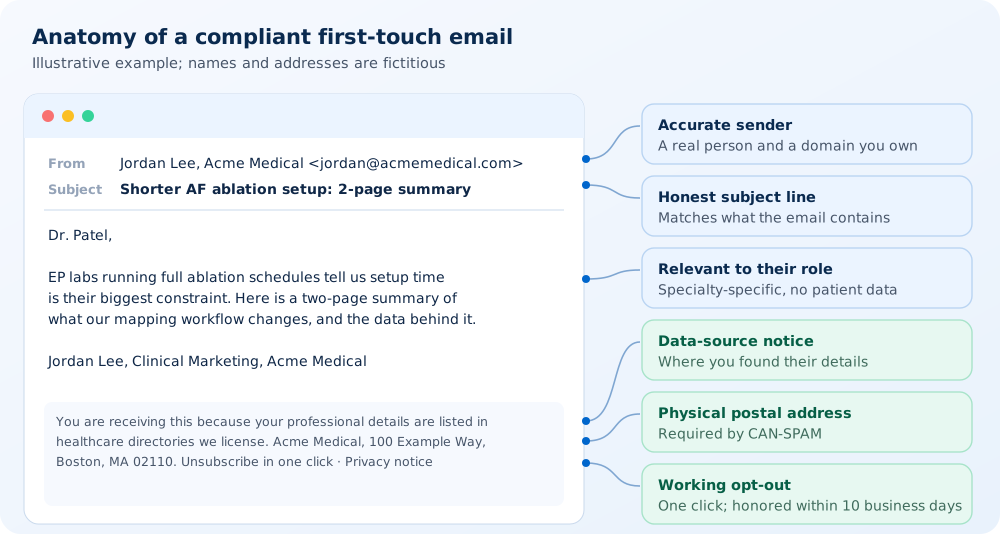
Gmail and Yahoo rules sit on top of CAN-SPAM
Mailbox providers now enforce sender requirements of their own. Google's guidelines ask senders to authenticate mail (SPF, DKIM and DMARC), support one-click unsubscribe for marketing messages and keep spam rates below 0.3%, ideally below 0.10%. Senders who send more than 5,000 messages a day to Gmail accounts face the strictest requirements.2 A campaign can be legal under CAN-SPAM and still land in spam if it breaks these rules.
Common healthcare mistakes
- Sending from a lookalike or rented domain that hides who you are
- Opt-outs held in one tool but not shared with the SDR sequencing platform
- Subject lines that imply an existing clinical relationship ("Following up on your patient")
- Agencies running campaigns under your brand without your suppression list
- California treats business contacts like consumers; plan for access, deletion and opt-out requests.
- Most other state laws still exclude business-context data, but the list keeps changing.
- Pass deletion requests to your vendor and every tool that holds the record.
Chapter 3: U.S. State Privacy Laws and B2B Contacts
Most U.S. state privacy laws don't affect B2B outreach much. California is the exception, and it's an important one. Since January 1, 2023, when the employee and B2B exemptions expired, the CCPA, as amended by the CPRA, has given business contacts the same privacy rights as consumers.4 Most other state privacy laws still exclude people acting in a business or employment role.
California (CCPA / CPRA)
If your company meets the CCPA's thresholds, California-based clinicians and executives on your lists have the right to:
- Know what personal information you hold about them and where it came from
- Delete that information, subject to limited exceptions
- Correct inaccurate information
- Opt out of the sale or sharing of their information
- Not be discriminated against for using these rights
California also regulates data brokers, the companies that sell data about people they have no direct relationship with. Data brokers must register with the state and process deletion requests made through the state's central deletion system. Ask whether your list vendor is registered where required.
Other states
Comprehensive privacy laws in states such as Virginia, Colorado, Connecticut and Texas generally exclude information about people acting in a commercial or employment context. That usually takes B2B professional contacts out of scope, but the details differ by state and keep changing.
What to do
- Confirm with counsel whether your company meets the CCPA thresholds
- Update your privacy notice to cover prospect data and where it comes from
- Set up a process to answer access, deletion and correction requests
- Pass deletion requests to your list vendor and every tool that holds the record
- Review new state laws each quarter, as several are added every year
- Consent rules differ by country; segment lists and apply each market's rules.
- GDPR B2B outreach usually relies on legitimate interests, with a documented assessment and a data-source notice.
- Where consent is required, start with channels that do not need it, such as direct mail.
Chapter 4: International Outreach: GDPR, UK PECR and CASL
Outside the U.S., the key question changes. It's no longer just "is the message compliant?" but "do we need consent before the first email at all?" The answer differs by country, sometimes by type of recipient within a country, so it pays to plan each market separately rather than applying one rule everywhere.
At a glance
| Market | Main rules | Consent before a B2B email? | Key obligations |
|---|---|---|---|
| European Union | GDPR + national ePrivacy laws | Varies by country; some (e.g., Germany) effectively require it | Lawful basis, notice of data source, rights requests answered within one month |
| United Kingdom | UK GDPR + PECR | Not for corporate addresses; yes for sole traders and some partnerships | Opt-out in every message, notice of data source |
| Canada | CASL + PIPEDA | Yes, express or implied | Sender identification, working unsubscribe, consent records |
GDPR (EU and UK)
- Lawful basis. B2B outreach usually relies on legitimate interests (Article 6(1)(f)). Document a Legitimate Interests Assessment showing your outreach is relevant to the person's role and proportionate.
- Tell people where you got their data. When data comes from a third party, Article 14 requires you to give the person a privacy notice, at the latest in your first communication and within one month.
- Respect rights. Access, deletion and objection requests must be answered within one month. An objection to direct marketing must always be honored.
- Penalties. Serious breaches can bring fines of up to €20 million or 4% of global annual turnover, whichever is higher.3
UK PECR
You can send B2B marketing email to corporate subscribers, such as staff at an NHS trust or a limited company, without prior consent, if you identify yourself and offer an opt-out. Individual subscribers, such as sole traders and some partnerships, need prior consent. Many independent practitioners fall into this group.
Canada's CASL
CASL requires consent before you send a commercial electronic message. Implied consent can apply when a professional has published their business email openly, the message relates to their role, and they have not said they do not want unsolicited messages. Keep records showing how consent applied to each contact.
Practical rules for global campaigns
- Segment lists by country and apply each country's rules
- Put a short data-source notice and privacy link in every first-touch email
- Keep consent and legitimate-interest records with each contact
- When in doubt, start with channels that need no consent, such as direct mail, and invite people to opt in
- Each channel has its own rules: a contact you may email may still need consent before you text.
- Treat mobile numbers carefully; many "direct dials" are personal mobiles.
- Keep one source of truth for opt-outs across every channel and partner.
Chapter 5: Channel-by-Channel Rules
Multi-channel campaigns are effective, but each channel comes with its own rules. A contact you can email freely may still need consent before you text them, and a call that's fine from a rep's phone may not be fine from an automated dialer. Check the rules for every channel before you build a sequence that uses them.
| Channel | Main U.S. rules | Consent needed? | Watch out for |
|---|---|---|---|
| CAN-SPAM | No, but opt-out required | Opt-outs not synced across tools | |
| Phone, manual dialing to business lines | TCPA, state telemarketing laws | Generally no | Calling hours, state registration rules |
| Phone, autodialed or prerecorded to mobiles | TCPA | Yes, prior express written consent for marketing | Many "direct dials" are personal mobile numbers |
| SMS / text | TCPA, state laws such as Florida's FTSA | Yes, prior express written consent | Automated texting platforms count as autodialing in many cases |
| Fax | Junk Fax Prevention Act | Established business relationship + opt-out notice | Fax is still common in healthcare, and unsolicited fax ads draw lawsuits |
| Direct mail | Postal rules; privacy laws cover the data | No | Honor do-not-mail requests |
| LinkedIn User Agreement | Platform rules apply | Scraping and automation tools break the terms |
Mobile numbers deserve extra care
The TCPA treats calls and texts to mobile phones more strictly than calls to landlines, even when the phone is used for work. Before any automated dialing or texting:
- Identify which numbers are mobile
- Scrub against the National Do Not Call Registry and your internal do-not-call list
- Use manual dialing unless you hold prior express written consent
- Check state rules in the states you are calling
Keep one source of truth for opt-outs
An opt-out from any channel should follow the contact everywhere. Sync email unsubscribes, do-not-call requests and deletion requests across your CRM, sequencing tool, dialer and agency partners.
- The biggest healthcare risk is what an email offers or claims, not the email itself.
- Avoid gifts and prizes for clinicians who prescribe, order or refer; use educational value.
- Route promotional content through medical, legal and regulatory review first.
Chapter 6: Healthcare-Specific Rules: Incentives, Transfers of Value and Promotion
This is the chapter general B2B marketing guides leave out, and it's where healthcare is genuinely different. The biggest risk usually isn't the email itself. It's what the email offers and what it claims. A $50 gift card for booking a demo is routine in SaaS marketing. Offered to a prescribing physician, the same gift card can create legal and reporting obligations that nobody on the campaign team anticipated.
Which rules apply to whom
| Rule | Applies to | What it means for outreach |
|---|---|---|
| Federal Anti-Kickback Statute | Anyone whose products or services are paid for by Medicare, Medicaid or other federal health programs | Do not offer anything of value to induce clinicians to order, prescribe or refer your products |
| Open Payments (Physician Payments Sunshine Act) | Manufacturers of covered drugs, devices, biologicals and supplies, and group purchasing organizations | Payments and transfers of value to physicians, teaching hospitals, PAs and nurse practitioners must be reported to CMS |
| PhRMA Code | Pharmaceutical companies (voluntary industry code) | Strict limits on meals and gifts; no non-educational items |
| AdvaMed Code | Medical device companies (voluntary industry code) | Similar limits on gifts, meals and entertainment for HCPs |
| State gift and disclosure laws | Manufacturers selling in states such as Vermont, Minnesota and Massachusetts | Extra gift bans or disclosure duties beyond federal rules |
| FDA promotion rules | Prescription drug, biologic and device marketers | Claims must be truthful, balanced and within approved or cleared uses |
| FTC Act | Every company, including HealthTech and services | Claims must be truthful and backed by evidence |
Incentives in campaigns
- Avoid gift cards, cash or prizes for clinicians who prescribe, order or refer your products. Use educational value instead, such as research summaries, CME-eligible events run by accredited providers, or clinical tools.
- Track every transfer of value. Meals at events, travel and fees for advisory work may be reportable under Open Payments. Capture the recipient's NPI so reports match CMS records.
- Check the recipient type. Rules can differ for physicians, nurse practitioners, hospital executives and IT buyers. Your compliance team should set clear rules for each audience.
Promotional content
- Prescription drugs and biologics: promotional emails need fair balance and important safety information. Materials are generally submitted to FDA (Form FDA 2253) when first used.
- Medical devices: keep claims within cleared or approved indications. Do not promote off-label uses in outreach.
- HealthTech and services: back every outcome claim, such as "reduces readmissions by 20%", with evidence you can produce.
Always route healthcare promotional content through your company's medical, legal and regulatory (MLR) review before it reaches a clinician's inbox.
Complete one line for each market and channel you use.
- Markets you contact (U.S. states, EU countries, UK, Canada):
- Channels used in each market:
- Where prior consent is required, and how you obtain and record it:
- Where you rely on legitimate interests, and where the assessment is stored:
Chapter 7: Building a Compliant Outreach Program
Compliance holds up best when it's built into how you work, rather than checked from scratch for each campaign. The workflow below has six steps, and every campaign follows the same ones. If you only remember one of them, make it the last: every opt-out and rights request flows back into the suppression list before the next send. Most real compliance problems start when that loop breaks.
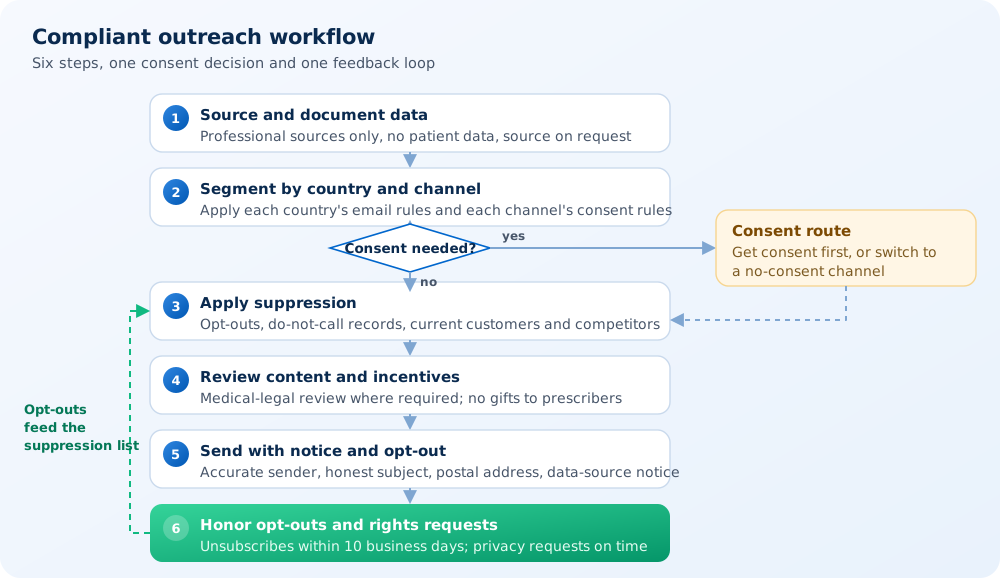
The consent decision happens once per country and channel, not per contact. Most U.S. email and manual calling needs no prior consent. Automated calls or texts to mobiles, Canadian email and some EU markets do.
What a documented program looks like
Reviewers and customers increasingly ask to see how you work, not just what you promise. A short compliance file for your outreach program usually includes:
- Your data sourcing statements from each vendor
- A map of markets, channels and the consent basis for each
- Your suppression-list process and sync schedule
- Your content-review procedure and approver names
- A log of rights requests, with response dates
- A copy of each approved campaign sign-off
Who owns each step
| Step | Typical owner | Record to keep |
|---|---|---|
| 1. Source and document data | Marketing operations | Vendor sourcing statement and data agreement |
| 2. Segment by country and channel | Marketing operations | Country and channel rules applied per segment |
| 3. Apply suppression | Marketing operations | Suppression list version and date |
| 4. Review content and incentives | Compliance / MLR | Approval record and reviewer |
| 5. Send with notice and opt-out | Demand generation / sales development | Final template and send log |
| 6. Honor opt-outs and rights requests | Privacy owner | Request log with response dates |
- Build compliance into the six-step workflow so every campaign follows it.
- Assign an owner and a record to each step.
- The step that closes the loop, honoring opt-outs, is the one most programs skip.
Chapter 8: Pre-Launch Checklist and Legal Sign-Off Template
Run this checklist before every new campaign. Then send the sign-off template to your legal or compliance reviewer, already filled in. Reviewers are much quicker to approve a campaign when they can see everything in one place, rather than piecing it together across weeks of email threads.
Pre-launch checklist
Data
- Vendor has confirmed in writing that no data comes from patient records
- Data sources are documented and available if a contact asks
- Contacts are segmented by country, and each country's rules are applied
- Current customers, opt-outs and do-not-contact records are suppressed
- Sending domain and "From" name identify your company
- Subject lines match the content
- Physical postal address and a working unsubscribe link are in every email
- Data-source notice and privacy link are in first-touch emails
Phone and text
- Mobile numbers identified, with manual dialing unless consent is on file
- Numbers scrubbed against the National Do Not Call Registry and internal lists
Content and incentives
- Content passed medical, legal and regulatory (MLR) review where required
- No gifts or incentives to clinicians who prescribe, order or refer your products
- Transfers of value tracked with recipient NPIs for Open Payments
Rights and records
- Access, deletion and objection requests have an owner and a deadline
- Opt-outs sync across CRM, sequencing tool, dialer and agencies
Legal sign-off template
OUTREACH CAMPAIGN COMPLIANCE SIGN-OFF

Campaign: [name]        Owner: [name]        Launch date: [date]

AUDIENCE
  Roles / specialties: [e.g., interventional cardiologists, hospital CIOs]
  Countries and U.S. states: [list]
  Volume: [number of contacts]
  Data vendor and sources: [vendor; source types]

CHANNELS
  [ ] Email   [ ] Manual phone   [ ] Automated phone/SMS (consent on file?)
  [ ] Direct mail   [ ] LinkedIn   [ ] Fax

CONTENT
  Product type: [Rx drug / device / HealthTech / service]
  MLR review completed: [yes / not required, with reason]
  Incentives or items of value offered: [none / describe]

CONTROLS
  Suppression list applied: [yes, date]
  Unsubscribe and postal address in template: [yes]
  Data-source notice included: [yes]
  GDPR legitimate interests assessment (if EU/UK): [link]

APPROVAL
  Reviewer: [name]   Decision: [approved / approved with changes / rejected]   Date: [date]
- Run the pre-launch checklist before every campaign.
- Send legal one filled-in sign-off page, not weeks of email.
- Keep the evidence: sources, assessments, approvals and request logs.
Chapter 9: Handling Rights Requests and Complaints
Sooner or later, a recipient will ask where you got their data, ask you to delete it, or complain to a regulator or to your data vendor. That's normal and, handled well, it's rarely a big deal. A prepared, prompt response is what keeps a small request from becoming a larger problem.
A simple response process
| Step | What to do | Typical deadline |
|---|---|---|
| 1. Log the request | Record who asked, what they asked and when it arrived | Same day |
| 2. Verify the person | Confirm the request is genuine before acting | A few days |
| 3. Find the data | Search your CRM, sequencing tool, dialer, spreadsheets and agency files | Within the legal deadline |
| 4. Act | Delete, correct, export or stop processing, as requested | One month under GDPR |
| 5. Notify others | Tell your vendor and any partners that hold the record | Same time as step 4 |
| 6. Respond and record | Confirm what you did, and keep a record | Within the legal deadline |
Handling an angry reply
Most complaints come from recipients who feel the email was irrelevant or that they never agreed to hear from you. Respond politely, remove them from every list at once and tell them where their details came from. A fast, courteous answer ends most complaints.
- Log, verify, find, act, notify and respond; give every request an owner and a deadline.
- Search every tool and partner that holds the record.
- Answer complaints quickly and politely, and suppress the person everywhere.
Compliance Starts With the Data
Compliant outreach starts before the first email is written, with where the contact data comes from and how it's maintained. Once you have a clean, documented source, the rest mostly comes down to habits: honest messages, working opt-outs, the right channel for each contact and incentives your compliance team can comfortably defend. None of it needs to slow you down once it's built into the way your team works.
How MedicalProspects supports compliant outreach
| Your requirement | How MedicalProspects helps |
|---|---|
| Lawful, documented sources | Records compiled from professional sources such as the CMS NPI registry, licensing boards, medical association directories and licensed B2B partners |
| No patient data | Never sourced from patient health records or clinical systems |
| Accurate records | Monthly re-verification, with 60-day cycles for high-turnover roles, and retired or deactivated providers removed |
| Rights requests | Access, correction and deletion requests answered within 30 days via [email protected] |
| GDPR alignment | EU and UK professional data processed under legitimate interests (Article 6(1)(f)) |
| Secure delivery | Data encrypted in transit (TLS 1.3) and at rest (AES-256) |
| NPI on clinical records | Supports Open Payments tracking and suppression by NPI |
Start with a sample
Request 20 free custom sample contacts built on your criteria. Share them with your compliance team along with this handbook's checklist, and see how quickly a campaign can be approved when the data is documented from the start.
Visit medicalprospects.com or email [email protected].
Appendix A: Regulation Quick Reference
| Rule | Where | Applies to | Core requirement |
|---|---|---|---|
| CAN-SPAM | U.S. | Commercial email | Honest headers, postal address, working opt-out, honor opt-outs within 10 business days |
| TCPA | U.S. | Calls and texts | Consent for autodialed or prerecorded calls and texts to mobiles |
| CCPA / CPRA | California | Personal information, including business contacts | Notice, access, deletion, correction and opt-out rights |
| GDPR | EU | Personal data of EU residents | Lawful basis, source notice, rights handled within one month |
| UK GDPR and PECR | UK | Personal data and electronic marketing | Corporate subscribers need no consent; individuals do |
| CASL | Canada | Commercial electronic messages | Express or implied consent, sender ID, unsubscribe |
| Anti-Kickback Statute | U.S. | Federal health program payors and suppliers | Nothing of value to induce orders, prescriptions or referrals |
| Open Payments | U.S. | Drug, device and biologic manufacturers | Report transfers of value to physicians and certain other clinicians |
Appendix B: Glossary
| Term | Meaning |
|---|---|
| PHI | Protected health information: individually identifiable patient health information under HIPAA |
| Covered entity | A health plan, clearinghouse or provider covered by HIPAA |
| Business associate | A company that handles PHI on behalf of a covered entity |
| Legitimate interests | A GDPR lawful basis often used for relevant B2B outreach |
| Suppression list | Contacts you must not email, call or text |
| MLR review | Medical, legal and regulatory review of promotional content |
| Open Payments | CMS program that publishes manufacturers' payments to physicians and teaching hospitals |
| TCPA | Telephone Consumer Protection Act, governing calls and texts |
| Data broker | A company that sells personal data about people it has no direct relationship with |
| NPI | National Provider Identifier: the unique 10-digit identifier for U.S. health care providers |
Sources
- Federal Trade Commission, CAN-SPAM Act: A Compliance Guide for Business. https://www.ftc.gov/business-guidance/resources/can-spam-act-compliance-guide-business
- Google Workspace Admin Help, Email sender guidelines. https://support.google.com/a/answer/81126
- General Data Protection Regulation, Article 83(5). https://gdpr-info.eu/art-83-gdpr/
- Morgan Lewis, California Consumer Privacy Act employee and B2B exemptions expire January 1, 2023. https://www.morganlewis.com/pubs/2022/10/california-consumer-privacy-act-employee-and-b2b-exemptions-expire-january-1-2023

John Britton
John works with healthcare sales and marketing teams on precision targeting, campaign strategy, and audience intelligence solutions at MedicalProspects.
More ebooks →