What is subspecialty targeting?
Also called: Specialty & Micro-Specialty Targeting, Sub-Specialty Taxonomy Code, micro-specialty targeting
Subspecialty targeting means building audiences around narrow clinical subspecialties, such as interventional cardiology or pediatric hematology, instead of broad specialties, usually by selecting the matching NUCC taxonomy codes.
Why it matters for healthcare sales and marketing
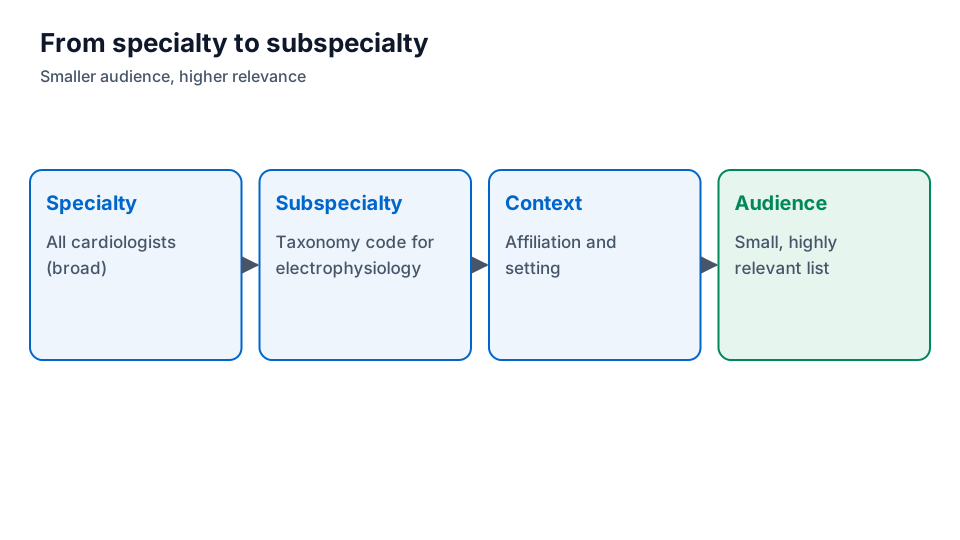
Many products are relevant to a small slice of a specialty. Sending to the whole specialty wastes budget and trains recipients to ignore you. Subspecialty audiences are smaller but far more relevant, so response and conversion rise.
How it works
- Use taxonomy codes: select the specialization codes for your subspecialty, not just the broad classification.
- Check secondary taxonomies: some subspecialists list their focus as a secondary code.
- Add practice context: setting, affiliation or procedures performed where available.
- Size it: get a count before you plan the campaign.
Example
Illustrative scenario. A company launching a device for cardiac rhythm management targets electrophysiologists rather than all cardiologists, using the subspecialty's taxonomy code and hospital affiliations. The list is much smaller than the full specialty, but most recipients actually perform the procedures.
Common mistakes
- Targeting the classification only. Include specialization codes.
- Ignoring secondary codes. You'll miss some subspecialists.
- Assuming bigger is better. A precise small list usually beats a broad one.
Related terms
Put it to work
- Cardiac electrophysiologists list: a subspecialty audience
- NUCC taxonomy codes, explained: how codes define subspecialties
- Surgeons and subspecialties lists: surgical subspecialty audiences