What is audience segmentation in healthcare marketing?
Also called: Use-Case Audience Segmentation, list segmentation
Audience segmentation is dividing a healthcare audience into groups that share attributes, such as specialty, role, care setting, organization size, geography or technology, so each group gets the most relevant message.
Why it matters for healthcare sales and marketing
A cardiologist in a private practice and a hospital CFO need different messages, even about the same product. Segmentation lets you send each group something relevant, which lifts engagement and protects deliverability.
How it works
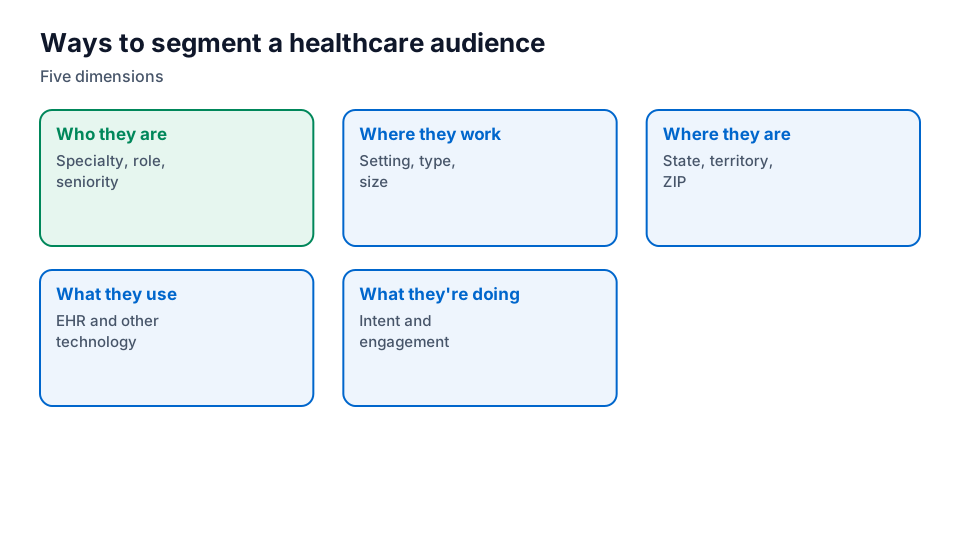
- Who they are: specialty, subspecialty, role, seniority.
- Where they work: care setting, organization type and size, affiliation.
- Where they are: state, region, territory, ZIP code.
- What they use: EHR or other technology.
- What they're doing: intent signals or engagement history.
Example
Illustrative scenario. A diagnostics company splits its audience into hospital lab directors, independent lab owners and ordering physicians, and writes a different email for each: throughput for lab directors, margins for owners, turnaround time for physicians.
Common mistakes
- Segments too small to matter. Balance relevance with size.
- Segmenting without different messages. Segmentation only helps if the content changes.
- Using unreliable fields. Segment on verified data such as taxonomy codes.
Related terms
Put it to work
- Multi-channel marketing use case: segmented campaigns
- Custom list build, explained: combining segments
- Request a custom count: tell us your audience