What is revenue cycle management in healthcare?
Also called: RCM, Revenue Cycle Management (RCM) Buyer
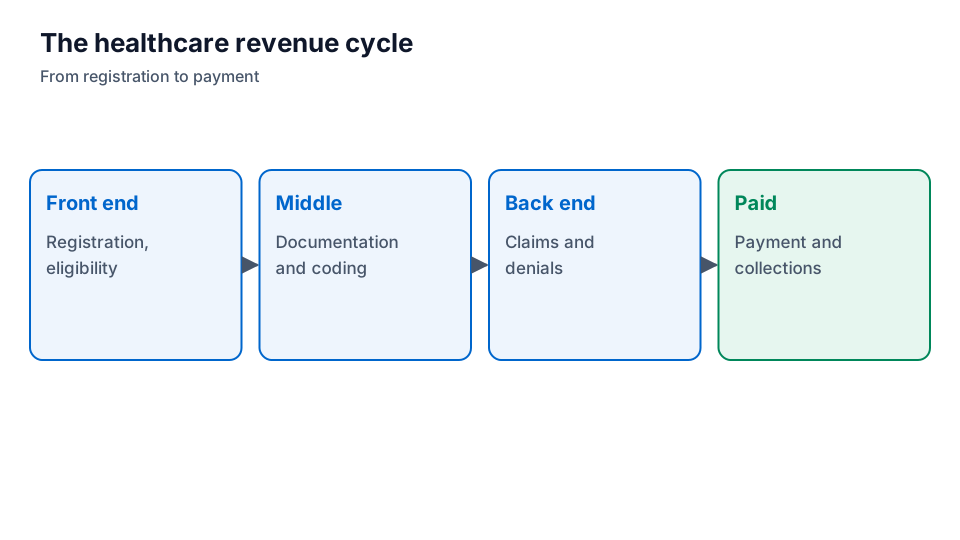
Revenue cycle management (RCM) is the process healthcare organizations use to get paid for care, from patient registration and insurance checks through coding, claims, denials and collections.
Why it matters for healthcare sales and marketing
Every hospital and practice depends on its revenue cycle, and small improvements in denials or collection speed matter. RCM software and services are a large market, sold to finance and revenue cycle leaders.
How it works
- Front end: scheduling, registration, eligibility and prior authorization.
- Middle: clinical documentation and coding.
- Back end: claims, denial management, payment posting and patient collections.
Typical buyers: the CFO, VP of revenue cycle, patient financial services director, and health information management (HIM) director.
Example
Illustrative scenario. A denial management vendor targets VPs of revenue cycle and patient financial services directors at mid-sized hospitals, and uses intent data to prioritize hospitals researching denial topics.
Common mistakes
- Pitching only the CFO. Revenue cycle leaders run evaluations.
- Ignoring the stage. Front-end, coding and back-end products have different buyers.
- Vague ROI. Revenue cycle buyers expect concrete financial cases.
Related terms
Put it to work
- Revenue cycle directors list: RCM decision makers
- RCM software users list: users of revenue cycle software
- RCM software case study: a campaign example