What is healthcare intent data?
Also called: buyer intent data, intent signals, purchase intent data
Healthcare intent data shows which hospitals, practices and healthcare companies are actively researching a topic, such as revenue cycle software or surgical robotics, based on unusual increases in their online research activity.
Why it matters for healthcare sales and marketing
Most target accounts aren't shopping at any given moment. Intent data helps teams find the ones that are:
- Prioritization. SDRs work accounts that are researching your category first.
- Timing. Outreach lands while a health system is evaluating options, not after it has chosen.
- Messaging. The topics an account is researching hint at the problem it is trying to solve.
Intent data works best combined with fit (does the account match your ICP?) and contact data (who on the buying committee should you reach?).
How it works
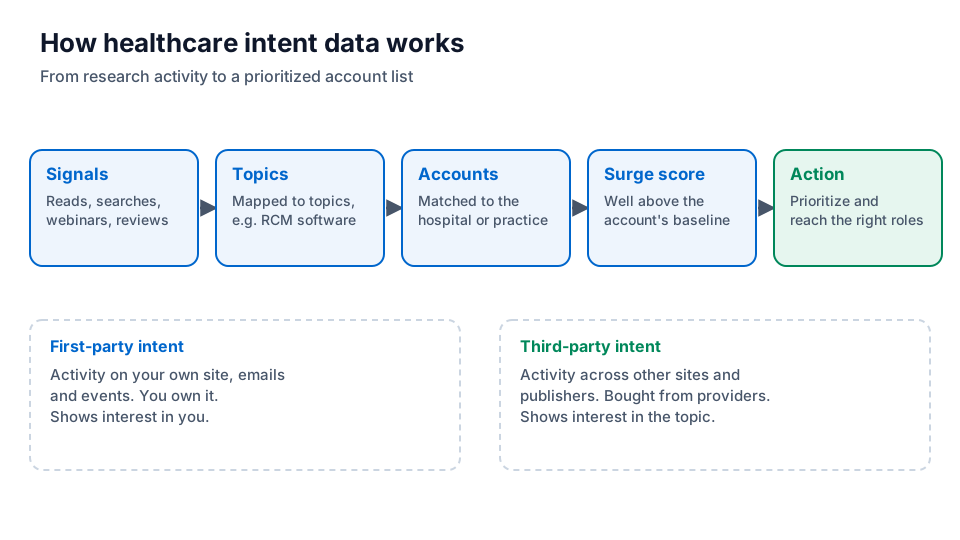
- Signals are collected from research activity: articles read, searches, webinar sign-ups, review site visits and similar actions.
- Topics. Each signal is mapped to a topic such as "RCM software" or "surgical robotics".
- Accounts. Activity is matched to the organization behind it, usually a hospital, health system, practice or company, rather than to a named person.
- Surge score. An account "surges" on a topic when its activity rises well above its own normal level.
- Action. Surging accounts are prioritized, and teams reach the right roles there with relevant messages.
First-party intent comes from your own channels: website visits, email clicks, event attendance. It shows interest in you. Third-party intent comes from activity across other sites and publishers, bought from data providers. It shows interest in the topic, often before an account has found you.
Example
Illustrative scenario. A revenue cycle software company sees several mid-sized health systems surging on "denial management" and "claims automation". Its SDRs move those accounts to the top of their list and reach the VP of revenue cycle and the patient financial services director at each one with a message about denial rates. Accounts that match the ICP but aren't surging stay in a lower-touch nurture program.
Common mistakes
- Treating intent as a named lead. Most intent data is account-level. You still need to find the right people at the account.
- Acting on one signal. Look for sustained surges across related topics rather than a single spike.
- Ignoring fit. A surging account outside your ICP is still a poor prospect.
- Leading with surveillance. "We saw you researching..." puts buyers off. Use intent to choose who and when, then lead with their problem.
How MedicalProspects does it
MedicalProspects offers healthcare intent signals across more than 20 research topics as an add-on to its contact lists, so teams can combine who is in market with verified contacts for each role at those accounts.
Related terms
Put it to work
- Intent data and technology intelligence whitepaper: using intent in healthcare sales
- Account-based marketing use case: combining intent with account targeting
- Revenue cycle directors list: an example audience for RCM intent
Sources
- Intent Data and Technology Intelligence for Healthcare Sales, MedicalProspects