What is an HCP list?
Also called: HCP database, healthcare professional list, HCP email list
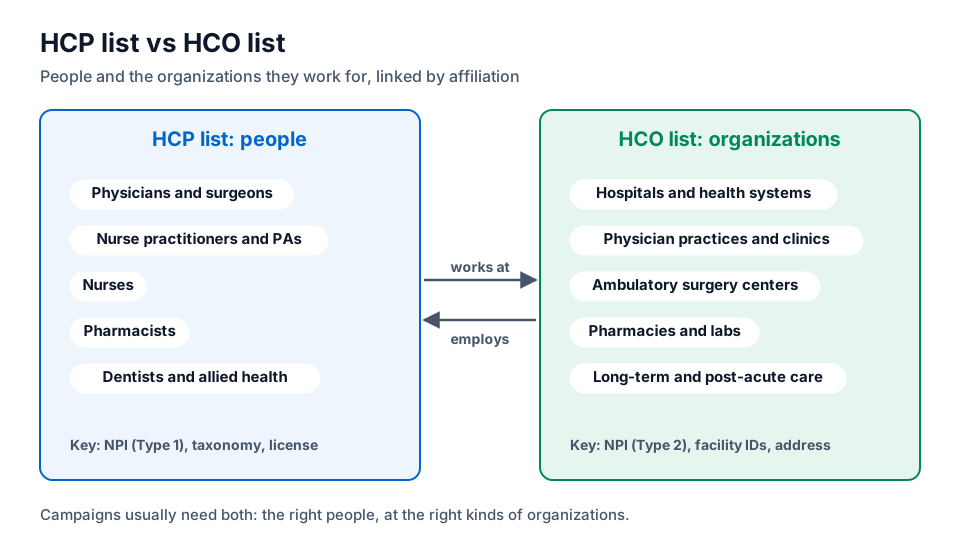
An HCP list is a database of individual healthcare professionals, such as physicians, nurse practitioners, pharmacists and nurses, with identifiers, specialties and contact details used for sales and marketing. Its counterpart, an HCO list, covers healthcare organizations.
Why it matters for healthcare sales and marketing
"HCP" is the standard pharma and MedTech term for the clinicians a company needs to reach: prescribers, device users, referrers and clinical influencers. The HCP list is the foundation of every campaign aimed at them, so its quality decides who sees your message:
- Pharma brand teams use HCP lists to reach prescribers in a therapeutic area.
- MedTech teams use them to find the surgeons and specialists who use or choose a device.
- HealthTech and services companies use them to reach the clinicians who champion new tools inside their organization.
How it works
A useful HCP list answers five questions about each person:
- Who are they? Name, credentials and, for U.S. clinicians, an NPI that confirms identity.
- What do they do? Specialty, usually from the NUCC taxonomy code, plus practice focus where known.
- Where do they work? Practice, hospital or health system affiliation, which links the HCP to an HCO list.
- How do you reach them? A verified business email, a phone number and a work address.
- Is it current? When the record was last checked, since clinicians change jobs and addresses often.
HCP lists are usually combined with HCO data: you need the right people, at the right kinds of organizations.
Example
Illustrative scenario. A pharma brand team launching a migraine therapy builds its HCP list in layers. The core is neurologists and headache specialists, selected by taxonomy code. A second layer adds primary care physicians who see high volumes of headache patients. Each record is linked to its practice and health system, so the team can see which systems employ the most target prescribers and coordinate with its account managers there.
Common mistakes
- Judging a list by its size. A large list with unverified emails reaches fewer people than a smaller list with verified ones. Ask how many records have a verified business email.
- Buying "all doctors". Broad lists dilute response. Define the audience by taxonomy and practice setting first.
- Ignoring affiliation. Without the HCO link, you can't coordinate with account-based plans or see which systems hold your audience.
- Not refreshing. Clinician data decays as people move, retire and change roles. A list bought once and reused for a year degrades.
How MedicalProspects does it
MedicalProspects HCP lists are scoped by taxonomy code, matched to an active NPI for U.S. clinicians, linked to practice and hospital affiliations where available, and refreshed monthly. Each list page shows a sample record and the fields included.
Related terms
Put it to work
- Physician email list: physicians across every specialty
- Nurses email list: RNs, NPs and specialty nurses
- Headache and migraine specialists list: an example of a narrowly scoped HCP list
Sources
- NPPES NPI Registry, CMS
- Health Care Provider Taxonomy code set, National Uniform Claim Committee