What is a hospital buying committee?
Also called: health system buying committee, buying group, decision-making unit, Buying Committee (Health Systems)
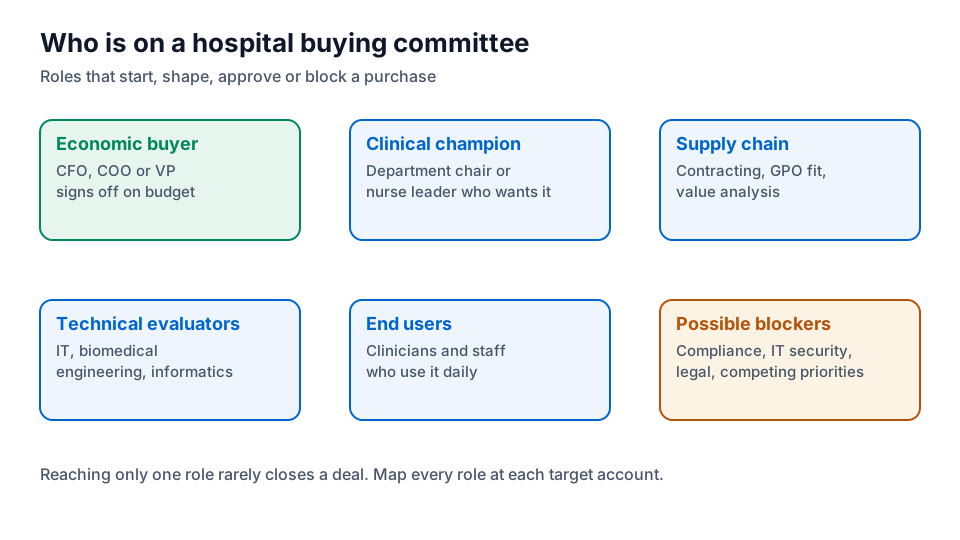
A hospital buying committee is the group of people who decide on a purchase together. It usually includes an economic buyer who controls budget, a clinical champion, technical evaluators, supply chain, the end users, and anyone who can block the deal.
Why it matters for healthcare sales and marketing
Hospital purchases are rarely made by one person. A deal can have a strong clinical champion and still stall because finance didn't see the business case, IT security raised concerns, or supply chain wasn't involved. For sales and marketing this means:
- Multi-threading. Reps need relationships with several roles at each account, not one contact.
- Different messages per role. A CFO cares about cost and return, a department chair about outcomes, IT about integration and security.
- Account-based planning. Marketing builds audiences that cover every role at each target account, not just one job title.
How it works
Names vary, but these roles show up in most hospital purchases:
| Role | Typical titles | What they care about |
|---|---|---|
| Economic buyer | CFO, COO, VP of the service line | Budget, return, strategic fit |
| Clinical champion | Department chair, medical director, nurse leader | Patient outcomes, workflow, clinician adoption |
| Supply chain | Supply chain director, value analysis manager | Contract fit, total cost, vendor reliability |
| Technical evaluators | CIO, CMIO, IT security, biomedical engineering | Integration, security, maintenance |
| End users | Physicians, nurses, technicians | Ease of use, time saved |
| Possible blockers | Compliance, legal, IT security, competing projects | Risk, priorities, contracts |
For larger purchases, a formal process such as a value analysis committee or an IT governance review usually sits on top of these roles.
Example
Illustrative scenario. A health IT company selling a nurse scheduling platform finds strong interest from a chief nursing officer, but the deal stalls. When the team maps the committee, it finds the CFO hasn't seen the business case and the CIO's team hasn't reviewed integration with the existing HR system. The company runs a second track: a cost-savings model for finance and a technical session for IT. Marketing then adds those roles at every target hospital to the next campaign.
Common mistakes
- Relying on one champion. If the champion leaves or loses priority, the deal goes with them.
- Reaching blockers too late. IT security and compliance reviews take time, so start them early.
- Sending everyone the same message. Each role needs its own reason to say yes.
- Building lists by one title. Target every role on the committee at each account.
Related terms
Put it to work
- Hospital C-suite lists: CFOs, CIOs, CMOs and other economic buyers
- Mapping the hospital buying committee (ebook): a full guide to each role
- Account-based marketing use case: covering every role at target accounts