What is Joint Commission accreditation?
Also called: Joint Commission Accreditation Standards, TJC accreditation
Joint Commission accreditation shows that a hospital or other healthcare organization meets The Joint Commission's standards for quality and safety. The Joint Commission is an independent nonprofit, and its accreditation can be used to show compliance with Medicare's conditions of participation.
Why it matters for healthcare sales and marketing
Accreditation surveys are high-stakes events for hospitals. Products and services that help meet standards for patient safety, infection control, medication management and documentation get attention, especially from quality, nursing and compliance leaders.
How it works
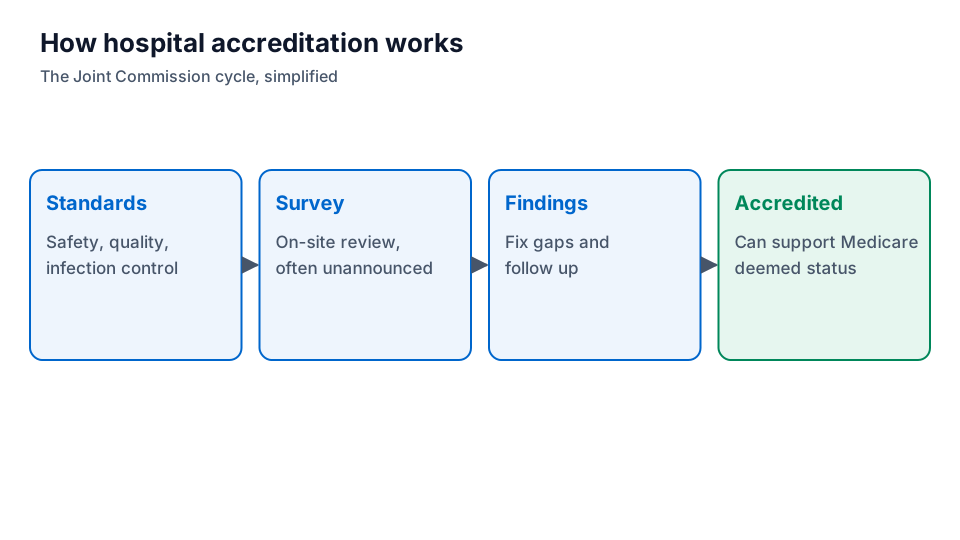
- Standards cover areas such as patient safety, infection prevention, medication management and leadership.
- Surveys are on-site reviews, usually unannounced for hospitals.
- Deemed status: CMS recognizes accreditation from approved organizations, including The Joint Commission, as meeting Medicare requirements.
- National Patient Safety Goals highlight specific safety priorities each year.
Example
Illustrative scenario. A medication safety technology vendor reaches quality directors and pharmacy directors at hospitals, connecting its product to specific accreditation standards and safety goals they are preparing for.
Common mistakes
- Overclaiming. Products support compliance; they don't guarantee accreditation.
- Ignoring quality leaders. They own accreditation readiness.
- Assuming every facility uses The Joint Commission. Other accrediting bodies exist.
Related terms
Put it to work
- Hospitals list: hospital and health system contacts
- Department directors lists: quality and pharmacy directors
- Hospital C-suite lists: executives managing value-based contracts
Sources
- The Joint Commission, The Joint Commission