What is an integrated delivery network (IDN)?
Also called: IDN, health system, integrated health system
An integrated delivery network (IDN) is an organization that owns or runs several kinds of care settings, typically hospitals, physician groups, outpatient centers and post-acute care, under one parent, usually with shared purchasing, IT and clinical standards.
Why it matters for healthcare sales and marketing
A growing share of U.S. hospitals and physicians sit inside health systems, so for many vendors the IDN, not the single hospital, is the real customer.
- Decisions move to the center. System-level supply chain, value analysis and IT teams often choose products and platforms for every facility at once.
- One win can be large. A system-wide agreement can cover many hospitals, clinics and surgery centers.
- More people are involved. System committees, facility leaders and clinicians all weigh in, so selling to an IDN is an account-based effort rather than a single conversation.
How it works
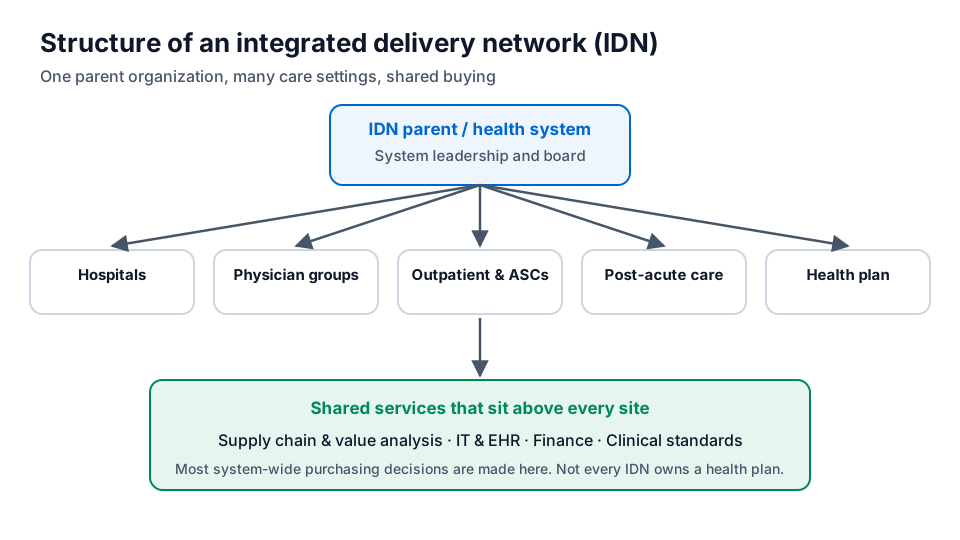
IDNs vary widely in size and structure, but most share a pattern:
- A parent organization with system leadership and a board.
- Care settings such as acute care hospitals, employed physician groups, outpatient and ambulatory surgery centers, and post-acute care. Some IDNs also own a health plan.
- Shared services that sit above every site: supply chain and value analysis, IT and the EHR, finance, and clinical standards. Most system-wide purchasing decisions are made here.
How centralized buying is depends on the category. Commodity supplies and enterprise software are usually decided centrally. Physician preference items, such as some implants, can still depend heavily on individual surgeons and departments.
Example
Illustrative scenario. A surgical robotics company targets a regional IDN. Instead of pitching each hospital separately, the team maps the system first: which hospitals already run robotic programs, who leads system supply chain and value analysis, which surgeons chair the relevant service lines, and whether the system buys through a GPO contract. The sales plan then works on two levels: system-level executives and the value analysis committee for the agreement, and surgeons at each hospital for adoption.
Common mistakes
- Treating each hospital as independent. A local champion can't approve a purchase that the system decides centrally.
- Assuming everything is centralized. For physician preference items, individual surgeons and departments still carry a lot of weight.
- Forgetting employed physicians. Physician groups owned by the IDN often follow system contracts and standards.
- Mixing up IDNs, GPOs and ACOs. An IDN delivers care, a GPO negotiates contracts, and an ACO is a payment arrangement built around shared savings.
Related terms
Put it to work
- Hospitals list: contacts at hospitals and health systems
- Hospital C-suite lists: system and hospital executives
- Account-based marketing use case: building account-based programs for health systems
Sources
- Compendium of U.S. Health Systems, Agency for Healthcare Research and Quality