Beyond the Contact Record
How Intent Data and Technology Intelligence Shorten Healthcare Sales Cycles
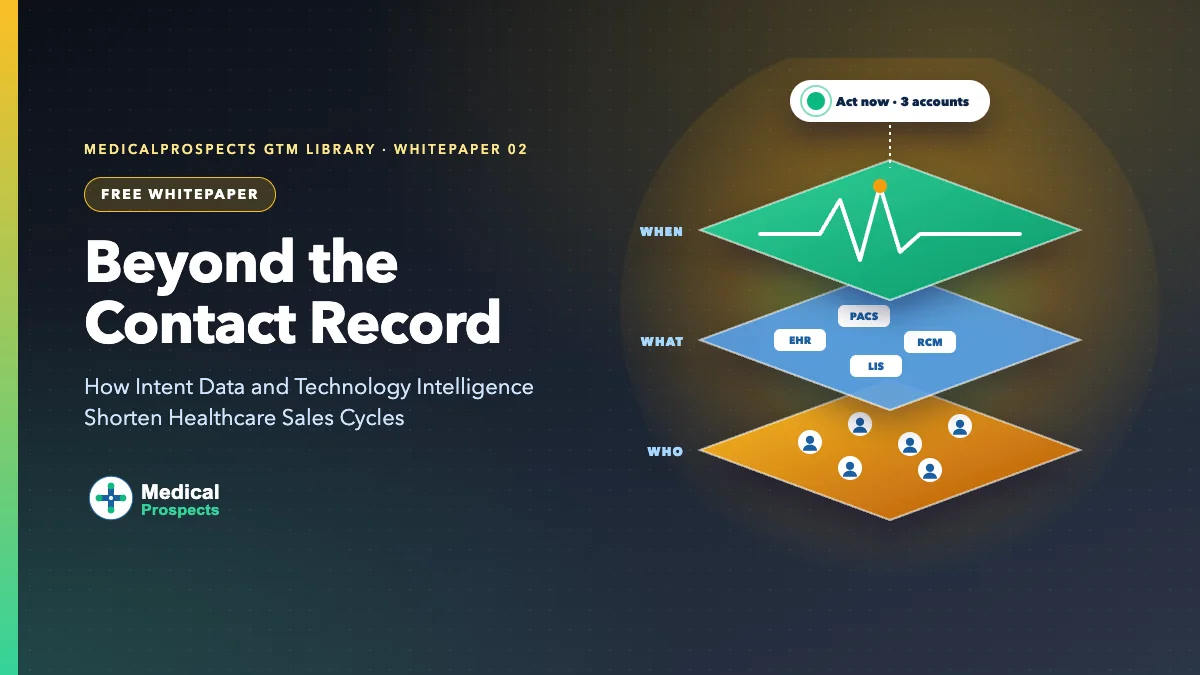
This MedicalProspects whitepaper sets out a three-layer model of healthcare audience intelligence: verified people (who), installed technology (what) and buying intent (when). It shows what each layer can and cannot tell you, how to combine them into an account priority model, and how to roll the model out in 90 days.
Key points
- Three gaps stall healthcare deals: the committee gap, the timing gap and the context gap.
- Three layers close them: People, Technology and Buying Intelligence, on a verified contact foundation.
- Intent data answers "when", not "who"; use it at account level and act within days.
- Technology data enables four plays: displacement, integration, complementary and gap targeting.
- A fit-by-intent model decides which accounts get sales attention this month.
- A 90-day rollout with a control group proves whether the model works.
What's inside this whitepaper
-
Executive Summary
A verified contact list tells you who to reach. What it can't tell you is which accounts are in the market right now, or what those accounts already run. Healthcare teams that add those two answers end up spending their time on fewer, better accounts, and they reach them while the decision is still genuinely open.
-
Why Healthcare Deals Stall
Healthcare sales cycles are long for structural reasons, not because reps are slow. In our experience, three gaps cause most of the delay, and contact data on its own closes none of them.
-
The Three Layers of Healthcare Audience Intelligence
Think of audience intelligence as three layers. Each answers one question, and each depends on the layer beneath it. Intent and technology signals point you to organizations; verified contact data turns those organizations into people you can reach.
-
Buying Intelligence: Intent Data in Healthcare
Intent data shows which organizations are researching a topic more than usual right now. It answers "when," not "who," and it's easy to over- or under-estimate. Used well, it decides which accounts get your team's attention this month.
-
Technology Intelligence: Knowing What They Already Run
What an organization already runs shapes almost everything about how you should sell to it: what it can buy, how to position your offer and who will evaluate it. Technology Intelligence answers that question for both software and clinical equipment, and it's often the fastest way to make a first message feel specific.
-
Putting the Layers Together: Account Prioritization
Score every account on two dimensions. Fit combines the ideal customer profile (type, size, geography) with technology fit (a platform you integrate with, a competitor you displace, or a gap you fill). Intent is the strength and freshness of research on your topics. The quadrant decides what each account gets this month.
-
Use Cases by Team
Each type of healthcare vendor combines the three layers a little differently, but the underlying pattern holds: fit decides who's eligible, technology shapes the message, and intent sets the timing.
-
A 90-Day Rollout Plan
The temptation with any new data source is to roll it out everywhere at once. We'd recommend the opposite: start with one product, one segment and one team. Prove the model there, then expand. Three 30-day phases are enough to show whether it's working.
-
Evaluating an Audience Intelligence Provider
Many vendors now sell intent or technology data. Ask these questions before you buy.
-
Privacy and Responsible Use
Account-level signals are generally less sensitive than person-level tracking, but responsible use still matters.
-
Conclusion: Who, What and When
A healthcare contact list answers one question. The teams that consistently win answer three: who the buyers are, what they already run and whether they're in the market now. Together, those answers turn a long list into a short, ranked plan, and generic outreach into a timely, relevant conversation that buyers are glad to have.
Get the full whitepaper
All 11 sections, with checklists, tables and templates you can use with your team.
Read the full whitepaper
The complete text of Beyond the Contact Record, the same content as the PDF. Download the PDF above for the designed version with worksheets you can print.
Executive Summary
A verified contact list tells you who to reach. What it can't tell you is which accounts are in the market right now, or what those accounts already run. Healthcare teams that add those two answers end up spending their time on fewer, better accounts, and they reach them while the decision is still genuinely open.
That matters because healthcare buyers now do much of their research before talking to any vendor. By the time a hospital issues an RFP or a practice books a demo, the shortlist may already be set. Vendors who arrive at that point usually end up competing on price, if they're invited at all.
This paper sets out a three-layer model of healthcare audience intelligence:
- People Intelligence (who): verified decision-makers, clinicians and organizations, anchored on NPI data where it applies
- Technology Intelligence (what): the software platforms and clinical equipment each organization has deployed
- Buying Intelligence (when): intent signals that show which organizations are actively researching relevant topics
If buyers spend only a small share of their time with any one supplier, most of the decision is formed in research you cannot see. Intent and technology data are ways to see more of it.
This paper explains what each layer can and cannot tell you, shows how to combine them into an account priority model, gives use cases for MedTech, HealthTech, pharma and services teams, and closes with a 90-day rollout plan and the metrics to track.
Section 1: Why Healthcare Deals Stall
Healthcare sales cycles are long for structural reasons, not because reps are slow. In our experience, three gaps cause most of the delay, and contact data on its own closes none of them.
1. The committee gap
A hospital purchase can involve clinical champions, department heads, IT, security, procurement, finance and the C-suite. A rep who reaches one person can be blocked by any of the others. Teams need to see every role at the account, not just one name.
2. The timing gap
Healthcare organizations buy on budget cycles, contract renewals and strategic initiatives. Outreach that arrives a year before a renewal is ignored. Outreach that arrives after the shortlist is set is too late. Without timing signals, reps spread effort evenly across accounts that are not equally ready.
3. The context gap
A pitch that ignores what an organization already runs sounds generic. A revenue cycle vendor that does not know a hospital's EHR cannot speak to integration. A device company that does not know a hospital's installed imaging equipment cannot position an upgrade or a replacement.
What each gap costs
| Gap | What happens | Cost to the vendor |
|---|---|---|
| Committee | One contact goes quiet; the deal stalls | Months added to the cycle |
| Timing | Outreach misses the buying window | Effort spent on accounts that cannot buy yet |
| Context | Messages ignore the current stack | Low reply rates; seen as a generic vendor |
People Intelligence closes the committee gap. Buying Intelligence closes the timing gap. Technology Intelligence closes the context gap.
- Three gaps stall healthcare deals: the committee, the timing and the context.
- Contact data alone closes none of them.
- Each gap has a matching layer: people, buying and technology intelligence.
Section 2: The Three Layers of Healthcare Audience Intelligence
Think of audience intelligence as three layers. Each answers one question, and each depends on the layer beneath it. Intent and technology signals point you to organizations; verified contact data turns those organizations into people you can reach.
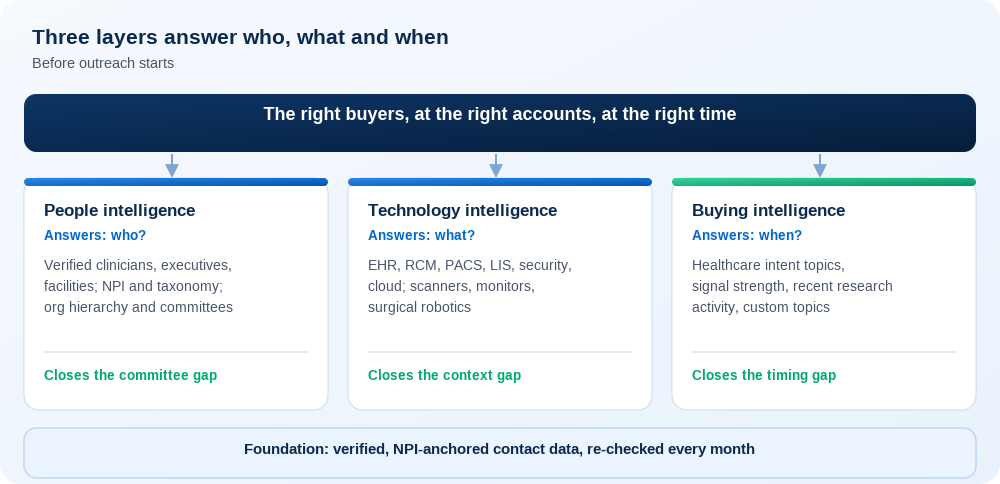
Without that foundation, the other layers have nothing to act on. A strong intent signal at a hospital is worthless if your contact there left last year. That's why the people layer comes first, and why it has to stay fresh.
What each layer is made of
| Layer | Typical sources | Refresh pattern | Level |
|---|---|---|---|
| People | Registries, licensing boards, directories, partners | Monthly re-verification | Person and organization |
| Technology | Surveys, filings, directories, usage signals | Periodic refresh | Organization |
| Buying | Research activity across publisher networks | Weekly or faster | Organization (account) |
Section 3: Buying Intelligence: Intent Data in Healthcare
Intent data shows which organizations are researching a topic more than usual right now. It answers "when," not "who," and it's easy to over- or under-estimate. Used well, it decides which accounts get your team's attention this month.
How intent signals work
B2B intent data is built from research activity: people at an organization reading articles, comparing solutions and consuming content about a topic. When an organization's activity on a topic rises well above its normal level, that rise is the signal.
MedicalProspects' Healthcare Intent Data adds three fields to an audience:
- Intent topics: what the organization is researching
- Intent strength: how strong the signal is compared with normal activity
- Recent research activity: how fresh the signal is
Healthcare intent topics
Topics available include AI in healthcare, EHR/EMR, revenue cycle management, telehealth, medical imaging, healthcare cybersecurity, clinical decision support, laboratory solutions, healthcare analytics, population health, clinical workflow automation, patient engagement, healthcare CRM, medical devices, cloud platforms, remote patient monitoring, healthcare staffing, pharmacy management, value-based care and digital transformation. Custom topics can be built around a specific product or market.
What intent data can and cannot tell you
| Intent data can | Intent data cannot |
|---|---|
| Show that an organization is researching a topic now | Tell you which individual is doing the research |
| Rank accounts by how strong and how recent the interest is | Confirm budget, authority or a formal buying project |
| Suggest which topic to lead with in outreach | Replace verified contacts for the people on the committee |
| Flag new interest at accounts you were not watching | Stay accurate for long; signals lose value within weeks |
Using intent responsibly
- Act on the account, not the person. Do not tell a prospect you know what they have been reading. Use the signal to choose the topic and timing, then lead with value.
- Combine it with fit. A strong signal at an account outside your ideal customer profile is still a poor use of time.
- Move fast. Route new signals to sales within days, not at the next quarterly planning cycle.
- Intent data shows which accounts are researching a topic more than usual.
- It does not identify individuals, confirm budget or replace verified contacts.
- Act on the account, combine with fit, and move fast; signals lose value within weeks.
Section 4: Technology Intelligence: Knowing What They Already Run
What an organization already runs shapes almost everything about how you should sell to it: what it can buy, how to position your offer and who will evaluate it. Technology Intelligence answers that question for both software and clinical equipment, and it's often the fastest way to make a first message feel specific.
Coverage
| Digital health technology | Clinical infrastructure |
|---|---|
| Electronic health records (EHR/EMR) | MRI and CT scanners |
| Revenue cycle management (RCM) | Diagnostic imaging equipment |
| PACS and medical imaging systems | Laboratory analyzers and robotics |
| Laboratory information systems (LIS) | Patient monitoring systems |
| Healthcare cybersecurity platforms | Surgical robotics and devices |
| Cloud infrastructure and hosting | |
| Telehealth and virtual care platforms |
Four plays technology data enables
- Competitive displacement. Target organizations running a competitor's product. Lead with the specific weaknesses customers raise about it and a clear migration path.
- Integration targeting. Target organizations running a platform you integrate with. "Built for your EHR" removes the first objection IT will raise.
- Complementary selling. An organization with a new PACS may need AI imaging tools. A hospital with surgical robotics may need related instruments, training or analytics.
- Gap targeting. Organizations without a category of technology may be early prospects, for example facilities with no remote patient monitoring platform.
Why it changes the conversation
Technology context turns a generic first email into a relevant one. Compare:
- Without: "Our platform helps hospitals improve revenue cycle performance."
- With: "Teams running your current EHR use our integration to cut manual claim edits. Here is how one health system set it up."
The second message names the prospect's reality and gives IT a reason to say yes.
Message examples by technology environment
| What they run | Opening line |
|---|---|
| A major EHR you integrate with | "Teams on [EHR] use our integration to remove manual steps; here is how one system set it up." |
| A competitor's product | "Here is a migration path and what customers tell us about the first 90 days." |
| A new imaging platform | "Sites that recently added [platform] often look at AI tools next; here is a short evidence summary." |
| No platform in a category | "Many facilities start with a light version before a full rollout; here is how that works." |
- Technology data tells you what an organization can buy and who will evaluate it.
- Four plays: displacement, integration, complementary and gap.
- A message that names the prospect's environment earns attention on the first line.
Section 5: Putting the Layers Together: Account Prioritization
Score every account on two dimensions. Fit combines the ideal customer profile (type, size, geography) with technology fit (a platform you integrate with, a competitor you displace, or a gap you fill). Intent is the strength and freshness of research on your topics. The quadrant decides what each account gets this month.
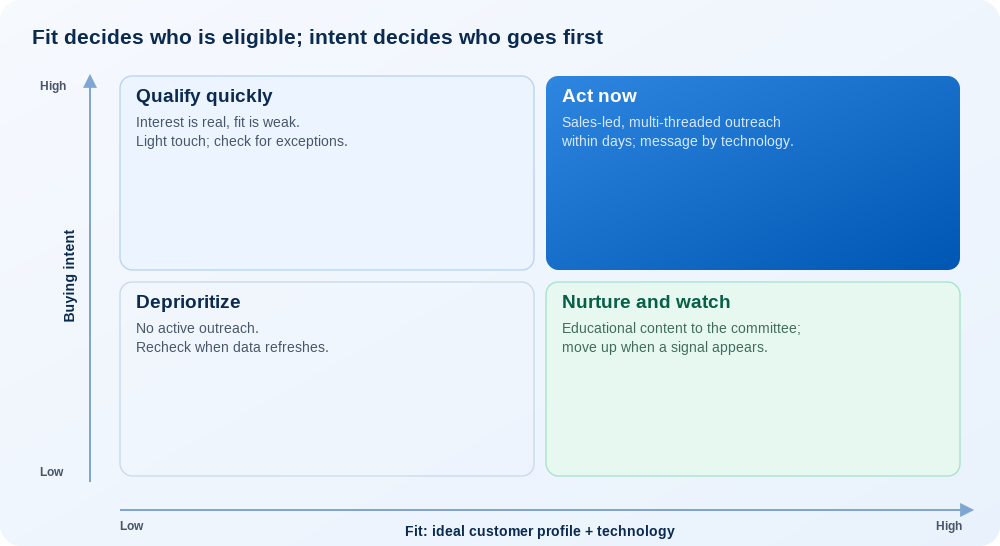
Re-score accounts whenever intent signals refresh. Accounts move between quadrants as their research activity changes, and that movement is the moment to act.
What each quadrant gets
| Quadrant | Owner | Outreach | Message built from |
|---|---|---|---|
| Act now | Account executive + SDR | Multi-threaded sequences to every committee role, within days of the signal | Their technology environment and the topic they are researching |
| Nurture and watch | Marketing | Educational content and events for the committee | Their technology environment |
| Qualify quickly | SDR | One short, low-effort touch to test fit | The topic they are researching |
| Deprioritize | None | No active outreach | — |
Scoring accounts in practice
A simple scoring model is enough to start:
| Factor | Example scoring (illustrative) |
|---|---|
| Ideal customer profile fit (type, size, geography) | 0–3 points |
| Technology fit (integrate, displace or fill a gap) | 0–3 points |
| Intent strength | 0–3 points |
| Intent freshness | 0–1 point |
Add the points, set thresholds for "act now" and "nurture" and revisit them after the first 60 days. Keep the model simple enough that sales can explain it.
Complete before building an audience.
- Ideal customer profile: organization type, size, geography:
- Technology that makes an account a fit (integrate, displace, fill gap):
- Three to five intent topics that match your product:
- Threshold for "act now", and how fast sales must respond:
Section 6: Use Cases by Team
Each type of healthcare vendor combines the three layers a little differently, but the underlying pattern holds: fit decides who's eligible, technology shapes the message, and intent sets the timing.
| Team | People (who) | Technology (what) | Buying (when) | The play |
|---|---|---|---|---|
| HealthTech: RCM software | CFOs, revenue cycle directors, CIOs | Current EHR and RCM vendor | Surging interest in revenue cycle management | Integration-led outreach to hospitals on a compatible EHR that are researching RCM now |
| MedTech: imaging AI | Radiology chairs, imaging directors, CMIOs | Installed PACS and scanners | Interest in AI in healthcare and medical imaging | Complementary offer to sites with recent imaging investments |
| MedTech: surgical devices | Surgeons by subspecialty, OR directors, value analysis committees | Surgical robotics installed | Interest in medical devices for the procedure area | Pair robot-equipped hospitals with the surgeons who use the robots |
| Pharma and biotech | Specialists by taxonomy code, pharmacy directors, P&T committee members | Pharmacy management and EHR platforms | Interest in a therapeutic or value-based care topic | Time medical and access outreach to systems researching the area |
| Cybersecurity vendors | CISOs, CIOs, compliance officers | Cloud hosting and security platforms | Surging interest in healthcare cybersecurity | Competitive displacement at accounts running a rival platform |
| Staffing and services | CNOs, HR directors, department heads | Telehealth and virtual care platforms | Interest in healthcare staffing | Reach systems researching staffing before the next hiring push |
A worked example
A revenue cycle software company targets U.S. hospitals.
- Fit: filter to hospitals with 100+ beds whose EHR it integrates with.
- Intent: rank that group by recent, strong interest in revenue cycle management.
- People: for the top-ranked accounts, map the CFO, revenue cycle director, CIO and patient financial services lead.
- Message: lead with the integration, a peer health system example and a short assessment offer.
The sales team works a short, ranked list with the right message for each account, instead of every hospital in alphabetical order.
- Fit decides who is eligible, technology decides the message and intent decides timing.
- Keep scoring simple and explainable.
- Re-score when signals refresh; movement between quadrants is the moment to act.
Section 7: A 90-Day Rollout Plan
The temptation with any new data source is to roll it out everywhere at once. We'd recommend the opposite: start with one product, one segment and one team. Prove the model there, then expand. Three 30-day phases are enough to show whether it's working.
- Days 1–30: Define and build. Write the ideal customer profile, including the technologies you need or replace. Choose 3–5 intent topics that match your product. Size the audience with the Audience Estimator, then build it with People, Technology and Buying Intelligence. Agree with sales which accounts go to which tier, and how fast reps must act on a new signal.
- Days 31–60: Launch and learn. Run tier-specific campaigns: account-based plays for top-tier accounts, nurture for the rest. Write technology-specific messages for your two or three most common environments. Hold a weekly review of new signals with sales.
- Days 61–90: Measure and expand. Compare the tiered accounts with a control group worked the old way. Refresh intent signals and re-tier accounts. Extend the model to a second product or segment if the results hold up.
Metrics to track
| Metric | What it shows | Compare |
|---|---|---|
| Reply and meeting rate by tier | Whether top-tier accounts engage more | Top tier vs. lower tiers vs. control group |
| Time from first touch to opportunity | Whether timing signals speed up deals | Intent-led accounts vs. control group |
| Opportunities per rep hour | Whether reps spend time better | Before vs. after rollout |
| Accounts with 3+ engaged roles | Whether you are reaching the whole committee | By tier |
| Win rate on displacement deals | Whether technology context improves positioning | Technology-led vs. generic messaging |
Common pitfalls
| Pitfall | What goes wrong | Prevention |
|---|---|---|
| Treating intent as certainty | Pressure on accounts that are not buying | Combine with fit and verify through conversations |
| Slow routing | Signals go stale before sales acts | Agree a response time with sales |
| Telling prospects what they read | Feels intrusive and damages trust | Use the signal to pick the topic only |
| Ignoring the contact layer | Right account, wrong or missing contact | Keep people data verified and fresh |
| Generic messages | The technology context is not used | Write messages for your two or three common environments |
Section 8: Evaluating an Audience Intelligence Provider
Many vendors now sell intent or technology data. Ask these questions before you buy.
- Are all three layers linked to the same organizations? Intent and technology data are only useful if they connect to verified contacts at the same account.
- Is the contact layer verified and fresh? Ask about sources, NPI matching and refresh frequency. Intent cannot rescue an outdated contact list.
- Are intent topics healthcare-specific? Generic B2B topics miss terms such as revenue cycle management, PACS or value-based care.
- How are signal strength and freshness shown? You need both to rank accounts.
- Does technology data cover clinical equipment as well as software? For MedTech, installed equipment often matters more than software.
- Can custom topics be built for your product?
- How is the data delivered? Check that it loads cleanly into your CRM and marketing automation fields.
- How is privacy handled? Confirm that signals are used at account level and that the provider follows CAN-SPAM, GDPR and CCPA.
Section 9: Privacy and Responsible Use
Account-level signals are generally less sensitive than person-level tracking, but responsible use still matters.
- Confirm how the provider collects signals, and that it follows applicable privacy laws.
- Use signals at account level to choose topics and timing.
- Keep CAN-SPAM, GDPR and CCPA obligations in your outreach: an accurate sender, a working opt-out and respect for rights requests.
- Document how you use intent data so legal and compliance teams can review it.
Who, What and When
A healthcare contact list answers one question. The teams that consistently win answer three: who the buyers are, what they already run and whether they're in the market now. Together, those answers turn a long list into a short, ranked plan, and generic outreach into a timely, relevant conversation that buyers are glad to have.
MedicalProspects brings the three layers together in one audience:
- People Intelligence: verified healthcare professionals, executives, facilities and organizational hierarchy, with NPI data where it applies and monthly re-verification
- Technology Intelligence: software platforms and clinical equipment deployed across hospitals and practices
- Buying Intelligence: healthcare intent topics with signal strength and recent research activity, plus custom topics
Both intelligence layers are available as optional enhancements across all MedicalProspects audiences. You can size the audience first with the Interactive Healthcare Audience Estimator.
Request an audience brief at medicalprospects.com or email [email protected].
Section 10: Appendix: Glossary
| Term | Meaning |
|---|---|
| Intent data | Signals showing that an organization is researching a topic more than usual |
| Intent strength | How far research activity rises above the organization's normal level |
| Technology intelligence | Data on the software and clinical equipment an organization has deployed |
| Ideal customer profile (ICP) | A description of the accounts most likely to buy and succeed |
| Account-based marketing | Focusing marketing and sales effort on named target accounts |
| Competitive displacement | Winning accounts that currently use a competitor's product |
| Multi-threading | Building relationships with several buying-committee members at once |
| Control group | A comparison group worked the old way, used to measure the impact of a new approach |
| EHR | Electronic health record system |
| RCM | Revenue cycle management |
Sources
- Gartner research on B2B buying, as reported in industry coverage (Gartner page not accessible to verify).
- American Hospital Association, Fast Facts on U.S. Hospitals, 2026 (2024 AHA Annual Survey). https://www.aha.org/statistics/fast-facts-us-hospitals
- Physicians Advocacy Institute and Avalere Health, Physician Employment and Practice Ownership Trends 2019–2023. https://physiciansadvocacyinstitute.org/PAI-Research/PAI-Avalere-Study-on-Physician-Employment-Practice-Ownership-Trends-2019-2023

John Britton
John works with healthcare sales and marketing teams on precision targeting, campaign strategy, and audience intelligence solutions at MedicalProspects.
More whitepapers →