What is territory planning?
Also called: sales territory design, territory mapping, territory alignment
Territory planning is dividing a market into sales territories so each rep gets a fair share of potential customers and a workload they can cover. In healthcare, potential is usually measured in target providers, facilities and procedure volume by geography.
Why it matters for healthcare sales and marketing
Territories decide where reps spend their time. Badly drawn territories leave some reps buried and others starved, and leave real opportunity uncovered. In healthcare the stakes are higher because:
- Potential is uneven. Specialists, hospitals and surgery centers cluster in metro areas, so equal geography rarely means equal opportunity.
- Accounts cross lines. A health system can span several territories, so account ownership needs rules.
- Launches and expansion change the map. New products, new reps and new regions all force a redraw.
How it works
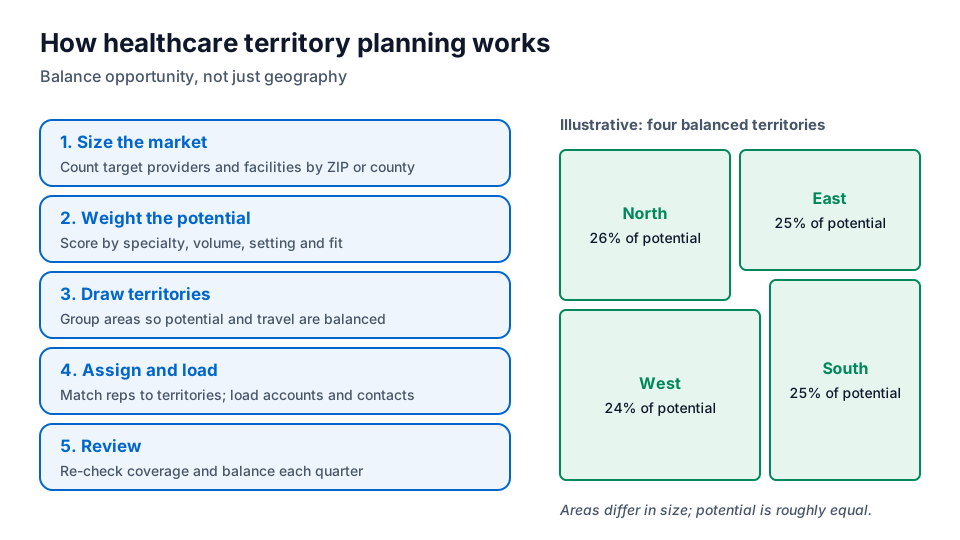
- Size the market. Count target providers and facilities by ZIP code or county, for example orthopedic surgeons and the ASCs and hospitals where they operate.
- Weight the potential. Score areas by what matters for your product: specialty mix, procedure volume, care setting and fit.
- Draw territories. Group areas so that potential and travel time are roughly balanced.
- Assign and load. Match reps to territories and load the accounts and contacts into the CRM.
- Review. Re-check coverage and balance every quarter, and after any launch or hiring change.
The core input is accurate counts of your target audience by geography, kept current as providers move and practices open or close.
Example
Illustrative scenario. An orthopedic device company is growing from four to six reps in one region. Instead of splitting the map into six equal shapes, it counts orthopedic surgeons, orthopedic-focused ASCs and hospitals with high joint replacement volume by county, weights them by fit, and draws six territories of roughly equal potential. One large metro area gets split between two reps, and a big rural area becomes a single territory. Health systems that span two territories are assigned to one owner.
Common mistakes
- Drawing equal shapes. Equal geography almost never means equal potential.
- Counting everyone. Use the target specialty and setting, not every physician in the area.
- No rules for system accounts. Decide who owns a health system that spans territories before conflicts start.
- Setting it once. Provider movement, new facilities and hiring all shift the balance. Review quarterly.
Related terms
Put it to work
- Healthcare audience count calculator: estimate target counts by specialty and state
- Sales teams use case: loading territories with verified contacts
- Orthopedic surgeons list: an example audience to count by territory