What is a custom list build?
Also called: White-Glove Custom Database Filtering, custom audience, custom data build
A custom list build is a contact list assembled to your exact specification, combining criteria such as specialty, role, care setting, geography and technology, instead of buying a ready-made list as is.
Why it matters for healthcare sales and marketing
Ready-made lists fit standard audiences. Many campaigns need combinations: interventional cardiologists at hospitals with cath labs in six states, or revenue cycle leaders at health systems running a specific EHR. A custom build gives you exactly that audience, without paying for records you don't need.
How it works
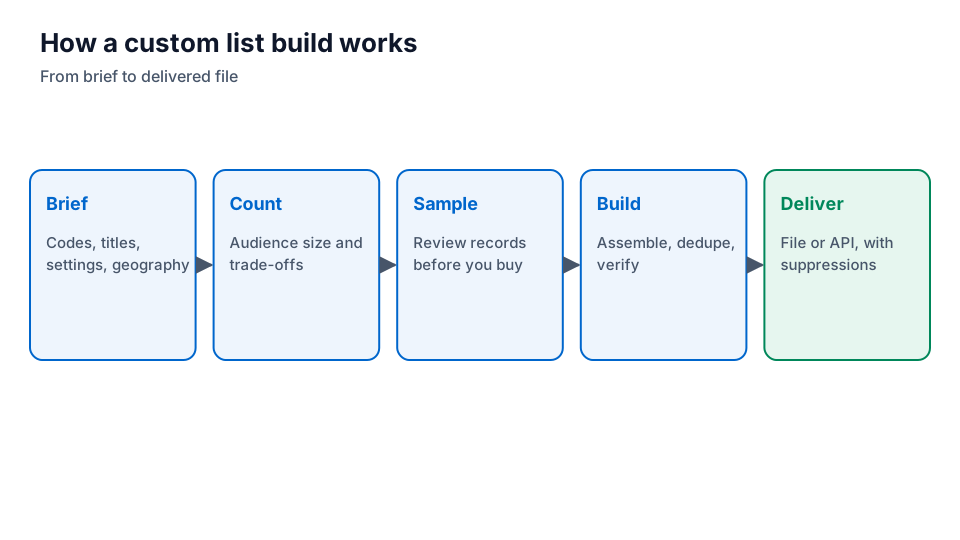
- Brief: describe the audience, ideally with taxonomy codes, titles, settings, geography and exclusions.
- Count: the provider returns the size of the audience and any trade-offs.
- Sample: review sample records before you commit.
- Build and verify: records are assembled, de-duplicated and verified.
- Deliver: as a file or through an API, with your suppressions applied.
Example
Illustrative scenario. An event organizer wants nurse leaders and infection prevention specialists at hospitals within driving distance of its conference venue. It sends a brief with titles, hospital types and a radius, approves the count and a sample, and receives a file with its past attendees suppressed.
Common mistakes
- Vague briefs. "Decision makers at hospitals" can mean anything.
- Skipping the sample. Check fit before paying.
- Forgetting suppressions. Exclude current customers and opt-outs.
How MedicalProspects does it
MedicalProspects builds custom audiences from any combination of its 474 lists and filters: send a brief, get a count and 20 sample records, then receive the verified file. The house name for this service was "white-glove custom filtering".
Related terms
Put it to work
- Request a custom count: tell us your audience
- Custom builds in our FAQ: how custom audiences work
- Audience count calculator: estimate audience size