What is account-based marketing in healthcare?
Also called: ABM, Account-Based Marketing (ABM) in Healthcare
Account-based marketing (ABM) is a B2B approach in which sales and marketing focus together on a defined list of high-value target accounts, such as specific health systems, and reach the people on each account's buying committee with tailored messages.
Why it matters for healthcare sales and marketing
Healthcare deals often involve a few large accounts and many decision makers. ABM concentrates effort where the revenue is, and coordinates marketing and sales so every role at a target account hears a consistent, relevant story.
How it works
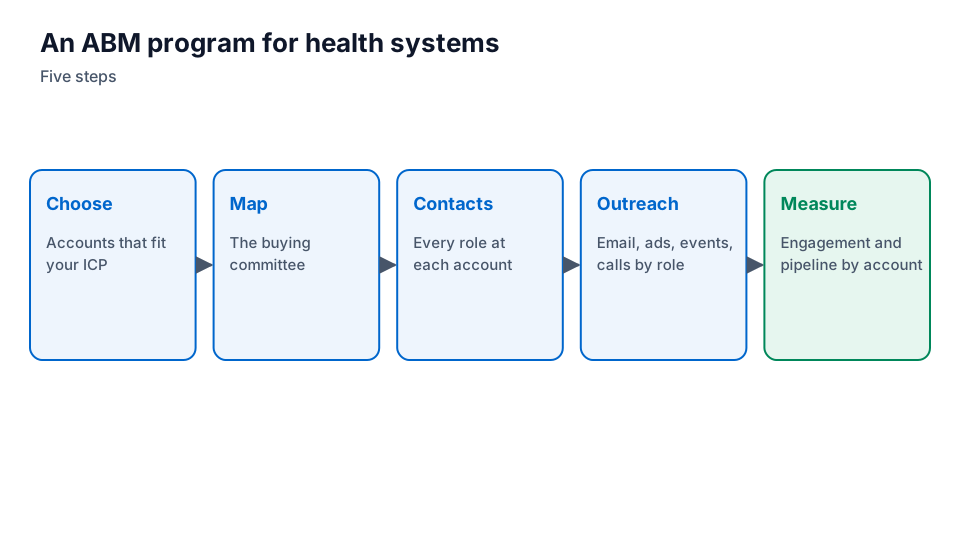
- Choose accounts that match your ideal customer profile, often with intent or technographic signals.
- Map the buying committee at each account.
- Get contacts for every role on the committee.
- Coordinate outreach across email, ads, events and sales calls, with messages by role.
- Measure by account: engagement and pipeline at each target account, not just leads.
Example
Illustrative scenario. A health IT company picks 50 health systems that run a compatible EHR and match its size profile. For each, it targets the CIO, CMIO, CFO and relevant department leaders with role-specific emails and ads, while account executives follow up with the most engaged.
Common mistakes
- Too many accounts. ABM works when the list is focused.
- One contact per account. Cover the buying committee.
- Measuring leads. Measure account engagement and pipeline.
Related terms
Put it to work
- Account-based marketing use case: building account-based programs
- Pharma ABM case study: an ABM campaign example
- Hospital buying committee, explained: the roles to cover