Who Buys What in Healthcare? A Product-to-Buyer Guide for MedTech, Pharma & HealthTech

VP of Marketing, MedicalProspects
September 25, 2026
TL;DR
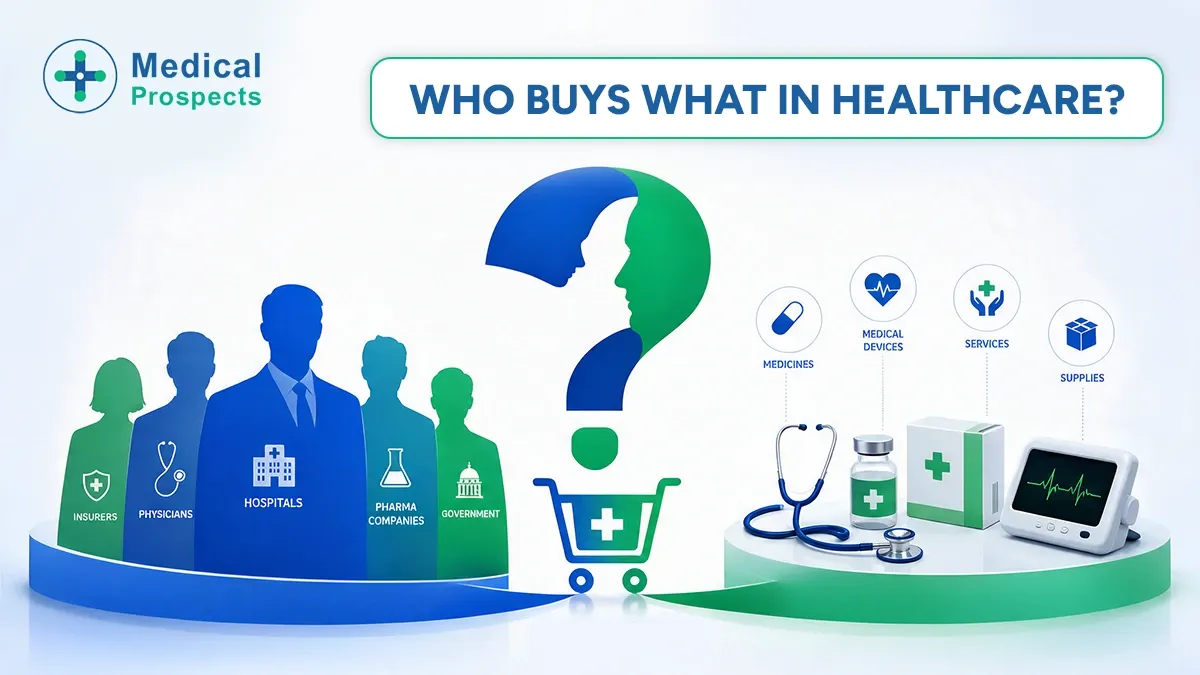
The person who uses a healthcare product is not always the person who buys it. Healthcare purchases often involve a buying committee spanning clinical, operational, financial, technology, and procurement roles. This guide maps those roles across MedTech, HealthTech, diagnostics, pharma, clinical research, and healthcare services.
Knowing what you sell is only half the equation. The other half is understanding who (healthcare buyers) is involved in buying it, and how healthcare purchasing decisions actually get made inside an organization.
Each involves a different mix of clinical, operational, financial, procurement, and technology stakeholders, with each weighing the product against different priorities.
That is why targeting "hospitals," "healthcare providers," or even broad groups such as "medical directors" is often not enough. This article maps who buys what across MedTech, pharma, and HealthTech to align outreach with the real decision path.
Who Is Involved in Buying What You Sell?
The people who matter to healthcare sales are not always obvious from the product itself. A product may be used by one group, evaluated by another, and approved or purchased by others.
That makes the buying group an important part of market definition. Looking beyond job titles to the roles involved in evaluation, financial ownership, procurement, and final approval can reveal a much more relevant target group.
The buyer map below shows how this plays out in practice, by product category, primary buyer, and the stakeholders who shape the decision alongside them.
| You sell | Start with | Also involve | Target facilities | Useful qualification |
|---|---|---|---|---|
| Orthopedic implants | Orthopedic surgeons | Surgical services, VAC, procurement | Hospitals, ASCs | Procedure volume |
| Imaging AI | Radiology leadership | CIO, CMIO, IT/security | Hospitals, imaging centers | PACS/EHR stack |
| Revenue-cycle software | Revenue Cycle Director | CFO, CIO, finance | Hospitals, health systems | EHR + RCM environment |
| Oncology therapy | Oncologists | Pharmacy, formulary/P&T | Cancer centers, hospitals | Specialty + treatment setting |
| Healthcare staffing | CNO / Nursing leadership | HR, operations, procurement | Hospitals, health systems | Facility type + workforce need |
Find the right healthcare buyers for your product. Talk to our MedicalProspects experts today for free samples.
Get Free Samples →
MedTech & Medical Devices: Mapping Products to Healthcare Buyers
MedTech purchasing often begins with a clinical need. The table below outlines common MedTech products, their primary clinical users, and the functions that may influence their evaluation or purchase.
| Product | Primary clinical target | Other important buyers |
|---|---|---|
| Orthopedic implants | Orthopedic surgeons | Surgical services, VAC, procurement |
| Spine devices | Spine surgeons/neurosurgeons | OR leadership, supply chain |
| Cardiovascular devices | Interventional cardiologists | Cath lab leadership, procurement |
| Electrophysiology devices | Electrophysiologists | Cardiology leadership, supply chain |
| Neurovascular devices | Neurointerventional specialists | Neurosurgery, hospital procurement |
| Surgical robotics | Surgeons / service-line chiefs | COO, CFO, OR leadership, procurement |
| Endoscopy equipment | Gastroenterologists | Endoscopy directors, procurement |
| Anesthesia equipment | Anesthesiologists | OR leadership, biomedical engineering |
| Patient monitoring systems | Critical-care leadership | Nursing, biomed, procurement |
| Wound-care products | Wound specialists/WOC nurses | Nursing leadership, supply chain |
In a nutshell, for MedTech companies, defining the addressable market means looking beyond the primary clinical user to the wider buying group. It is the organizations, departments, and stakeholders connected to the specific clinical and purchasing decision.
HealthTech: Understanding Who Buys Healthcare Technology
Healthcare technology products often sit between clinical workflows, IT infrastructure, and business operations. As a result, identifying the right buyer group requires looking beyond the product category to the functions involved in evaluating, implementing, managing, and approving the technology.
Here’s a table that highlights major HealthTech products and their primary buyers, and other stakeholders who may influence the purchasing process.
| Product | Primary buyer | Additional stakeholders |
|---|---|---|
| EHR integrations | CIO/CMIO | Informatics, EHR teams |
| Interoperability platforms | CIO / Interoperability Director | CMIO, IT architecture |
| Ambient AI scribes | CMIO / clinical informatics | Physicians, CIO, AI governance |
| Clinical decision support | Medical/clinical informatics leadership | CIO, physician leaders |
| Healthcare cybersecurity | CISO | CIO, risk, compliance |
| Cloud infrastructure | CIO / infrastructure leadership | CISO, architecture |
| Revenue-cycle software | Revenue Cycle Director | CFO, CIO |
| Patient-engagement platforms | Patient Experience/Digital Health | CIO, operations |
| Telehealth platforms | Virtual Care leadership | CIO, medical leadership |
| Remote patient monitoring | RPM/virtual-care leaders | Relevant specialists, IT |
For HealthTech companies, identifying relevant buyers and stakeholders means accounting for the people who shape technology adoption, not simply those who use the solution.
Diagnostics & Clinical Equipment: Where Clinical and Operational Needs Meet
Diagnostic and clinical equipment sits at the intersection of patient care, technical infrastructure, capital investment, and hospital operations.
While the diagnostic department using the equipment may identify the need. The purchasing process can involve finance, procurement, engineering, IT, and other operational stakeholders.
The table below provides a scannable buyer map for key diagnostic and clinical equipment categories, showing the primary audiences as well as other functions that may contribute to the purchasing process.
| Product | Primary target | Additional buyers |
|---|---|---|
| MRI/CT/imaging equipment | Radiology leadership | CFO, biomed, capital procurement |
| PACS/RIS | Radiology administrators | CIO, IT, security |
| AI imaging software | Radiologists | CIO, CMIO, data/AI leadership |
| Laboratory analyzers | Laboratory directors | Pathology, procurement |
| IVD assays | Lab leadership / pathologists | Procurement, clinical leadership |
| Point-of-care testing | Laboratory/POCT leadership | Nursing, clinical operations |
| Sterilization equipment | SPD leadership | Infection prevention, OR, procurement |
The buying group for these solutions extends beyond clinical users to the teams responsible for technology, investment, and operational priorities.
Pharma, Biotech & Clinical Research: Understanding the Stakeholder Landscape
In pharma, biotech, and clinical research, the path from product or solution to adoption can involve clinical, research, pharmacy, market access, and organizational stakeholders. The relevant audience also varies considerably by the type of therapy, technology, or research service being offered.
This table outlines main offerings and the groups that may examine, evaluate, influence, or participate in the associated healthcare decision-making process.
| Offering | Primary target | Wider buying/influence group |
|---|---|---|
| Specialty therapies | Relevant specialists | Pharmacy/formulary stakeholders |
| Oncology therapies | Oncologists | Oncology pharmacy, health-system leadership |
| Rare-disease therapies | Disease-specific specialists | Referral specialists, genetic counselors, centers of excellence |
| Vaccines | Relevant physicians / public-health stakeholders | Pharmacy, health-system leadership |
| Clinical-trial technology | Clinical research leadership | PIs, trial managers, IT |
| Patient recruitment solutions | Research/recruitment directors | PIs, site leadership |
| RWE/HEOR platforms | HEOR / RWE leadership | Medical affairs, market access |
In these markets, identifying the right stakeholders requires accounting for the clinical, research, and commercial roles connected to each offering.
Healthcare Services & Infrastructure: The Buyers Behind Operational Decisions
Healthcare services and infrastructure solutions support the systems that keep healthcare organizations running. Therefore, their purchasing decisions can involve operational, financial, administrative, and procurement functions, depending on the service.
The table below outlines the primary audiences for key healthcare services and the additional stakeholders who may influence these decisions.
| Service | Primary buyer | Additional stakeholders |
|---|---|---|
| Healthcare staffing | CNO / Nursing Directors | HR, operations, procurement |
| RCM/billing services | CFO / Revenue Cycle | Operations, finance |
| Healthcare consulting | Strategy/operations leadership | CEO, CFO, service-line leadership |
| Medical waste services | Facilities/operations | Infection control, procurement |
| Hospital construction/equipment planning | Facilities & capital construction | COO, CFO |
| Healthcare logistics/supply services | Supply-chain leadership | Procurement, operations |
A clear view of these roles helps distinguish the teams that use a service from those responsible for bringing it into the organization.
Five Questions to Identify the Right Healthcare Decision-Maker
Identifying the right healthcare decision-maker requires more than knowing which organization uses a product. It also helps to understand the different roles people play in bringing that product into an organization.
For example, a surgical robotics solution can involve different stakeholders at each stage of the purchasing process.
Looking at these roles separately gives a clearer picture of who needs to be reached, and why they matter to the purchase.
| Question | Example: Surgical Robotics |
|---|---|
| Who uses it? | Surgeons and surgical teams |
| Who champions it? | Service-line chief / surgical leadership |
| Who evaluates it? | Clinical, biomed, IT where applicable |
| Who controls commercial approval? | Finance, procurement, value analysis |
| Which organizations should be targeted? | Hospitals/health systems with relevant procedure volume and infrastructure |
Bottom Line
For B2B healthcare marketers, a market is more than a list of hospitals, health systems, or providers. The relevant buyer landscape depends on what you sell and the people involved in evaluating, influencing, approving, and purchasing it.
That makes buyer identification part of market definition itself. Starting with the product, then identifying the roles and organizations connected to its purchase, creates a more precise view of the market.
The goal is not to reach everyone in healthcare. It is to identify the organizations and people most relevant to the specific buying decision and focus outreach on those prospects.
Talk to Medical Prospects about building an audience around your actual buyers.
Disclaimer: Healthcare purchasing decisions may involve a buying committee, including value analysis, procurement, finance, clinical, technology, and operational stakeholders, alongside the primary buyer and other decision-makers.
Frequently Asked Questions (FAQs)
Q:
Who buys medical devices in hospitals?
No single person "buys" a medical device. The clinician who uses it, such as a surgeon or specialist, typically drives the initial interest, while decisions move through service-line leadership, biomed or clinical engineering, procurement, and finance before a purchase is finalized.
Q:
Who decides what medical equipment hospitals buy?
Final decisions usually sit with a combination of clinical leadership and financial or procurement teams, such as a value analysis committee. Clinical staff assess fit and outcomes, while finance and procurement evaluate cost, contracts, and capital approval.
Q:
Who buys healthcare software?
It depends on the type of software. Clinical tools like decision support or EHR integrations are typically driven by the CIO or CMIO, while operational software like revenue-cycle platforms is usually owned by finance or the Revenue Cycle Director, often with IT involved on the technical side.
Q:
How do hospitals purchase medical devices?
The process generally starts with clinical evaluation, moves through committee review (often involving procurement and value analysis), and ends with financial sign-off. Larger capital purchases typically add finance and operations leadership earlier in the process.
Q:
Who are the buyers for healthcare technology?
Healthcare technology buyers usually span the CIO, CMIO, and relevant department leadership, with additional input from IT security, compliance, or clinical informatics depending on the product. The specific mix shifts based on whether the tool is clinical, operational, or infrastructure-focused.
Q:
How do you identify healthcare buyers?
Start with the product, not the facility. Map who uses it, who champions it internally, who evaluates it, and who controls budget or final approval. This role-based approach identifies the actual buying group instead of relying on broad titles or facility type alone.
Related Insights

Comparison
MedicalProspects vs. HealthVerity: Choosing the Right Healthcare Data Partner for B2B Outreach
Compare MedicalProspects vs. HealthVerity for healthcare audience targeting and B2B outreach. Evaluate verified physician email lists, claims data, RWE, and pricing models.
Read article
Strategy
Why Market Intelligence Has an Expiration Date in Pharma
Pharma market intelligence expires fast. Learn why the winners treat it as an ongoing habit, not a one-time deliverable, to stay ahead of the curve.
Read article