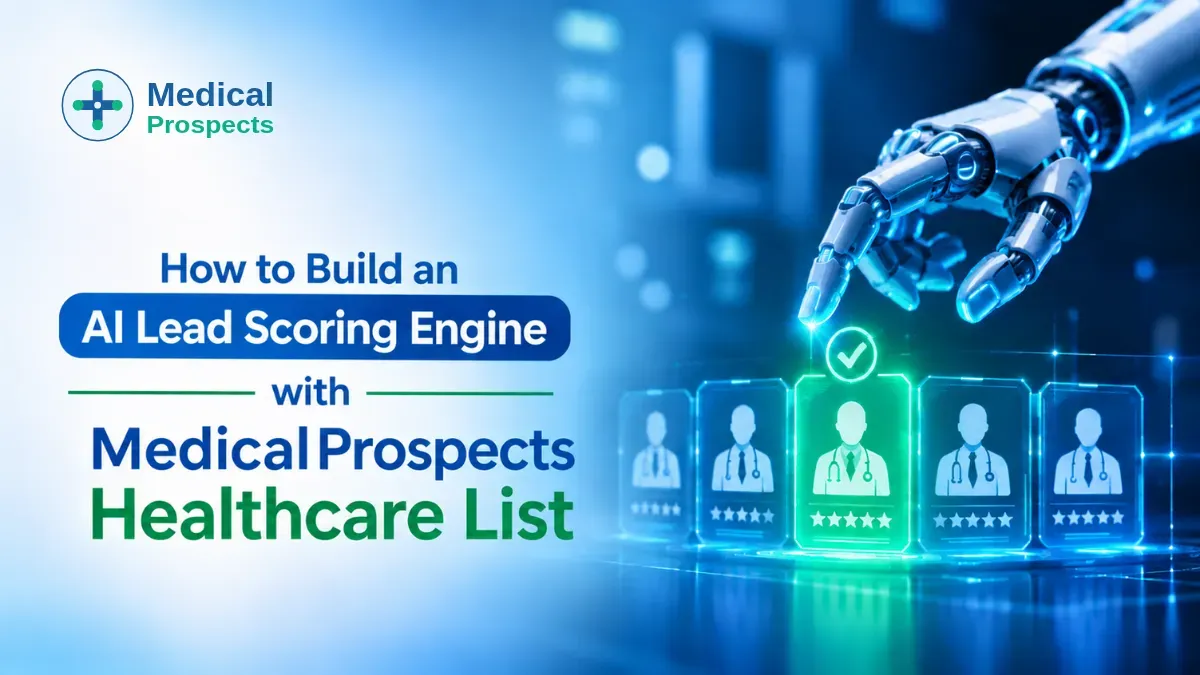
How to Build an AI Lead Scoring Engine with MedicalProspects Healthcare List
Your CRM has AI, your sales team has automation, and you've probably invested in tools that promise to identify your sales prospects.
But here's a question: Does your CRM actually know enough about your healthcare prospects to distinguish a high-value opportunity from an ordinary contact?
Last month, I spoke with a MedTech VP of Sales who was frustrated with his company's AI lead scoring initiative. They had purchased an expensive CRM AI upgrade, activated predictive scoring, and expected their sales team to receive a steady stream of qualified healthcare prospects.
Instead, the scores were practically useless.
The problem wasn't the AI. Their CRM knew the prospects' names and email addresses, but little else. It couldn't distinguish a solo dental practice from a 40-location dental support organization (DSO), identify a physician's specialty, or determine which EHR software a hospital already used.
In other words, they had given AI a calculator without giving it the numbers.
We approached the problem differently. Instead of building a custom machine learning pipeline, we used ChatGPT to help design the scoring logic, MedicalProspects' healthcare lists to enrich the CRM, and the client's existing CRM capabilities to operationalize the process.
Here's how the approach works.
How Do We Build an AI Lead Scoring Engine?
Here's the approach I'd recommend to healthcare sales and RevOps teams.
Think of it as a three-part engine: an LLM designs the scoring architecture, MedicalProspects supplies the healthcare data intelligence, and your native CRM puts everything into action.
Phase 1: Use ChatGPT, Claude, or Gemini as Your Lead Scoring Architect
Step 1Feed Your Historical Sales Data Into an LLM
Start with your existing CRM data.
Export relevant historical closed-won and closed-lost opportunities, including account characteristics, professional roles, specialties, organization sizes, technology environments, and available buying signals.
Remove or anonymize personally identifiable and confidential information before sharing records with an external LLM. Use only approved data sources and configurations.
Next, provide the LLM with MedicalProspects' healthcare data dictionary so it understands which attributes are available for audience segmentation.
Your objective is simple: help AI understand what your best healthcare customers have in common.
Step 2Ask AI to Identify Your Best-Fit Healthcare Prospects
Now, ask AI to compare successful deals against unsuccessful ones.
For example, a MedTech company targeting dental practices could investigate:
- Do multi-location DSOs generate more opportunities than solo practices?
- Which dental specialties align most closely with successful deals?
- Do certain practice management platforms indicate stronger product compatibility?
- Which professional roles influence purchasing decisions?
- What buying signals tend to appear before an opportunity is created?
The LLM can analyze these patterns and suggest which healthcare attributes deserve greater weight in your scoring model.
Step 3Generate a Weighted Healthcare Lead Scoring Rubric
Once the patterns are identified, ask the LLM to translate them into a weighted scoring framework.
For example:
| Scoring dimension | Illustrative weight |
|---|---|
| ICP and practice fit | 30% |
| Professional and specialty fit | 25% |
| Technology compatibility | 20% |
| Buying intent | 15% |
| Engagement | 10% |
| Total | 100% |
These weights are starting assumptions, not universal benchmarks. Your historical conversion data should determine the final distribution.
A useful prompt would be:
Prompt
"Analyze our historical closed-won and closed-lost healthcare opportunities alongside the supplied healthcare data dictionary. Identify the attributes most associated with successful conversions. Generate a weighted lead scoring rubric, explain each scoring criterion, and recommend CRM-compatible formulas and qualification thresholds. Separate contact-level fit from account-level potential."
The output should include scoring conditions, positive and negative criteria, field requirements, and recommended score thresholds.
Step 4Generate Your CRM Field Mapping and Scoring Logic
Here's where the LLM becomes particularly useful for RevOps teams.
Ask it to translate the scoring framework into practical CRM implementation instructions.
For example, it can recommend how to map MedicalProspect's data fields, such as specialty, NPI, practice size, facility type, and technology insights, to existing CRM properties.
It can also draft conditional formulas, workflow logic, and score classifications for your operations team to review and implement.
The important distinction: the LLM designs the architecture. Your CRM executes the production scoring logic.
Build a More Complete Healthcare Prospect Profile
Get verified healthcare contacts enriched with specialty, practice, facility, and technology insights to give your scoring model more context.
Phase 2: Deploy the Engine Inside Your Native CRM
Step 5Import MedicalProspects' Healthcare Data Intelligence
With the scoring architecture ready, bring the required healthcare attributes into your existing CRM.
MedicalProspects helps you identify and segment healthcare professionals and facilities around your exact ICP.
Depending on your audience requirements, this can include:
- Verified healthcare specialist contacts.
- NPI and specialty information.
- Practice and facility characteristics.
- Job titles and professional seniority.
- Installed EHR and practice management technologies.
- Relevant buying and intent signals.
Map these attributes to the corresponding CRM fields. Match existing contacts and accounts, standardize records, and resolve duplicates before activating scoring workflows.
This gives your CRM the healthcare data context it previously lacked.
Give Your CRM the Healthcare Context It Needs
Identify the right healthcare professionals and facilities with custom audience intelligence aligned with your ICP and scoring criteria.
Step 6Activate Native CRM AI and Scoring Automation
Now, put the scoring architecture to work.
Depending on your CRM and subscription, you can use native predictive capabilities, scoring tools, calculated properties, and workflow automation.
For example:
HubSpot
Use supported Breeze and predictive or lead scoring capabilities alongside CRM properties and automation.
Salesforce
Use available Einstein predictive capabilities and scoring-related CRM functionality.
Microsoft Dynamics 365
Use supported AI and predictive capabilities within its sales environment.
Your RevOps team can implement the approved scoring criteria through supported CRM functionality and configure predictive models where available and appropriate.
One important distinction: a weighted scoring formula and a predictive AI model aren't the same thing. The former applies predefined rules; the latter learns patterns from eligible historical data. Both can contribute to a stronger qualification process.
Step 7Automate Healthcare Prospect Prioritization
Once the scoring and automation workflows are configured, your CRM can classify and route prospects according to their fit and qualification scores.
For example:
High-priority prospects
Route to SDRs or account executives for timely outreach.
Medium-priority prospects
Add to relevant nurture campaigns and monitor for stronger buying signals.
Low-priority prospects
Deprioritize or retain for future qualification.
Now, instead of manually researching every healthcare prospect, your sales team has a structured way to decide whom to approach first.
That's the real advantage of combining healthcare data intelligence with CRM-native AI.
How to Measure and Optimize Your Healthcare AI Lead Scoring Engine
Getting your scoring engine operational is only the beginning. The real test is whether it improves sales outcomes.
I recommend tracking three indicators:
- Sales Acceptance Rate Are sales representatives accepting the prospects your scoring engine prioritizes?
- Lead-to-Opportunity Conversion Are higher-scoring healthcare prospects progressing into qualified opportunities more frequently?
- Time to Qualification Is your team spending less time evaluating qualified prospects?
Compare these results against historical performance and review whether your scoring criteria accurately reflect successful conversions.
Also, revisit your scoring weights as your ICP, product offerings, and market priorities evolve.
Remember, an AI scoring model shouldn't be a set-it-and-forget-it investment. It needs reliable data, ongoing validation, and periodic refinement.
Final Takeaway
You don't necessarily need another AI platform to improve healthcare lead qualification. You need better data intelligence flowing into the technology you already use.
MedicalProspects helps healthcare-focused companies identify and reach the right professionals and facilities through custom-built, verified healthcare account intelligence enriched with professional, firmographic, technographic, and intent attributes.
Give Your CRM the Healthcare Data Intelligence It Needs
Tell us which healthcare professionals, specialties, facilities, and buying roles you're targeting. We'll help you build a healthcare database aligned with your ICP and CRM requirements.
Better Healthcare Data. More Focused Prospecting.
Tell us which specialties, professional roles, facilities, and technologies matter to your ICP. We'll help you build a verified healthcare audience around those requirements.
Frequently Asked Questions
1.
How do you build an AI lead scoring engine for healthcare?
Start by analyzing historical closed-won and closed-lost deals to identify your best-fit healthcare accounts and contacts.
Use an LLM to design weighted scoring criteria, enrich your CRM with relevant healthcare data, and activate scoring and automation through supported CRM capabilities.
2.
What healthcare data is needed for AI lead scoring?
Effective healthcare lead scoring uses professional specialties, NPI details, job titles, seniority, practice size, facility type, and installed technologies.
Firmographic, technographic, and buying intent attributes help evaluate account fit, product compatibility, and potential buying readiness.
3.
Can ChatGPT build an AI lead scoring model for my healthcare business?
ChatGPT can analyze anonymized historical sales data, identify potential conversion patterns, and recommend scoring weights, CRM field mappings, and qualification rules.
Your CRM must implement and execute that logic; ChatGPT does not automatically create or operate a production scoring engine.
4.
How does MedicalProspects' healthcare database improve AI lead scoring?
MedicalProspects provides custom-built healthcare audience intelligence enriched with verified professional contacts, specialty, practice, and facility details, technographics, firmographics, and relevant intent signals.
These attributes give your CRM more context to evaluate healthcare prospects against your ICP.

John Britton
VP of Marketing, MedicalProspects
John works with healthcare sales and marketing teams on precision targeting, campaign strategy, and audience intelligence solutions at MedicalProspects.
Related Insights