Why MedTech Deals Stall Even When Healthcare Buyers Show Interest

VP of Marketing, MedicalProspects
November 17, 2026
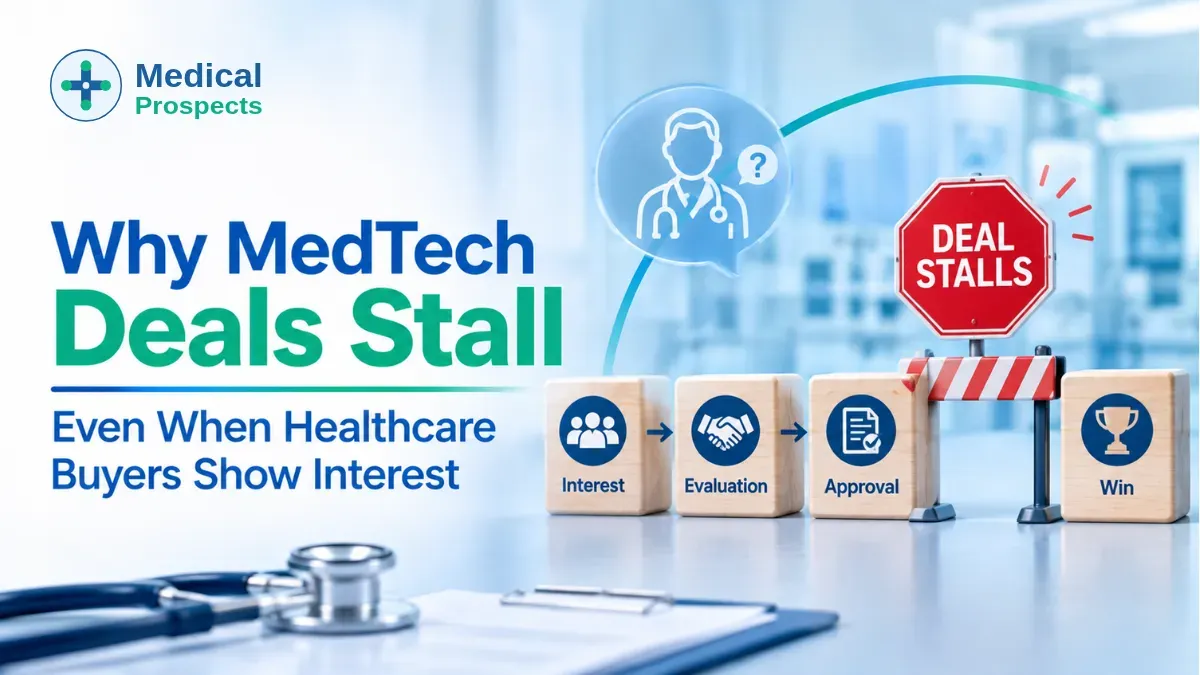
I hear this constantly from MedTech sales teams: even when multiple stakeholders are interested, getting a deal across the finish line is a “hard job” for them.
The physician may like your platform, the IT team may be satisfied with the implementation demo, and procurement may see value in the solution. Yet, the sale still stalls. What went wrong?
Healthcare procurement involves more than initial interest. Several factors, like invisible stakeholders, GPOs and IDN procurement structures, buyers’ shifting priorities, and existing supplier contracts, can influence whether a deal moves forward.
MedTech sales and marketing teams need to understand who evaluates, funds, approves, and uses their products, along with what each stakeholder needs before a purchase can proceed.
Healthcare Buying Committees Are Larger Than They Look
The healthcare buyers who attend your product demonstrations aren't necessarily the only people who influence the purchase of your solution. Others may review it, raise concerns, or delay approval without directly interacting with your sales team.
These behind-the-scenes decision makers are often referred to as "invisible stakeholders." Their opinions, requirements, and veto powers can shape the final purchase, even when they don't participate in initial vendor discussions.
Who are these invisible decision makers? Mostly the hospital CFOs, health IT security teams, biomedical engineers, and compliance officers.
Here's the Clear Breakdown of Visible and Invisible Stakeholders
| Buying Committee | Stakeholders | Key Evaluation Factors |
|---|---|---|
| Visible Stakeholders | Physicians and Clinical Officers | Clinical outcomes, patient safety, treatment effectiveness |
| Department Heads | Departmental needs, product usability, operational fit | |
| CIOs, CTOs, and IT Leaders | System integration, data security, technical compatibility | |
| Procurement and Supply Chain Teams | Pricing, contracts, supplier qualifications, product availability | |
| Invisible Stakeholders | Nurses and Clinical Staff | Workflow impact, training, day-to-day usability |
| CFOs and Finance Teams | Total cost of ownership, budget impact, financial justification | |
| Compliance and Privacy Officers | Regulatory requirements, data protection, institutional policies | |
| Biomedical Engineers | Equipment safety, maintenance, technical performance | |
| Health IT Security Teams | Cybersecurity, data privacy, system risk |
MedTech sales teams should map the buying committee early and establish who evaluates the product, controls the budget, raises operational concerns, and holds final approval authority.
Build a More Complete View of Your Target Accounts
A targeted healthcare database can help SDRs identify relevant job roles, senior leaders, and procurement authorities across healthcare facilities.
GPOs and IDNs Shape Healthcare Procurement
Healthcare purchasing decisions can extend beyond individual hospital departments. In the U.S., Group Purchasing Organizations (GPOs) and Integrated Delivery Networks (IDNs) influence supplier access, contracts, product selection, and purchasing authority.
A hospital may show interest in your product but still need to follow a group-level purchasing process.
How GPOs and IDNs Influence Healthcare Purchasing in the U.S.
GPOs negotiate contracts with manufacturers and distributors on behalf of healthcare buyers. IDNs may coordinate purchasing, contracting, and product standardization across multiple hospitals and facilities.
The individual hospitals retain some purchasing authority, depending on the organization and agreement.
Their reach makes them important to MedTech marketing and sales teams:
- More than 95% of U.S. hospitals use GPOs to purchase medications, medical devices, and supplies.
- In 2024, the three largest GPOs accounted for 84.1% of U.S. hospital affiliations, compared with 61.7% in 2014.
How MedTech Sales Teams Can Navigate GPOs and IDNs
Next time, when you approach a target hospital, establish whether it purchases independently, follows an IDN-level agreement, uses a GPO contract, or participates in centralized tendering.
Use this checklist to assess procurement readiness:
| Area | What Your Team Should Verify | Status |
|---|---|---|
| Stakeholder Mapping | Identify clinical, technical, financial, and procurement contacts | |
| Purchasing Authority | Confirm whether decisions sit with the hospital, IDN, GPO, or government body | |
| Supplier Onboarding | Check vendor registration and qualification requirements | |
| Product Documentation | Prepare clinical evidence, technical specifications, and product information | |
| Regulatory Requirements | Verify applicable market authorization and compliance requirements | |
| Contract Access | Determine whether the supplier or product is eligible under the relevant purchasing arrangement |
This groundwork helps your growth team distinguish a hospital that is interested in evaluating a product from one with a viable path to purchase.
Identify Hospital Purchasing Authorities
Reach relevant hospital executives and procurement professionals across your target healthcare accounts.
Healthcare Buyers Priorities Shift During Purchase
Healthcare purchases rarely move directly from product demonstration to approval. They may involve clinical evaluation, technical validation, financial review, contracting, and implementation.
Stakeholder influence can change as the purchase progresses. The people involved may remain the same, but their priorities and responsibilities evolve.
When Does a Healthcare Buyer's Influence Shift?
| Buying Stage | What Happens | Where Influence May Shift |
|---|---|---|
| Initial Interest | A clinical need or operational problem creates interest | Clinical champions and department heads establish the need |
| Product Evaluation | Clinical evidence, usability, and product suitability are assessed | Physicians, nurses, and technical evaluators contribute |
| Technical Validation | Integration, security, infrastructure, and compatibility are reviewed | IT leaders and technical teams take a closer look |
| Financial Assessment | Costs, expected benefits, and alternatives are compared | CFOs, finance teams, supply chain, and value analysis professionals assess the business case |
| Approval and Procurement | Contracts, supplier requirements, and budgets are reviewed | Hospital leadership and authorized procurement teams determine whether the purchase can proceed |
| Implementation | Deployment, training, and operational readiness are planned | Clinical operations, IT, nursing leadership, and end users become central |
For MedTech marketing and sales teams, the key questions are: What happens next? Who owns that step? What evidence or approval is still outstanding?
To avoid relying on a single clinical champion:
- Map the buying committee Identify the clinical, technical, financial, and procurement stakeholders relevant to your product.
- Verify decision-making roles Establish who evaluates, influences, finances, and approves the purchase.
- Build relationships across departments Engage relevant decision-makers before the proposal reaches final approval.
- Use accurate contact intelligence Identify the right professionals across target hospitals instead of depending on a single contact.
The goal is to reach every healthcare buyer at the hospital who has a meaningful role in evaluating or approving your solution.
Value Analysis Committees: What MedTech Sales Teams Must Prepare
Even with a clinical champion and a clear purchasing path, your product may still need approval from a Value Analysis Committee (VAC).
A VAC brings clinical directors and material managers together to assess whether a product meets an institutional need and justifies its cost. Its review may cover clinical evidence, safety, financial impact, operational requirements, and alternatives.
Demonstrating that your product works is only part of the case. You also need to explain why it makes sense for the healthcare facilities.
What VACs Evaluate and What MedTech Sales Teams Should Prepare
Before presenting your solution, consider what each stakeholder needs to see. Prepare relevant and logical evidences that address their responsibilities.
| Type of Value | What to Demonstrate | Relevant Key Roles |
|---|---|---|
| Clinical | Patient outcomes, diagnostic accuracy, safety, and treatment effectiveness | Physicians, cardiologists, nurses, and clinical officers |
| Financial | Total cost of ownership, potential savings, budget impact, and resource utilization | CFOs, finance teams, and procurement leaders |
| Operational | Workflow efficiency, staff training, implementation, and equipment utilization | Nursing leaders, department heads, and clinical operations |
| Organizational | Regulatory alignment, integration, scalability, and strategic priorities | CIOs, CTOs, hospital executives, and compliance teams |
A strong value proposition connects product capabilities to the outcomes each stakeholder is responsible for assessing.
Reach Professionals Involved in Healthcare Purchasing
A targeted healthcare audience can help your team identify clinical, financial, operational, and technical decision-makers across relevant healthcare facilities.
Existing Contracts and Standardization: The Hidden Competition
Even when a product meets clinical requirements and receives positive feedback, a hospital may already have a competing solution in place.
Established supplier relationships, standardized equipment, and familiar workflows can make healthcare organizations reluctant to switch. Better features or pricing alone may not be enough to change that decision.
Why Hospitals Resist Switching to New MedTech Solutions
Incumbent suppliers often benefit from established relationships and familiarity with hospital systems. Replacing them can introduce additional costs and operational challenges, including:
- Staff retraining and changes to clinical workflows.
- Equipment replacement, integration, and implementation expenses.
- Service continuity and maintenance requirements.
- Compatibility issues with existing systems and infrastructure.
- Potential disruption during the transition.
A hospital may prefer a familiar product even when another option offers better features. The buying committee must determine whether the improvement justifies the cost, implementation effort, and potential disruption.
How MedTech Sales Teams Can Build a Stronger Displacement Case
To compete against an established supplier, your team needs to demonstrate why switching is worth the effort.
- Connect performance to outcomes Show why the improvement matters to the hospital, not just how your product compares feature by feature.
- Show measurable improvements Demonstrate relevant clinical, financial, or operational benefits.
- Compare total costs Account for the cost of maintaining the existing solution as well as switching to yours.
- Address implementation risks Explain how training, integration, maintenance, and service continuity will be managed.
The strongest displacement case links product performance to a meaningful improvement in clinical, financial, or operational outcomes.
Conclusion
Healthcare procurement involves more than the person who first expresses interest in a MedTech solution. The decision depends on the wider buying committee, purchasing authority, evaluation requirements, and existing supplier relationships.
Before advancing an opportunity, MedTech sales teams should establish who controls the purchase, which evaluations remain outstanding, and what barriers could prevent the hospital from switching.
A clinical champion can create an opportunity. Understanding the procurement process helps your team determine whether that opportunity has a viable path to purchase.
John Britton
VP of Marketing, MedicalProspects
John works with healthcare sales and marketing teams on precision targeting, campaign strategy, and audience intelligence solutions at MedicalProspects.
Related Insights