What is the difference between urgent care centers and retail clinics?
Also called: Urgent Care & Retail Clinic GTM, walk-in clinics
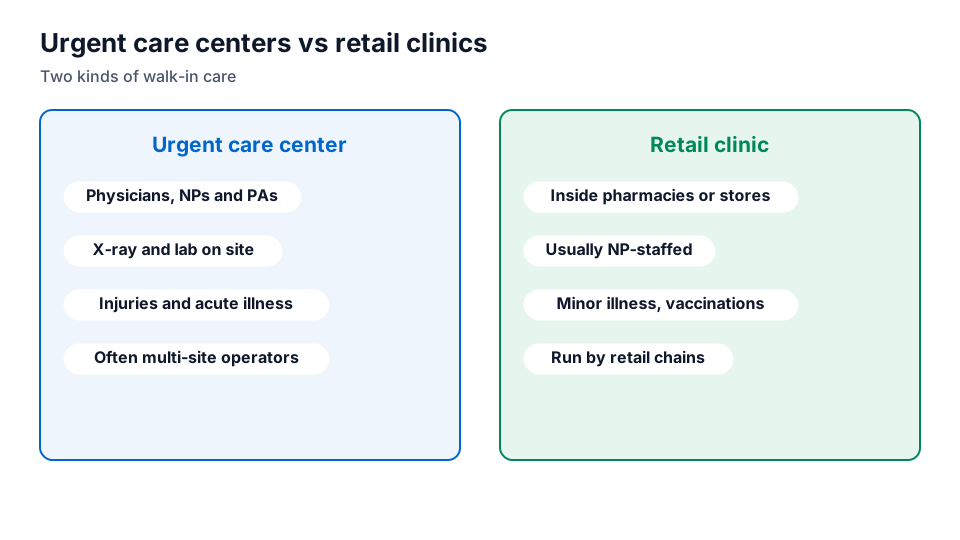
Urgent care centers and retail clinics both offer walk-in care for non-emergency needs. Urgent care centers usually have physicians, nurse practitioners or physician assistants plus on-site X-ray and lab testing; retail clinics sit inside pharmacies or stores and are usually staffed by nurse practitioners for minor illnesses and vaccinations.
Why it matters for healthcare sales and marketing
Both settings have grown as patients look for faster, cheaper alternatives to emergency departments. They buy supplies, diagnostics, staffing, scheduling and billing tools, and many belong to multi-site operators, so one relationship can cover many locations.
How it works
- Urgent care centers: treat injuries and illnesses that need prompt care but not an ED; often have X-ray and lab testing; owned independently, by chains, or by health systems.
- Retail clinics: inside pharmacies and retailers; treat minor conditions, provide vaccinations and screenings.
- Buyers: operators' leadership, medical directors and center managers.
Example
Illustrative scenario. A point-of-care diagnostics company targets urgent care operators with several locations, reaching medical directors and operations leaders at the parent organization rather than individual centers.
Common mistakes
- Treating each center as independent. Many belong to multi-site operators that buy centrally.
- Assuming the same services. Urgent care has imaging and labs; retail clinics usually don't.
- Missing health system ownership. Some centers follow a health system's contracts.
Related terms
Put it to work
- Hospitals and urgent care lists: urgent care and hospital contacts
- Urgent care physicians list: clinicians in urgent care
- Urgent care center directors list: center leadership