Who are gatekeepers in healthcare sales?
Also called: Gatekeeper Navigation in Healthcare, front desk, executive assistant
In healthcare sales, a gatekeeper is anyone who controls access to a decision maker: front-desk staff and practice managers at physician practices, and executive assistants for hospital leaders.
Why it matters for healthcare sales and marketing
Physicians and executives protect their time. Calls to a practice's main line usually stop at the front desk, and executive emails are often screened by assistants. Teams that treat gatekeepers as part of the process get further than those that try to bypass them.
How it works
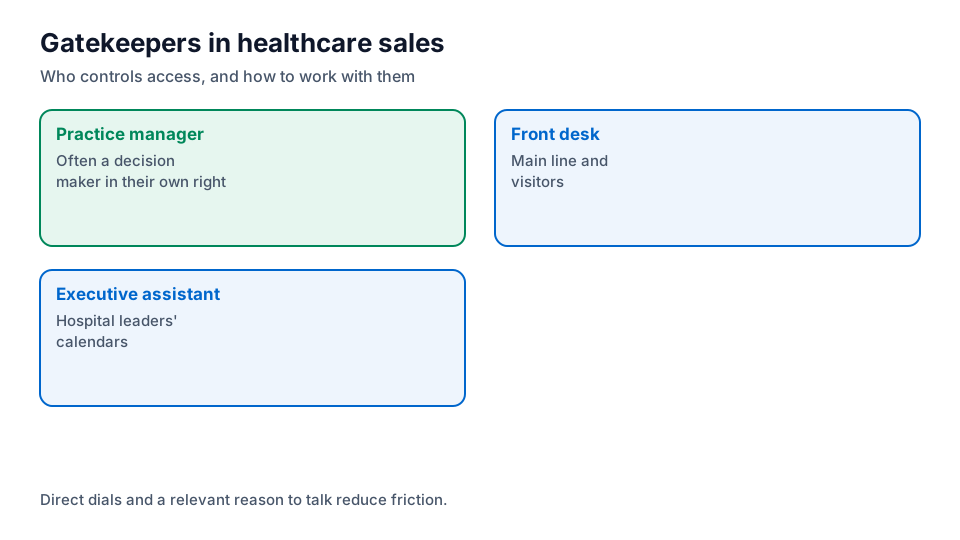
- Front desk: handles calls and visitors at practices.
- Practice manager or administrator: often a decision maker in their own right for operational purchases.
- Executive assistants: manage calendars for hospital executives.
Direct dials, verified business emails and a clear, relevant reason to talk reduce friction with gatekeepers.
Example
Illustrative scenario. A rep selling a patient intake tool calls the practice administrator directly instead of asking the front desk for a physician. The administrator owns the front-office workflow, books a demo, and brings in a physician partner later.
Common mistakes
- Treating gatekeepers as obstacles. They often influence or own the decision.
- Calling only main lines. Use direct dials where you have them.
- Vague requests. State a specific, relevant reason to talk.
Related terms
Put it to work
- Sales teams use case: direct dials and emails for reps
- Operations and administration lists: practice managers and administrators
- Direct dial, explained: reaching decision makers directly