What is value-based care?
Also called: Value-Based Care (VBC) Transition, VBC, value-based payment
Value-based care is a payment approach that rewards healthcare providers for the quality and cost of care rather than only the number of services they deliver, as in traditional fee-for-service.
Why it matters for healthcare sales and marketing
Under value-based contracts, providers gain from keeping patients healthy and avoiding unnecessary costs. That raises demand for care coordination, analytics, remote monitoring and preventive programs, and changes how vendors should frame their value.
How it works
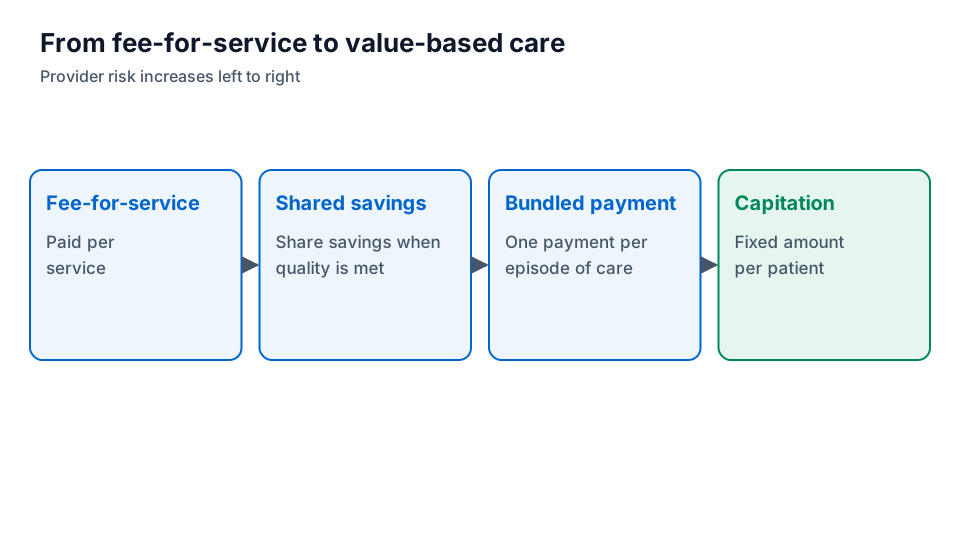
- Fee-for-service: paid per service, regardless of outcome.
- Shared savings: providers share in savings when total cost falls and quality targets are met, as in ACOs.
- Bundled payments: one payment covers an episode of care, such as a joint replacement.
- Capitation: a fixed amount per patient per period, with the provider taking on cost risk.
Many organizations operate under a mix of fee-for-service and value-based contracts.
Example
Illustrative scenario. A company selling a post-discharge follow-up service focuses on health systems with bundled payment and shared savings contracts, where fewer readmissions directly improve the organization's financial results.
Common mistakes
- Assuming everyone is fully value-based. Most organizations mix payment models.
- Pitching volume to value-based buyers. More visits isn't a benefit under risk contracts.
- Ignoring quality measures. Value-based payment depends on them.
Related terms
Put it to work
- Payers and partners lists: payer and ACO contacts
- Hospital C-suite lists: executives managing value-based contracts
- ACO, explained: the best-known value-based model