10 Mistakes Companies Make When Building Healthcare Target Lists

VP of Marketing, MedicalProspects
October 26, 2026
TLDR
Building a healthcare target list takes more than collecting contacts by job title. This guide explores 10 common mistakes that can reduce targeting accuracy, from ignoring specialty and organization context to relying on outdated data, overlooking buying signals, and measuring list size instead of quality. It shows what a stronger approach looks like—and how better segmentation, verification, technology intelligence, geography, and buying context can make healthcare prospecting more actionable.
Building a healthcare target list is not simply a matter of finding people with the right job titles and adding their contact information to a spreadsheet.
Healthcare organizations have complex buying structures. A single purchase can involve clinical users, IT teams, finance, procurement, operations, executive leadership, and other stakeholders. At the same time, the relevance of a contact can change based on their specialty, organization type, technology environment, geography, and current business priorities.
That is why a large database does not automatically become a strong target list.
A useful healthcare target list should help answer three questions: Who should you reach? Why are they relevant? And why might they be relevant now?
Here are 10 common mistakes companies make when building healthcare target lists, and what to consider instead.
1. Building the List Around Job Titles Alone
One of the most common mistakes in healthcare targeting is assuming that a senior job title automatically identifies the person with purchasing influence.
A Director, VP, or Chief-level executive may be important, but they are rarely the only person involved in a healthcare buying decision.
A hospital technology purchase, for example, could involve a CIO or CMIO, but the buying group may also include clinical leaders, IT specialists, finance, procurement, security, and operational stakeholders.
Look Beyond the Title
The important question is not simply:
“Who has the right title?”
It is:
“Who has a role in evaluating, influencing, approving, implementing, or using this solution?”
Depending on the product, relevant stakeholders could include:
- IT and technology leadership
- Clinical leadership
- Department heads
- Finance
- Operations
- Procurement
- Compliance and security
- End users and clinical specialists
Title-centric targeting can therefore produce a list that looks impressive but contains many contacts who have little connection to the actual buying process.
Better approach: Map contacts according to their role in the buying process, not just their organizational seniority.
2. Targeting the Right Role at the Wrong Organization
Even the right contact can become irrelevant when the organization behind that contact does not fit your ideal customer profile.
A hospital, health system, private practice, outpatient facility, and specialty clinic may all employ physicians or healthcare executives, but their structures, budgets, technology environments, and purchasing processes can be very different.
The same applies across other healthcare sectors.
For example:
- Pharma vs. biotech: Their research, commercial, and operational priorities may differ significantly.
- Pharma vs. CRO: A CRO may influence clinical research workflows but operate under a different purchasing structure.
- Healthtech vs. healthcare services: Technology vendors and healthcare service providers have different operational environments.
- Hospital vs. health system: A single facility may have a different buying process from a multi-site health system.
Company size and geographic footprint matter as well. A regional provider with several facilities may have very different technology needs from a national health system.
Better approach: Define the organization before defining the individual. Consider organization type, size, location, ownership, facility footprint, and business model alongside the contact's role.
3. Ignoring Specialty and Clinical Context
Healthcare is too specialized for broad professional categories to provide enough targeting precision.
Two professionals may share the same general job category while working in completely different clinical environments.
A surgeon treating orthopedic conditions does not necessarily have the same needs as a neurosurgeon or spine surgeon. A cardiologist working in a large health system may also have a different technology environment and workflow from one working in an independent practice.
This is where specialty and clinical context become important.
What Should You Consider?
Depending on your offering, relevant targeting criteria can include:
- Medical specialty
- Subspecialty
- Clinical department
- Service line
- Practice setting
- Procedure focus
- Organization type
- Clinical use case
Consider a medical device company selling technology specifically designed for spine surgery. Targeting a broad list of “surgeons” may create significant volume, but much of that list may have little relevance.
A more precise target could be spine surgeons within hospital-affiliated orthopedic or neurosurgical departments.
The narrower list may be smaller, but its relevance can be considerably higher.
Better approach: Connect the product or service to the specific clinical context in which it is used.
4. Treating Every Contact as a Decision-Maker
Not every person on a healthcare target list has purchasing authority.
More importantly, not every influential person has final approval power.
Healthcare purchasing often involves a buying group, with different stakeholders contributing at different stages of the decision.
A useful framework is:
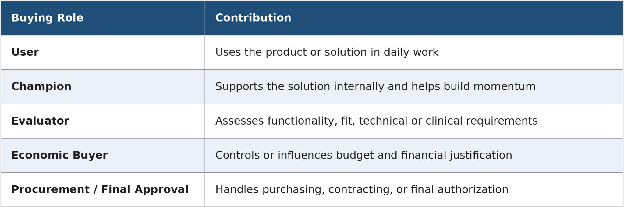
The exact structure varies by organization and product. A clinical leader may champion a solution, while IT evaluates the technology and procurement manages the commercial process.
That means treating every contact as “the decision-maker” oversimplifies the buying journey.
Better approach: Build lists around the buying group, not a single supposed decision-maker.
For a deeper look at how these roles work together, this section can naturally link to your article on healthcare buying committees/buying groups.
5. Building One Giant List Instead of a Segmented List
A bigger database is not necessarily a better target list.
One large spreadsheet containing physicians, executives, procurement professionals, IT leaders, and healthcare organizations across every state may provide reach—but it does not necessarily provide relevance.
The problem becomes even greater when every contact receives the same message.
A stronger approach is to segment the list according to the characteristics that actually affect your campaign.
Common segmentation criteria include:
- Role
- Specialty
- Organization type
- Geography
- Seniority
- Practice setting
- Technology environment
- Product or use case
- Company size
- Buying signals
For example, a healthcare technology company could create separate segments for:
- CIOs at large health systems
- CMIOs at integrated delivery networks
- IT leaders at regional hospitals
- Clinical leaders using a specific technology environment
Each segment can then receive messaging that reflects its specific challenges and priorities.
The goal is not to create the largest possible database.
It is to create smaller, more relevant groups that can be activated with the right message.
Better approach: Segment before you launch—not after your campaign underperforms.
6. Overlooking Healthcare Technology and Infrastructure
Traditional healthcare lists often stop at basic firmographic and professional information: name, title, organization, location, and contact details.
That information is useful, but it does not tell you much about the organization's technology environment.
For healthcare technology companies, medical device companies, software providers, and other vendors, this missing layer can be extremely valuable.
Organizations may differ based on:
- AI adoption
- EHR environment
- Existing technology stack
- Digital health infrastructure
- Interoperability capabilities
- Cloud and data infrastructure
- Cybersecurity environment
- Analytics and automation tools
- Relevant technology signals
For example, a healthcare software company selling an interoperability solution may have a much stronger prospect when it can identify organizations with specific infrastructure or integration requirements.
This is where healthcare intelligence data goes beyond a traditional contact database.
Instead of asking only:
“Who works at this organization?”
you can begin asking:
“What technology environment does this organization operate in?”
That additional context can improve segmentation, account prioritization, and campaign relevance.
Better approach: Add technology and infrastructure intelligence when the product's value depends on the organization's existing digital environment.
7. Using Decayed or Unverified Contact Data
Even a well-designed targeting strategy can fail when the underlying contact data is outdated.
Healthcare professionals change organizations. Job titles change. Email addresses become inactive. Physicians move between practices. Organizations merge or restructure.
A list that was accurate several months ago may not remain equally reliable over time.
Common data-quality problems include:
- Invalid or inactive email addresses
- Outdated job titles
- Former employees
- Incorrect organization affiliations
- Duplicate contacts
- Missing professional information
- Incomplete specialty data
- Incorrect phone numbers
Poor data quality creates more than wasted outreach.
It can affect campaign deliverability, sales productivity, segmentation accuracy, and the overall quality of your prospecting efforts.
Verification should therefore be treated as an ongoing process rather than a one-time task.
Better approach: Look for multi-step verification, regular refreshes, professional affiliation checks, and clear data-quality standards before activating a healthcare target list.
8. Ignoring Geography and Market Structure
Healthcare markets are not geographically uniform.
The same product can have very different opportunities across states, regions, metropolitan areas, or healthcare markets.
Geography can influence:
- Healthcare organization density
- Provider concentration
- Health system presence
- Market size
- Regional specialties
- Practice patterns
- Expansion opportunities
- Local healthcare infrastructure
For example, a company expanding a medical device offering may want to prioritize regions with a high concentration of relevant hospitals and specialists rather than distributing outreach evenly across the entire country.
Geography can also be important for field sales teams.
If representatives cover specific territories, a national list without geographic segmentation can create unnecessary work and poorly distributed leads.
Better approach: Combine geographic targeting with organization type, specialty, company size, and other ICP criteria instead of treating geography as a simple state-level filter.
9. Missing Out on Buying Signals
A contact's job title tells you who they are.
A buying signal can tell you what is happening around them.
This distinction is increasingly important in healthcare targeting.
Organizations leave signals when something changes in their business, technology, workforce, or market position.
Potential buying signals can include:
- New technology adoption
- Digital transformation initiatives
- New facility openings
- Expansion into new markets
- Leadership changes
- Mergers and acquisitions
- New service lines
- Technology implementations
- Funding or investment
- Hiring for relevant functions
- New strategic initiatives
Consider a health system that has recently announced a major digital transformation initiative. That organization may be more relevant to a healthcare technology vendor than another health system of identical size with no comparable initiative.
The organization has not changed simply because of its employee count.
Its context has changed.
That is what makes buying signals valuable.
Better approach: Combine static information—such as role and organization, with dynamic signals that indicate why an account may be relevant now.
10. Measuring List Size Instead of List Quality
The final mistake is one of the easiest to make: assuming that more contacts automatically mean better targeting.
A database containing 500,000 healthcare contacts may sound more valuable than a list containing 25,000 highly relevant prospects.
But if most of those 500,000 contacts fall outside your ICP, the additional volume may simply create more work for sales and marketing teams.
List quality should instead be evaluated across several dimensions:
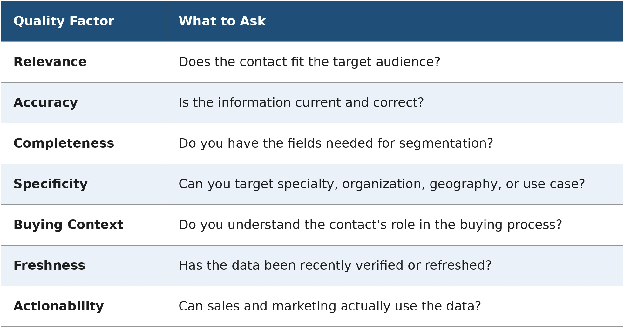
The goal should not be to maximize the number of rows in a database.
Final Thoughts
A strong healthcare target list is built on relevance, context, and timing, not volume. Job titles alone do not show buying influence, and without specialty, organization type, geography, verified data, and current buying signals, even a well-defined audience can lead to wasted outreach.
Start with your ideal customer profile, map the full buying group, and segment before you launch. Then judge the list by how usable it is for your sales and marketing teams, not by how many rows it holds.
Ready to build a healthcare target list that reflects how healthcare buying really works? Explore MedicalProspects to reach verified healthcare professionals segmented by specialty, role, organization type, and geography.
Build a High-Precision Healthcare Target List
Reach verified healthcare decision-makers, buying groups, and clinical specialists segmented by specialty, organization type, technology, and geography.
Talk to Our Experts Today →Frequently Asked Questions (FAQs)
Q:
What is a healthcare target list?
A healthcare target list is a focused set of contacts and organizations that match your ideal customer profile. Unlike a general database, it is built around who buys, why they are relevant, and why they may be ready now. If you are not sure what your list should include, share your requirements with our team and we will help you define it.
Q:
How do I build a healthcare target list that actually converts?
Start with your ideal customer profile, then segment by role, specialty, organization type, geography, and buying signals before you launch. Targeting by job title alone is one of the most common reasons campaigns underperform. Fill out the form, and we will build a segmented list around your offering.
Q:
Who is involved in a healthcare buying decision?
Most healthcare purchases involve a buying group, not one person. It can include users, champions, evaluators, economic buyers, and procurement or final approvers. Tell us what you sell, and we will map the right roles to reach.
Q:
How can I tell if a healthcare contact list is accurate?
Look for multi-step verification, regular refreshes, and affiliation checks. Outdated titles, inactive emails, and former employees are the most common signs of decayed data. Request a sample to see the data quality for yourself before you commit.
Q:
How big should my healthcare target list be?
There is no ideal number. A smaller list of 25,000 highly relevant prospects will often outperform 500,000 loosely matched contacts. Get a custom count to see exactly how many prospects match your criteria.
Q:
Can I target healthcare professionals by specialty and location?
Yes. You can narrow your audience by specialty, subspecialty, practice setting, organization type, and geography, so your outreach reaches only the contacts that fit. Submit your targeting criteria and our experts will get back to you with a tailored list.
John Britton
VP of Marketing, MedicalProspects
John works with healthcare sales and marketing teams on precision targeting, campaign strategy, and audience intelligence solutions at MedicalProspects.
Related Insights