NPI-Verified Targeting
A Methodology for Matching Provider Identity to Marketing-Ready Contacts
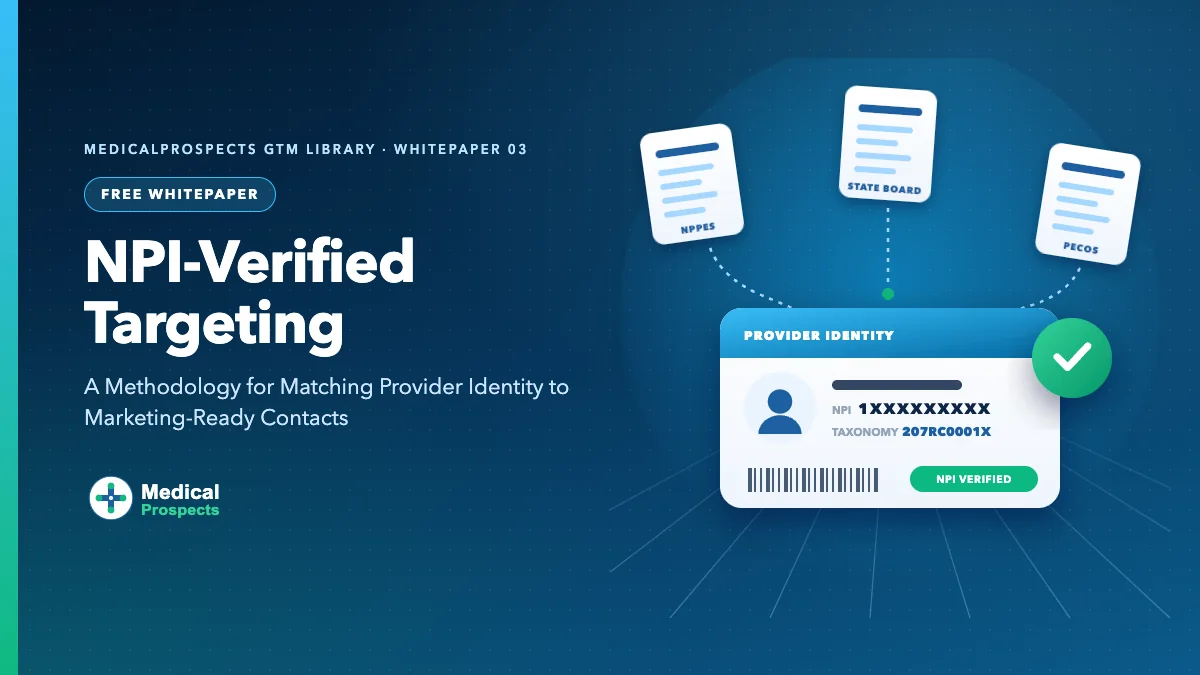
This MedicalProspects whitepaper explains how the National Provider Identifier solves identity drift in healthcare marketing data, what the NPI registry does and does not provide, and the six-step methodology MedicalProspects uses to build verified, marketing-ready records around each NPI.
Key points
- Identity drift is the root cause of poor healthcare data: moves, name collisions, title-based specialty and retirements.
- The NPI is a lifetime identity anchor, but the registry has no verified emails and its addresses are self-reported.
- A six-step method builds marketing-ready records around the NPI and re-checks them on a schedule.
- NUCC taxonomy codes separate general cardiologists from electrophysiologists in a way job titles cannot.
- The NPI is a shared key that joins marketing data to CRM, prescriber and credentialing data.
- A buyer's checklist tells real NPI verification from an NPI column copied from NPPES.
What's inside this whitepaper
-
Executive Summary
Healthcare marketing data fails when a contact record loses its link to the real provider behind it. Names repeat, titles are self-reported, practices move and specialties get mislabeled. Each mismatch wastes an email, a call or a sales rep's afternoon.
-
The NPI Registry in Numbers
The scale of the registry shows both its value and its limits.
-
The Problem: Identity Drift
Identity drift is the gap that opens between a contact record and the real person it describes. In healthcare it opens quickly, because providers' working lives change often.
-
What the NPI Registry Is, and What It Is Not
The NPI is a unique 10-digit identifier issued by the Centers for Medicare & Medicaid Services (CMS) under HIPAA's administrative simplification rules. CMS publishes the records through the National Plan and Provider Enumeration System (NPPES) and its public NPI Registry.
-
The MedicalProspects Verification Methodology
MedicalProspects builds each U.S. clinical record in six steps, with the NPI as the fixed point. Records then loop back through cross-source matching on a set schedule, so verification never stops at delivery.
-
Taxonomy Codes and Specialty Precision
Specialty is the most valuable targeting field in healthcare, and the one most often wrong. Taxonomy codes fix this by replacing free-text titles with a standard classification.
-
Keeping Records Fresh: Refresh Cadence and Decay
Verification is not a one-time event. A record verified at compile time starts aging the next day, so freshness depends on how often every record is re-checked.
-
How NPI-Verified Data Changes Campaign Outcomes
The NPI does more than verify a record. It is a shared key that connects marketing data to the CRM, claims, prescribing and credentialing data your company already holds. That connection makes four kinds of campaigns more precise.
-
Evaluating "NPI-Verified" Claims: A Buyer's Checklist
Many vendors put "NPI" on their lists. Fewer use it to verify every record. Use these questions to tell the difference.
-
Limits and Honest Caveats
NPI-verified targeting improves identity and specialty accuracy, but it does not make every record perfect.
-
Conclusion
An NPI tells you who a provider is for the whole of their career. Verified email, current practice, affiliation and specialty tell you how to reach them today. NPI-verified targeting brings the two together and keeps them aligned with monthly re-verification.
Get the full whitepaper
All 11 sections, with checklists, tables and templates you can use with your team.

John Britton
John works with healthcare sales and marketing teams on precision targeting, campaign strategy, and audience intelligence solutions at MedicalProspects.
More whitepapers →