The Hidden Cost of Healthcare Data Decay
How Outdated Contacts Drain Pipeline and Budget, and How to Stop It
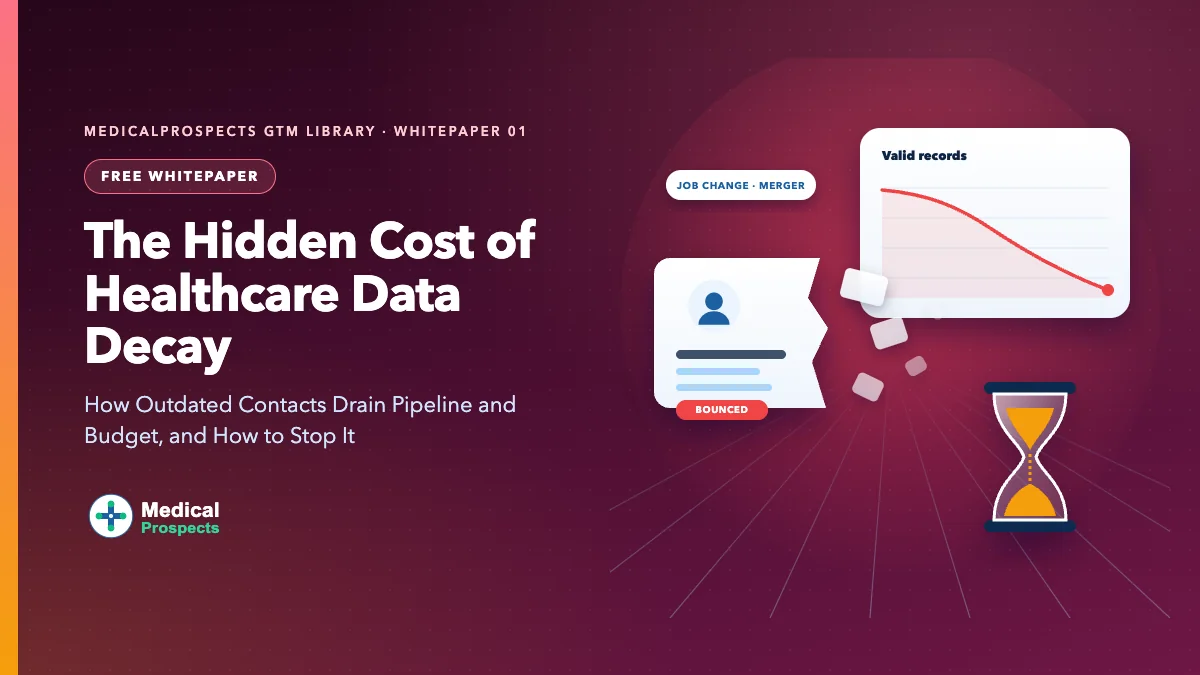
This MedicalProspects whitepaper explains why healthcare contact data decays faster than other B2B data and what it really costs. A simple cost model shows that the money wasted on bad records is small next to the pipeline those records never create, and five practices show how to keep data fresh.
Key points
- Six drivers make healthcare data decay fast, from provider mobility to consolidation and self-reported registries.
- Most fields fail silently: only email and phone failures announce themselves.
- One outdated record leaks value three ways: bounces, wrong-person delivery and dead lines.
- A cost model you can run shows pipeline not created dwarfs wasted data spend.
- Five practices stop decay: scheduled re-verification, cross-source matching, an NPI anchor, bounce feedback and pre-delivery validation.
What's inside this whitepaper
-
Executive Summary
Outdated contact data is one of the largest costs in healthcare marketing that no one reports. It never shows up as a budget line. It shows up as lower inbox placement, reps chasing people who have left, campaigns that underperform for no clear reason, and pipeline that never forms.
-
The Evidence: What the Public Numbers Show
Public data cannot tell you how fast your list is decaying. It does show that the market is moving, and that the sources most vendors rely on lag behind.
-
Why Healthcare Data Decays Faster
Healthcare data decays faster because the healthcare workforce and its organizations change constantly, and few of those changes are reported anywhere a marketer would see them.
-
Where Decay Hides: Field by Field
A record does not go out of date all at once. Some fields break loudly, others fail quietly, and the quiet failures cost the most because no one notices them.
-
How Decay Turns Into Cost
Every outdated record fails in one of three ways, and all three end in the same place: pipeline that never forms.
-
A Cost Model You Can Run on Your Own Numbers
In most healthcare campaigns, the money wasted on bad records is small next to the pipeline those records never create. This simple model puts both on the same page.
-
How Much of Your Data Is Outdated? A Sampling Method
You do not need to audit every record to estimate decay. A simple sample gives a usable number.
-
How to Stop Decay
No dataset can be kept 100% accurate. Decay can be cut sharply, though, by checking records against independent sources on a fixed schedule and feeding every failure back into that process.
-
A 90-Day Plan to Reduce Decay
-
Questions to Ask Before You Buy
-
Making the Case Internally
Finance and sales leaders respond to numbers they can check. Use this structure when you ask for budget:
-
Conclusion: Freshness Protects Revenue
Data decay is the cost that never appears on an invoice. It shows up as lost inbox placement, wasted rep hours and pipeline that never forms, and it compounds every month a list goes unchecked. The cost model shows the pattern: the money spent on bad records is small, and the opportunities they cost are large.
Get the full whitepaper
All 12 sections, with checklists, tables and templates you can use with your team.

John Britton
John works with healthcare sales and marketing teams on precision targeting, campaign strategy, and audience intelligence solutions at MedicalProspects.
More whitepapers →