The Specialty Targeting Playbook
Segmenting 425+ Medical Specialty Lists for Higher-Converting Campaigns
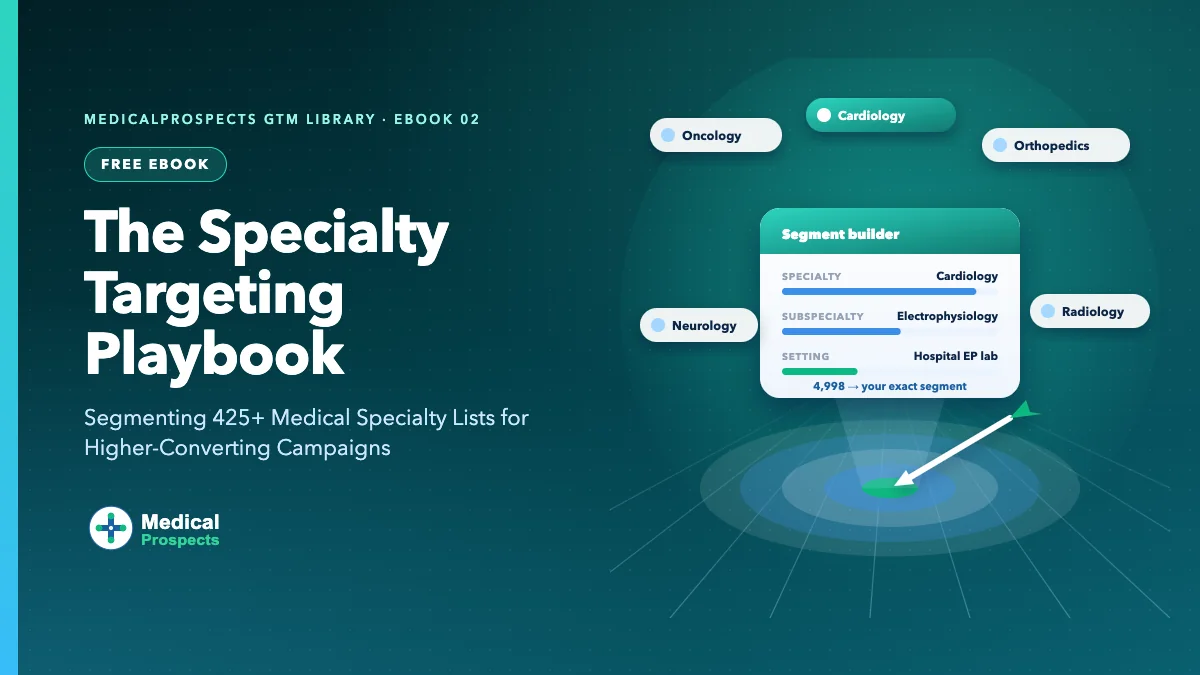
This MedicalProspects eBook shows why "physicians" is not an audience. It walks through the specialty hierarchy, five targeting dimensions and a three-ring method for grouping specialties by product fit, then gives five ready-made segment blueprints and a way to size and test each segment.
Key points
- Target the level where the product is used: 4,998 electrophysiologists, not all 40,704 cardiologists, for an ablation launch.
- Five dimensions turn a specialty into buyers: subspecialty, clinical focus, practice setting, buying authority and geography.
- Specialty must come from taxonomy codes, not self-reported job titles.
- Core, adjacent and excluded rings decide which specialties share a campaign and which never do.
- Every segment gets its own message naming the procedure, the constraint, the evidence and the buyer's role.
- Size before you build and test narrow segments against broad ones before scaling.
What's inside this ebook
-
Introduction: "Physicians" Is Not an Audience
The fastest way to improve a healthcare campaign is usually a narrower audience, not a better subject line. A message written for everyone in medicine fits no one well. A message written for one subspecialty in one practice setting speaks to that clinician's daily work, and clinicians notice the difference within seconds.
-
Chapter 1: Specialty, Subspecialty and Practice Setting
Every specialty breaks down into subspecialties that do different work, use different products and respond to different messages. Your audience starts at the level where your product is actually used, and that level is almost always below the specialty name.
-
Chapter 2: The Five Targeting Dimensions
Specialty is the starting point, not the whole audience. Five dimensions together turn a specialty into a group of people who can actually use and buy your product.
-
Chapter 3: Grouping Specialties by Product Fit
Group specialties by what they do with your product, not by how close they sit in a textbook. Two specialties belong in the same campaign only if they use your product the same way and respond to the same message.
-
Chapter 4: Writing a Message for Each Segment
A segment is only worth building if it gets its own message. The test is simple: could this email be sent unchanged to a different specialty? If yes, it is not specific enough.
-
Chapter 5: Seven Ready-Made Segment Blueprints
Use these blueprints as starting points. Each one lists the filters to apply, what to exclude and the angle to lead with. Counts are MedicalProspects list totals for October 2026, before your filters are applied.
-
Chapter 6: Beyond Physicians: Care Teams and Facilities
Many products are adopted by teams, not individual physicians. Nurses run the workflows, pharmacists manage formularies, technologists operate equipment and administrators control budgets. Leaving them out of a campaign leaves out many of the people who decide whether a product is used every day.
-
Chapter 7: Sizing and Testing Your Segments
A narrow segment is only useful if it is large enough to reach your goals and if it beats a broader one. Check both before you scale.
-
Conclusion: Smaller Lists, Better Campaigns
Specialty targeting trades list size for relevance. The trade is almost always worth making. A specific message to the right subspecialty, in the right setting, at the right level of authority, earns replies a broad campaign cannot.
Get the full ebook
All 9 sections, with checklists, tables and templates you can use with your team.

John Britton
John works with healthcare sales and marketing teams on precision targeting, campaign strategy, and audience intelligence solutions at MedicalProspects.
More ebooks →